

Every CFO asked to fund an AI transformation programme asks what the number is and how to defend it to a board that has seen a dozen tech bills come in.
There is no single number. There is a structure, and once you understand the structure, you can build the number for your own business with reasonable confidence. This article walks through the four cost buckets, the spend by phase, the hidden costs, and the Budget 2026 grants that bring the total down.
Why There Is No Single Price for AI Transformation
Two Malaysian SMEs with the same headcount and revenue can spend wildly different amounts on AI for small businesses. One has clean data in one accounting system. The other runs on three systems that disagree with each other. The gap is not in the AI licence. It is in everything that has to be fixed before the AI licence does anything useful.
What Are the Four Cost Buckets in Every AI Programme?
Every AI programme splits into the same four buckets. The weighting shifts by phase, but the categories do not change.
- People and change. Staff time to document processes, learn new tools, and run the pilot. Often the largest line and the easiest to underestimate.
- Software and licences. The AI tool itself, the orchestration layer, any new SaaS modules. Visible on an invoice, which is why most teams start their budget here.
- Integration. Connecting the AI to the systems it needs to read from and write to. Often the second-largest line after people.
- Cloud running cost. Compute, storage, and per-token or per-query charges once the system is live. Scales with usage.
How Does Spend Shift By Phase: Digitise, Simplify, Automate, AI?
AmplifyChampion’s four-phase progression lets a Malaysian SME see where the money goes and what each phase actually buys.
- Digitise. Moving off paper and spreadsheets. Spend concentrates in software and licences (POS, cloud accounting, document management) and in staff time to migrate records.
- Simplify. Consolidating duplicate systems into one source of truth. Integration becomes the dominant line. Software spend plateaus; staff time climbs.
- Automate. Rules-based workflows that remove manual steps. Software adds workflow or RPA licences. Integration costs continue. Cloud running costs start to appear.
- AI. Models drafting or deciding, with human review. Cloud running cost takes over the bill, driven by tokens or GPU-hours. Software and integration stabilise.
Skipping phases does not save money. A business that jumps to the AI phase on top of unfinished Simplify work pays twice: once for the pilot that fails on messy data and again for the retrofit that should have come first.

One-Off Costs vs Monthly Running Costs: What Is the Difference?
AI transformation spend breaks cleanly into two shapes: one-off costs that build the stack and monthly running costs that keep it operating.
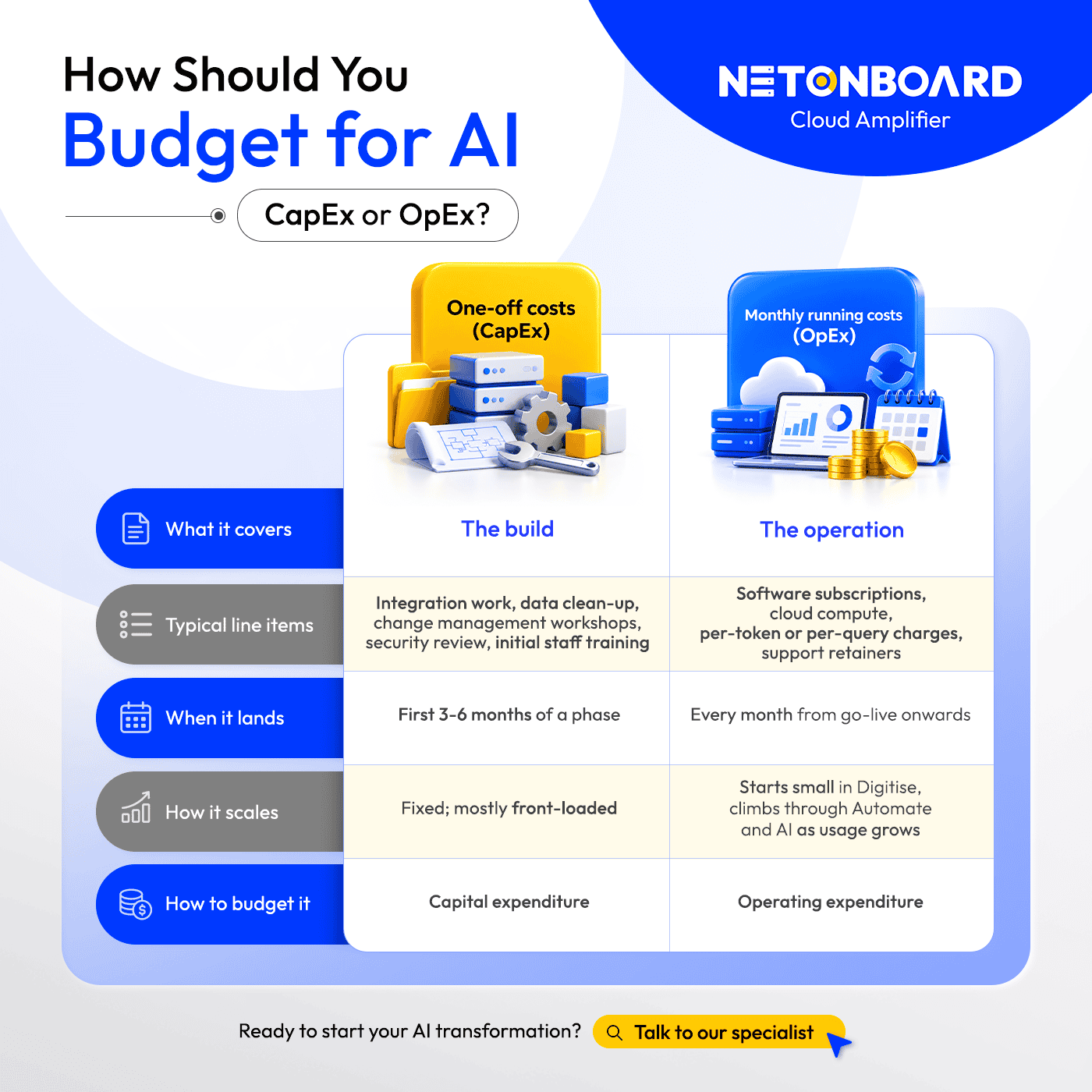
Boards that confuse the two underfund the later phases, because the first-month bill looks nothing like the twelfth-month bill.
What Are the Hidden Costs That Sink SME Budgets?
Three cost lines sink more SME AI programmes than any software overrun.
- Data clean-up. AI pointed at messy data returns confident, inconsistent answers. Cleaning the inputs usually costs more than the licences.
- Staff time. Pilots require senior people to document processes, test outputs, and sign off on changes. Pulling them off their day jobs for weeks has a cost that rarely sits in the project budget.
- Security and compliance review. PDPA obligations around personal data, access controls, and audit trails need design input. The 2024 PDPA amendments require a 72-hour breach notification from the moment awareness is established, which forces monitoring to be in place before go-live.
Budget 2026 Grants and Incentives for AI Transformation
Budget 2026 put RM5.9 billion toward AI and digital infrastructure, with specific categories for SMEs:
- MSME Digital Grant Madani: 50% matching grant up to RM5,000, administered by Bank Simpanan Nasional through MDEC-registered Technology Solution Providers. Drawn from an RM150 million pool. The most accessible entry point for a first-time applicant.
- Malaysia Digital Acceleration Grant for AI (MDAG-AI): funds up to 70% of project cost to a cap of RM2 million. Requires Malaysia Digital Status with MDEC. Sits in an RM53 million allocation and suits businesses doing deeper AI work.
- 50% additional tax deduction on AI and cyber training: MSMEs sending staff on courses accredited by the MyMahir National AI Council for Industry qualify for the uplift on training spend.
Grant availability and criteria change each cycle. Any SME planning a 12-18 month programme should check current MDEC schemes at the time of application rather than assuming last year’s rules still hold.
Before signing off on a budget, pressure-test whether the business is actually ready for the AI phase using our AI-readiness framework for Malaysian businesses. Scoping comes next: where the business sits across the four phases today, which workflows justify an AI model and which only need a rules-based bot, which data needs cleaning first, and which grants to apply for in what order.
Speak to the Net Onboard team if your board has asked for an AI budget by year end, if you have been given a vendor quote and no way to sanity-check it, or if you want the grant applications sequenced alongside the project plan.
Net Onboard’s AmplifyChampion team scopes the four phases against your current operations, prices each one, and sequences the spend so the earlier phases pay for the later ones in time, data quality, or captured efficiency.
Book a consultation to work through your cloud and AI transformation in Malaysia, map a realistic 12-18 month budget, and identify which Budget 2026 schemes your business qualifies for.