

Malaysia’s AI adoption story has two faces. One says 2.4 million businesses now use AI tools of some kind. The other says only about 15% of large enterprises have moved beyond Copilot licences and PowerPoint summaries, while startups race ahead with AI-native business models. Most large Malaysian enterprises know they sit on the wrong side of that gap.
The reason is rarely talent or budget. It is the absence of a working AI readiness framework in Malaysia that ties data, infrastructure, governance, and use-case selection into one sequence. Skip the sequence and the same thing happens every time: a pilot that runs for nine months, a cloud bill that goes sideways, and a quiet PDPA exposure no one wants to write down.
This guide walks through the seven steps that move a Malaysian enterprise from scattered experiments to production-grade AI, and how Net Onboard’s cloud and AI transformation in Malaysia delivers each one.
Where Most Malaysian Enterprises Stand Today
The AWS-commissioned 2025 Malaysian AI adoption study found 27% of businesses now use AI, up from 20% the year before. Among large enterprises with 500 or more employees, 74% remain at basic adoption levels. Only 15% are building AI-driven products. Microsoft’s Q1 2026 AI Diffusion data puts Malaysia’s national adoption rate at 21.8%, climbing but still trailing ASEAN leaders like Singapore at 60.9%.
Three patterns repeat across the enterprises we sit down with. Pilots run for months with a vague “let’s see what GPT can do” remit and no production target. Or procurement signs off on Copilot or ChatGPT Enterprise licences before anyone has audited where customer data lives. Mistakes get made when AI gets bought faster than your readiness.
The 4 AI-Adoption Maturity Tiers
- Tier 1 – Digitisation. Records exist in digital form. Workflows still move on email, spreadsheets, and PDFs.
- Tier 2 – Automation. Repeatable processes run on rules-based logic. Data flows through APIs between core systems.
- Tier 3 – AI-Augmented. Models assist decisions in defined functions: forecasting, document extraction, customer routing.
- Tier 4 – AI-Native. Core products and customer experiences are built around models, with the experience not existing without them.
Malaysian SMEs typically sit between Tier 1 and Tier 2. Large enterprises cluster around Tier 2 with Tier 3 ambitions. Knowing the starting tier is what makes the rest of your AI adoption roadmap in Malaysia realistic and precise.
The AmplifyChampion 4-Phase Growth Framework
The framework moves in sequence. Each phase builds the foundation for the next, and skipping phases is how most Malaysian enterprise AI projects stall in their first quarter.
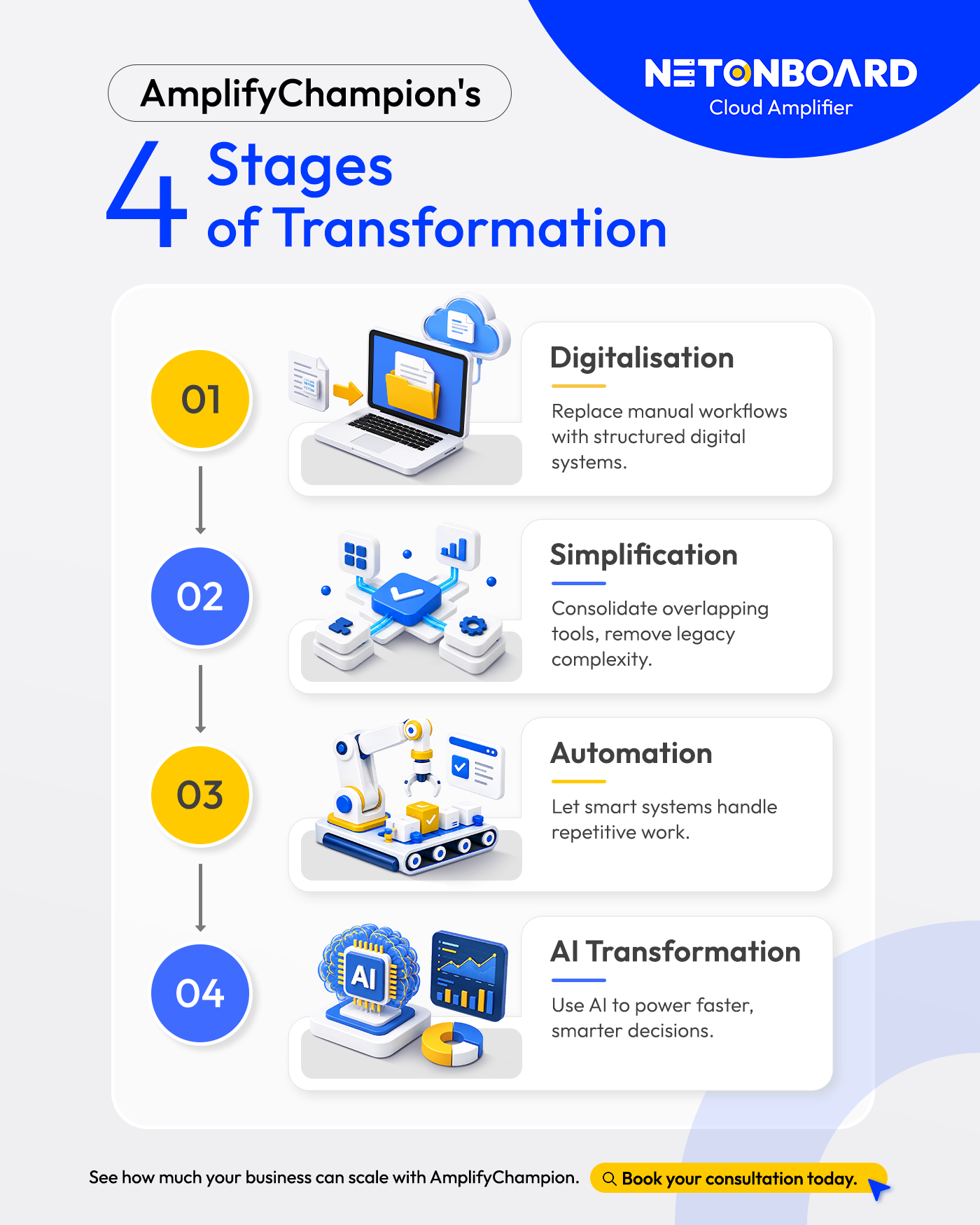
- Phase 1: Digitise. Move the business online with clean, fast digital systems. Replace manual workflows and fragmented tools with structured digital systems that centralise data, improve visibility and accuracy, and make information accessible anywhere.
- Phase 2: Simplify. Cut out the messy stuff and keep core processes sharp. Consolidate overlapping tools, remove legacy complexity, and build a leaner operational structure that teams can actually scale. The output is standardised processes lean enough to automate cleanly.
- Phase 3: Automate. Let smart systems handle repetitive work. Automated workflows take over routine tasks, reduce errors, and free people for higher-value work.
- Phase 4: AI Transformation. Use AI to boost the team’s decision-making power. AI-driven tools surface patterns in business data and deliver the insight leadership needs to move faster and make better calls. PDPA governance for training data, model outputs, and cross-border flows is non-negotiable here.
Each phase has owners, deliverables, and exit criteria. Net Onboard’s AmplifyChampion programme runs this sequence end-to-end with Malaysian enterprises in regulated sectors.

Five Criteria for Choosing an AI Infrastructure Partner
Buying GPUs is easy. Building AI infrastructure for enterprises in Malaysia that actually performs and complies takes more. When evaluating partners, look for:
- Local data residency. Workloads with PDPA exposure should stay in-country by default.
- Production-grade MLOps. Model deployment, versioning, monitoring, and rollback as a standard, not an add-on.
- FinOps discipline. GPU instances are the most expensive line items in modern cloud bills. The partner should have FinOps controls baked in.
- Regulatory fluency. PDPA, Bank Negara RMiT for financial services, and the Cybersecurity Act 2024 each affect what data can train what model.
- Advisory bandwidth. A partner who only delivers what is asked for is a vendor. A partner who challenges the use-case selection is what readiness actually needs.
Net Onboard in Action: 4U Academy
4U Academy, led by CEO Sherene Chew, ran an education business on paper-and-spreadsheet workflows that could not keep pace with how fast the sector was changing. The first move was digitisation. Automation followed.
The outcome was 2x faster innovation cycles and a measurably better customer experience, scaling faster than competitors on a foundation that supports AI use cases when the business is ready for them.
The journey is the AmplifyChampion sequence in practice: digitise, simplify, automate, then AI transform. The order matters. Jumping to AI before the earlier phases are in place is what causes most Malaysian enterprise pilots to stall.
From Great to Industry Leader
What got an enterprise to its current size rarely gets it to AI-native.
If you are evaluating a Microsoft Fabric or Azure OpenAI pilot, weighing GPU capacity against committed-use discounts, or aligning AI plans with PDPA before the next board review, the gap is usually in the framework, not the technology.
Cue Net Onboard, where the AmplifyChampion programme runs the four growth phases (digitise, simplify, automate, AI transform) end-to-end, with Malaysian regulatory context baked in and FinOps discipline from the first GPU hour.
Book a consultation with us for cloud and AI transformation in Malaysia to map your move from great to industry leader, and what the next two quarters for your business should look like.