

Most owners have already used ChatGPT for something. Draft an email, summarise a report, rewrite a proposal. That is prompting a chatbot, and it is useful. An agent is a different tool for a different job. It takes a goal, not a question, and it works through the steps itself.
Before mulling the benefits of AI agents in Malaysia for your business, it helps to understand what an AI agent is, how it differs from a chatbot or a scripted automation, and where cloud and AI transformation in Malaysia starts to make real operational sense.
What Is an AI Agent, in Plain Terms
An AI agent is software that pursues a goal. It reads the situation, decides on the next step, uses a tool or system to take that step, checks the outcome, and moves on. The reasoning engine is usually a large language model while the rest is data access, tool access, and permissions.
A useful way to picture it: a chatbot is a conversation, an automation is a recipe, an agent is a junior staff member with a checklist that adapts as it goes. It handles the messy middle where the next step depends on what the last step turned up.
Two ideas separate an agent from a chatbot. First, it acts on systems, so it can update a CRM, raise a ticket, pull an invoice, or send a reply. Second, it plans. It breaks a goal into steps and picks the next one based on the result of the last one.
AI Agent vs Chatbot vs Automation
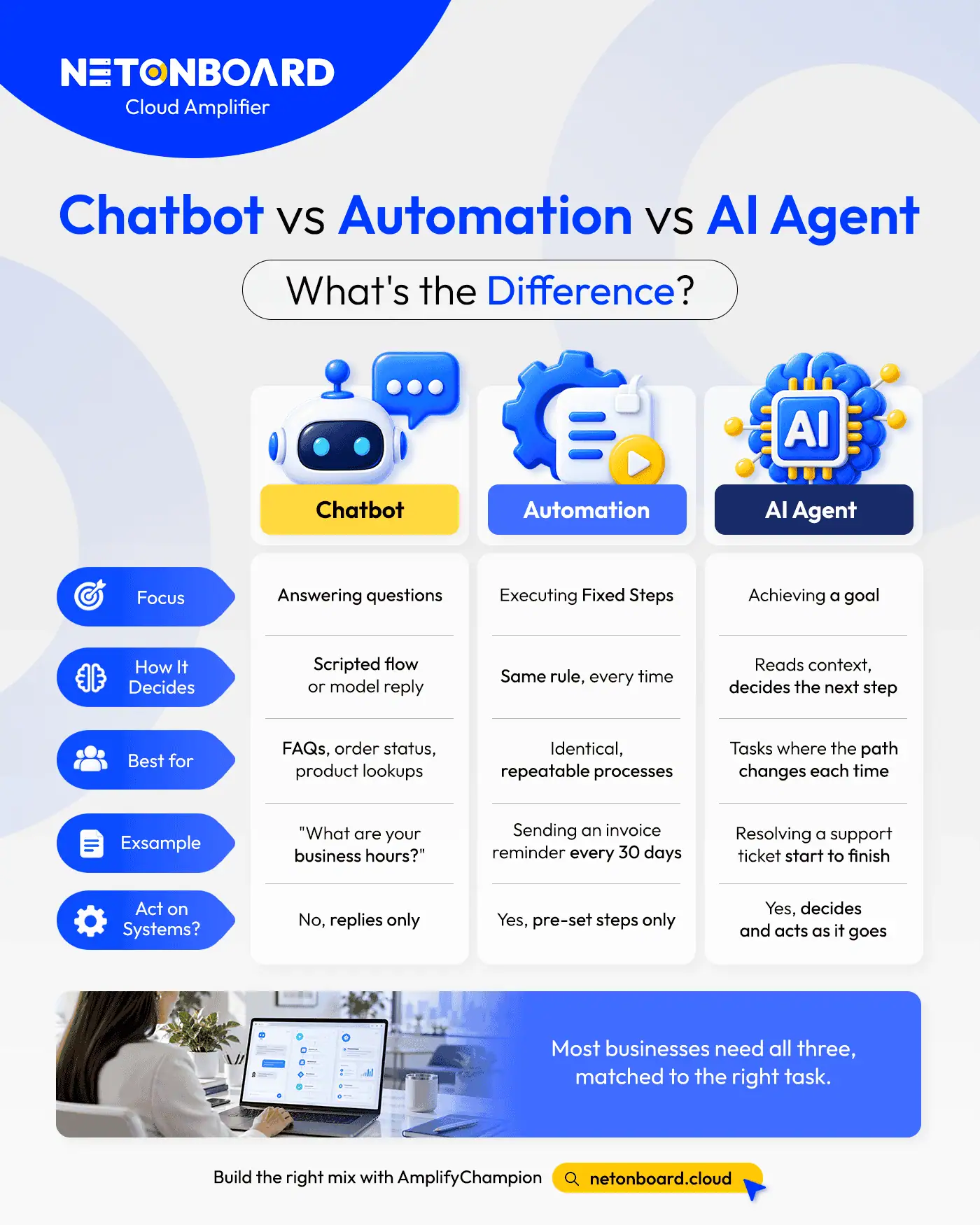
The three get lumped together in vendor pitches, which is where the confusion starts. In practice they solve different problems.
- Chatbot. Answers questions using scripted flows or a language model. Good for FAQs, order status, product lookups. Predictable in, predictable out.
- Automation. Executes fixed steps in a fixed order, with Zapier flows, RPA bots, scheduled jobs being some good examples. It’s reliable when the process is identical every time.
- Agent. Handles goals where the path changes each time. This can be a refund request that turns out to be a duplicate charge, or a supplier email that needs a purchase order matched, a discrepancy flagged, and a reply drafted.
The AI agent vs chatbot question really comes down to one thing: does the work need a decision at each step, or can it be scripted? If a business analyst can write the flow on a whiteboard in ten minutes, automation is enough. But if the flow branches every time, an agent starts to become the better choice.
What Agents Actually Do for a Malaysian Business
With their ability to handle more complex scenarios, the clearest wins of AI agents for businesses so far sit in three areas:
- Support. A first-line agent reads a ticket, checks the customer’s account, and either resolves the issue or hands it over with a clean summary.
- Sales. An agent qualifies inbound leads, drafts follow-ups, and updates the CRM without a human keeping the tabs open.
- Operations. An agent reconciles invoices, chases outstanding purchase orders, or flags data-entry errors before month-end close.
The market backdrop is moving. AWS research found roughly 27 per cent of Malaysian businesses had adopted AI by late 2025, up from 20 per cent a year earlier, with 65 per cent of adopters reporting revenue gains averaging 19 per cent. The same study noted that 73 per cent are still at basic use, which is where agent workloads tend to open the next tier of return.

Building or Customising Software With Agents
Most custom agents are not built from scratch. They sit on top of an existing model, wired to the tools and data a business already runs. The stack has three parts.
- The model. The reasoning engine. Often a hosted model from OpenAI or Anthropic, sometimes an open model like DeepSeek runs on the business’s own infrastructure.
- The tools. Read and write access to the systems the agent needs to touch, which can include CRM, ticketing, ERP, email, and storage. Each connection is a defined interface with scoped permissions.
- The guardrails. What the agent may do, on which data, with which approval. This also covers where a human sign-off is required and what gets logged for audit.
The build effort usually sits in the tools and guardrails, not the model. Swapping a model is a config change, but the permission model is a design decision, and it is the piece where PDPA obligations apply.
Where Agents Sit in the Transformation Journey
Agents are not step one. They are the fourth step in a sequence that starts with digitisation, moves to simplification, then automation, then AI. If the earlier steps are skipped, the agent has no clean data to work with, no simplified process to plug into, and no automated foundation to build on. It ends up as an expensive demo that never leaves the pilot phase.
This is where the Net Onboard AmplifyChampion pillar comes in. It runs the four-stage journey in order, so an agent lands on a workspace it can actually operate in. The underlying cloud environment gets sized and configured for the model and data the agent needs, whether that stays in-region for PDPA reasons or spans a public API.
Getting Ready for Agents Without Skipping Steps
The businesses that get value from agents tend to have three things in place first: a clean source of truth for the data the agent will read, a defined process for the task it will handle, and a permission model that says what the agent can do without asking. Without any one of those, the pilot stalls.
If your business is looking at AI agents in Malaysia but your data still lives in spreadsheets with no clear, organisation-wide process, the honest answer is to fix that first. That is the work AmplifyChampion is built for.
Cue Net Onboard, where the transformation journey runs digitisation to AI in order, with the cloud, security, and continuity foundations in place at each step. Our team scopes what an agent can realistically do for a specific business, hosts the model where it needs to sit, and manages the backend behind it so you can focus on the business.
Speak to our team or WhatsApp us today about cloud and AI transformation in Malaysia to see where agents fit in your roadmap. We have you covered for any concerns you might have.