
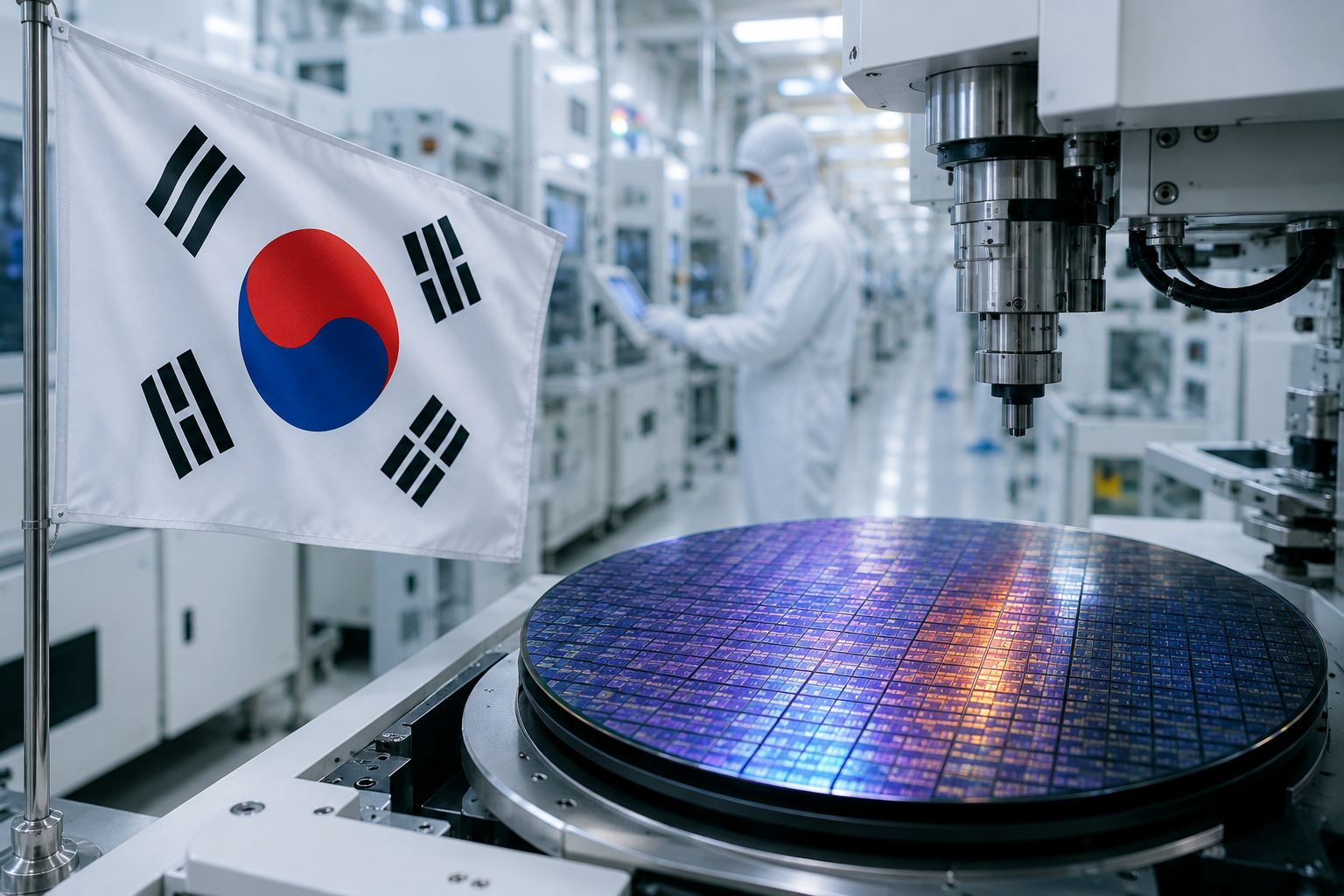
South Korea Wants More Than Just Big Chip Companies
When people think about South Korea’s semiconductor industry, two names usually come to mind: Samsung Electronics and SK Hynix.
But producing advanced chips requires much more than a few giant manufacturers.
On 10 August, South Korea announced plans for a new 5 trillion won semiconductor fund, worth approximately US$3.52 billion, aimed at companies involved in semiconductor materials, components, manufacturing equipment and chip design.
That means the country is looking beyond its biggest chipmakers and strengthening the businesses surrounding them.
AI Is Creating Enormous Demand
The timing is no coincidence.
AI systems require huge amounts of computing power, which in turn depend on advanced processors, high-bandwidth memory and increasingly sophisticated semiconductor manufacturing.
South Korea’s government says its existing production bases will not be enough to meet future demand driven by artificial intelligence.
The new semiconductor fund forms part of a much larger national chip initiative involving Samsung, SK Hynix, suppliers and local governments. Planned private and public investment in new chip manufacturing projects exceeds US$576 billion, according to Reuters.
The Smaller Companies Matter Too
A semiconductor factory cannot operate with processors alone.
It needs specialised chemicals, manufacturing equipment, testing systems, components, packaging technologies and companies capable of designing chips even if they do not manufacture them themselves.
These so-called fabless companies concentrate on semiconductor design while outsourcing manufacturing to foundries.
South Korea’s new fund specifically includes these companies, suggesting the strategy is aimed at strengthening the entire semiconductor supply chain rather than simply expanding Samsung and SK Hynix.
The government is also planning a separate 10-year, 1 trillion won programme to encourage collaboration between large chipmakers and smaller suppliers across development, testing and production.
Building Chips Also Means Building Infrastructure
There is another challenge that receives much less attention: semiconductor factories consume enormous amounts of electricity and water.
For a planned semiconductor cluster in the Gwangju-South Jeolla region, authorities aim to secure 650,000 metric tons of water per day by 2030.
Meanwhile, the Yongin semiconductor cluster is expected to receive as much as 14.7 gigawatts of electricity by 2041 through a combination of power-generation sources.
It highlights an important reality of the AI boom.
Building more powerful AI doesn’t just require better software. It requires factories, electricity, water, data centres and an increasingly complicated physical supply chain.
Closing Thoughts
The global AI race is quickly becoming an infrastructure race.
Countries are no longer competing only over who can create the best AI model. They are also competing over who can manufacture the chips and build the supply chains needed to run those models.
South Korea already has Samsung and SK Hynix.
Now it is investing billions to make sure the rest of its semiconductor ecosystem can keep up too.