
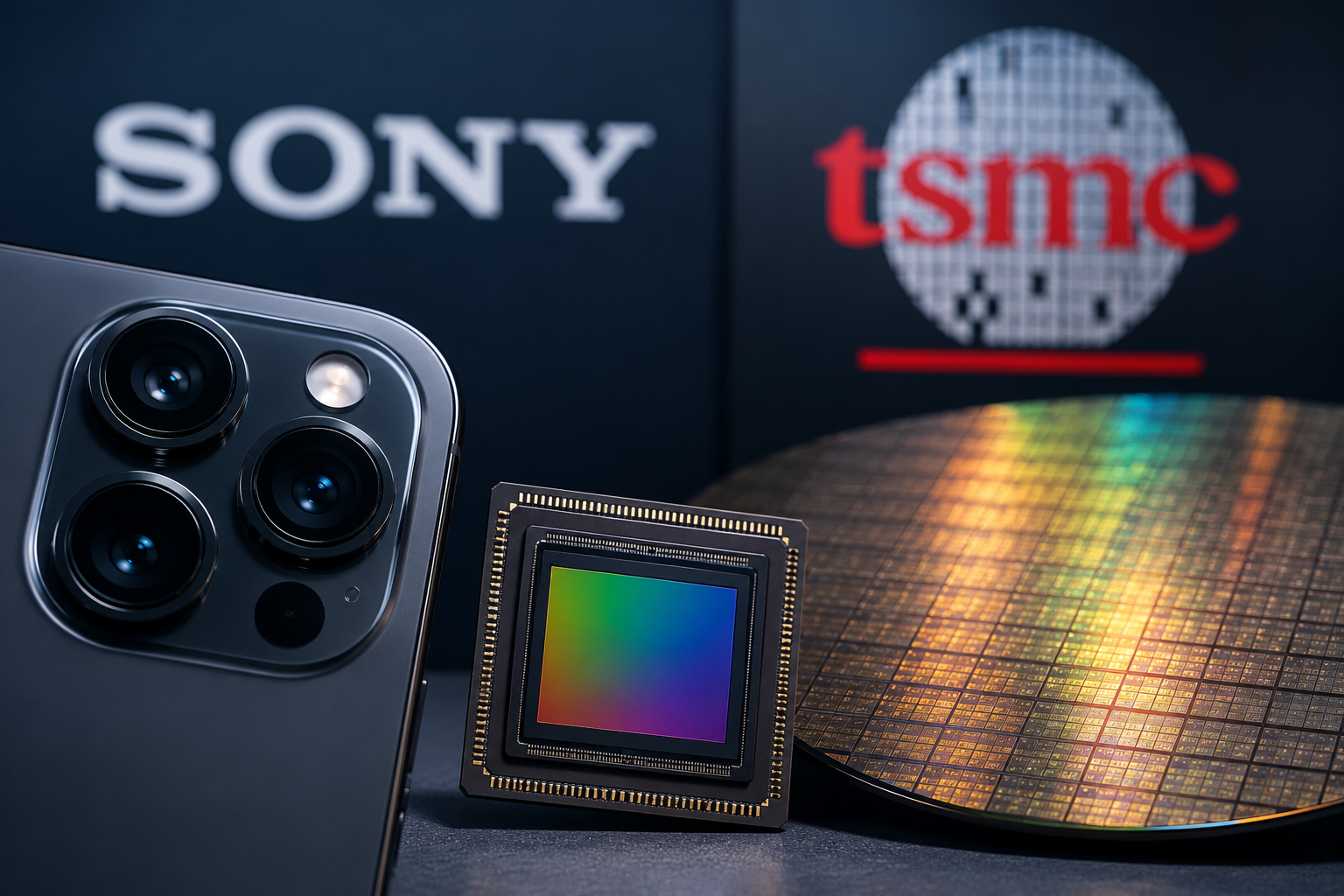
Your Next Smartphone Camera Could Come From This Partnership
Smartphone cameras have improved dramatically over the past decade, but the next major leap may depend just as much on semiconductor manufacturing as it does on lenses or software.
On 11 August, Sony Semiconductor Solutions and TSMC announced a definitive agreement to establish Advanced Vision Semiconductor Manufacturing Corporation, a new joint venture based in Kumamoto Prefecture, Japan.
The companies plan to use the facility as a development and manufacturing hub for next-generation smartphone image sensors.
Sony will remain the controlling shareholder, while TSMC will bring its advanced semiconductor manufacturing expertise into the partnership.
Why Sony Needs TSMC
Sony is already one of the biggest names behind smartphone camera sensors.
But modern image sensors are becoming increasingly complicated.
They need to process larger amounts of visual information while improving low-light performance, autofocus, image quality and power efficiency — all inside increasingly small devices.
This is where advanced semiconductor manufacturing becomes important.
Under the partnership, Sony will continue leading the development of its core image-sensor technology, product planning and design.
TSMC, meanwhile, will contribute its expertise in advanced semiconductor processes and manufacturing.
Instead of each company trying to master everything independently, the partnership combines what both companies already do best.
A ¥747 Billion Investment
The scale of the project is significant.
Sony plans to contribute around ¥465 billion through cash and the transfer of assets, including its newly constructed semiconductor facility in Koshi City.
TSMC plans to contribute approximately ¥282 billion in cash. Reuters valued the combined investment at about US$4.69 billion at the time of the announcement.
The investment will be made progressively depending on market demand and business conditions.
The companies are also considering additional investment for production capacity, with potential support from the Japanese government.
It Could Go Beyond Smartphones
Smartphones are the immediate target, but advanced image sensors are becoming important far beyond mobile photography.
Robots, autonomous machines, vehicles and AI-powered devices all need increasingly sophisticated ways to understand the physical world around them.
That makes image sensors something more than just camera components.
They are effectively becoming the eyes of AI-powered machines.
Sony has previously highlighted opportunities for its image-sensor technology in areas such as automotive systems, robotics and physical AI.
The new TSMC partnership could help accelerate that transition.
Closing Thoughts
The smartphone camera race is no longer simply about adding more megapixels.
Behind every better camera is an increasingly sophisticated combination of sensors, semiconductor technology and software.
Sony already has strong expertise in image sensing. TSMC has become one of the most important semiconductor manufacturers in the world.
Putting those strengths together could influence not only how future smartphones take pictures, but also how the next generation of intelligent machines sees the world around them.