
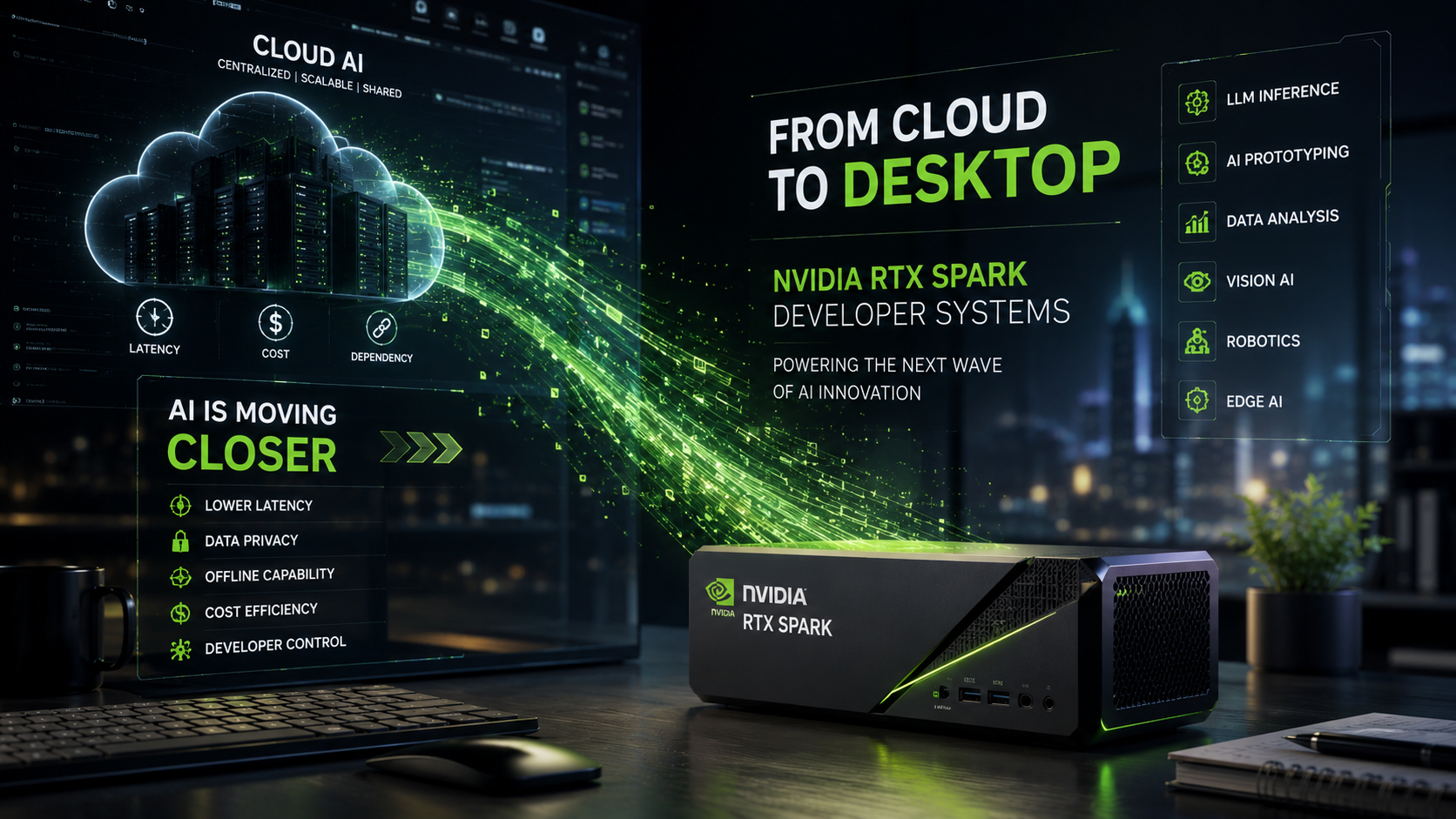
NVIDIA’s new RTX Spark platform brings up to 1 petaflop of AI performance to developer workstations. It enables engineers to run much larger AI models locally instead of relying entirely on cloud GPUs. The announcement isn’t just about faster hardware—it’s about changing where AI development happens.
What Happened
During Computex and Microsoft Build 2026, NVIDIA introduced RTX Spark, a new AI-focused desktop platform designed for developers building large language models and AI agents. Microsoft also announced the Surface RTX Spark Dev Box, making the platform part of its AI developer ecosystem. According to Reuters and Microsoft’s Build announcements, RTX Spark delivers roughly one petaflop of AI compute with up to 128GB of unified memory, allowing developers to run significantly larger models locally than previous desktop systems. Instead of treating the PC as a thin client for cloud AI, NVIDIA is positioning it as a serious development environment capable of inference, fine-tuning, and agent testing without constant cloud connectivity.
Why This Actually Matters
For the past two years, AI development has largely depended on cloud GPUs.
That has advantages.
It also comes with high costs, internet dependency, and limited control over sensitive data.
RTX Spark changes part of that equation.
Developers can prototype AI agents locally before deploying them to Azure, AWS, or Google Cloud. That shortens development cycles and reduces cloud spending during experimentation.
It also benefits industries handling confidential information.
Instead of sending internal documents to external inference endpoints, teams can test workflows entirely on local hardware.
This won’t replace cloud infrastructure.
Training frontier models still requires massive GPU clusters.
But many production applications don’t need hundreds of GPUs.
For inference, retrieval-augmented generation (RAG), and agent development, powerful local hardware is becoming practical again.
The Part Most Coverage Gets Wrong
Many reports compared RTX Spark with gaming PCs.
That misses its real purpose.
NVIDIA isn’t targeting gamers.
It’s targeting software engineers.
The important specification isn’t graphics performance.
It’s memory capacity.
Modern AI models often fail to run efficiently because they cannot fit into available VRAM.
Increasing unified memory lets developers experiment with larger context windows, more capable reasoning models, and multiple AI agents running simultaneously.
The bottleneck is shifting from raw compute to memory architecture.
That’s a much more important trend than benchmark scores.
What Happens Next
Expect AI development workflows to become more hybrid.
Developers will increasingly build and debug locally before moving workloads to the cloud for production deployment.
Frameworks like Ollama, LM Studio, vLLM, and containerized inference stacks are also likely to evolve quickly as more powerful desktop hardware becomes available.
The next generation of AI development won’t happen exclusively in the cloud.
It will happen across both local and cloud environments.
KEY TAKEAWAYS
- Local AI development is becoming practical for much larger models.
- Memory capacity is becoming just as important as GPU performance.
- Hybrid local-and-cloud workflows can reduce development costs and speed up iteration.