

Most businesses sign up for a managed cloud service expecting someone to handle the servers. While that is part of it, the day-to-day scope ofmanaged cloud support services goes deeper.
This article breaks down what that looks like in practice and how Net Onboard approaches each area as a Malaysia cloud service provider.
What Makes Malaysia’s Cloud Landscape Different Now
A few years ago, the main barrier to cloud adoption for Malaysian SMEs was access. Enterprise-grade cloud infrastructure meant routing traffic through data centres in Singapore or Hong Kong, which introduced latency and data-residency concerns. That’s changed significantly.
AWS launched its Malaysia cloud region in 2024 with a committed USD 6.2 billion investment.
Microsoft and Google committed USD 2.2 billion and USD 2 billion, respectively. All three now operate local availability zones, meaning Malaysian businesses can keep data in-country while still accessing global-tier cloud capabilities.
On the policy side, support is growing as well:
- SME digital transformation spending is growing at a 19.56% CAGR through 2031, with grants covering up to 80% of qualifying costs
- Budget 2026 allocated RM1 billion in financing and grants for SME automation and digitalisation
- The RM53 million Digital Acceleration Grant targets cloud, AI, and blockchain adoption specifically
The access barrier is gone. If you’ve been evaluating enterprise cloud services in Malaysia, the infrastructure and funding environment has never been stronger.
What Does “Managed Cloud” Actually Mean?
Managed cloud support services involve the ongoing management, monitoring, and optimisation of a business’s cloud environment. This is distinct from simply purchasing cloud infrastructure. With a managed service, the provider stays engaged after setup: configuring, maintaining, securing, and improving the environment as needs evolve.
Infrastructure Management: The Baseline
At its core, Malaysia cloud infrastructure management services keep your cloud environment running reliably. That includes:
- Provisioning and configuration. Setting up virtual machines, storage, networking, and compute resources to match workload requirements.
- Capacity planning. Ensuring the right resources are allocated so performance holds during peak demand without overspending on idle compute.
- Cloud platform selection. Helping businesses determine the right platform or combination of platforms, whether Azure, AWS, hybrid, or multi-cloud, based on what each workload requires.
At Net Onboard, this falls under AmplifyChoice, the foundation of the Cloud Amplifier framework. Platform decisions made at this stage affect everything that is built on top of them.
Security and Access Control
Infrastructure alone does not make a cloud environment safe. Security is a separate discipline and one of the most underestimated responsibilities of a managed cloud provider.
A managed cloud provider in this space typically handles:
- Endpoint security. Protecting every device that connects to your cloud environment, including laptops, mobile devices, and servers.
- Identity and access management (IAM). Controlling who can access what, with least-privilege access applied consistently across the environment.
- Threat monitoring and alerting. Monitoring for suspicious activity and escalating incidents according to defined response procedures.
- Data protection. Managing data access policies and ensuring sensitive information stays within governed boundaries.
Net Onboard’s AmplifyControl pillar covers this layer. This step is similar to fitting a building with access controls, monitoring systems, and defined security procedures. AmplifyControl helps businesses apply that same structured approach across their cloud environment.
Disaster Recovery and Business Continuity
Downtime carries real operational and financial costs. For Malaysian SMEs, even a few hours of disruption can affect revenue, customer commitments, and internal operations. Business continuity planning is usually overlooked until a disruption occurs.
A managed cloud provider with a continuity focus addresses this proactively. The responsibilities of a managed cloud provider in this area include:
- Regular, tested backups. Scheduled backups that are periodically verified to confirm they can actually be restored.
- Defined RTO and RPO targets. RTO (Recovery Time Objective) sets the maximum acceptable time to restore operations after a disruption. RPO (Recovery Point Objective) defines how much data loss is tolerable, specifically how old the recovered data can be. These are separate metrics, set per system based on business criticality.
- Failover planning. Ensuring critical systems can switch to secondary environments if primary systems go down.
- Documented incident response procedures. Written, tested processes for different failure scenarios so teams follow a plan rather than improvise under pressure.
This is the focus of Net Onboard’s AmplifyContinuitypillar. It covers the plans, systems, and tested procedures that keep your operations recoverable when something goes wrong.

Monitoring, Patching, and Performance
Cloud environments require ongoing attention to run well. Providers manage a continuous cycle of maintenance tasks that most internal teams do not have bandwidth for:
- 24/7 infrastructure monitoring. Tracking uptime, resource utilisation, latency, and anomalies across the environment.
- Patch management. Applying security patches and system updates on schedule across managed resources, reducing exposure to known vulnerabilities.
- Performance tuning. Identifying bottlenecks and adjusting configurations to keep workloads running efficiently.
- Cost optimisation. Reviewing cloud spend regularly and right-sizing resources to avoid unnecessary billing.
Skipping patch cycles leaves known vulnerabilities open, often long after fixes have been made available. A good managed cloud support service handles this on schedule without requiring internal follow-up.
Advisory, Roadmapping, and Transformation
This is where Malaysia cloud infrastructure management services diverge significantly between providers. For businesses with limited internal IT capacity, cloud advisory shapes whether a migration delivers long-term value or simply shifts problems to a new environment. Net Onboard’s AmplifyChampion pillar addresses this through four stages of digital maturity:
- Digitisation. Moving core processes and records into digital systems.
- Simplification. Streamlining operations to reduce friction and manual effort.
- Automation. Building workflows that run without constant human input.
- AI Transformation. Leveraging AI capabilities to support better decision-making and operational efficiency.
Infrastructure management is a standard offering across many providers. Helping a business understand where it is going and structuring the cloud environment to support is a different kind of engagement.
What Separates a Managed Cloud Partner from a Hosting Provider
Many hosting providers, including managed hosting tiers, handle server-level maintenance: patching, backups, uptime monitoring, and server-side security measures such as firewalls and malware scanning. That covers the server environment well.
A managed cloud partner covers the broader business IT environment. The scope difference shows up most clearly in a few specific areas:
| Area | Hosting Provider | Managed Cloud Partner |
| Scope | Server or website environment | Full business cloud environment across all workloads and systems |
| Security depth | Server-level: firewall, malware scanning, SSL | Environment-wide: identity governance, endpoint protection, access controls, and security operations across all connected systems |
| Disaster recovery | Automated backups; restoration available on request | Defined RTO/RPO targets per system, tested failover procedures, and documented incident response committed in the service agreement |
| Monitoring | Server uptime and performance monitoring | Environment-wide monitoring across infrastructure, workloads, and connected services with defined escalation and response |
| Strategic advisory | Not offered | Cloud roadmapping, platform selection guidance, and digital transformation planning |
Table alt tag: Managed Cloud Partner vs. Hosting Provider
A hosting provider is responsible for the server environment. A managed cloud partner takes responsibility for how the entire cloud environment performs, stays secure, and supports business continuity.
How Managed Cloud Removes the Bottleneck
Now, how do managed cloud services help Malaysian businesses scale? It turns IT from a fixed constraint into something that flexes with the business.
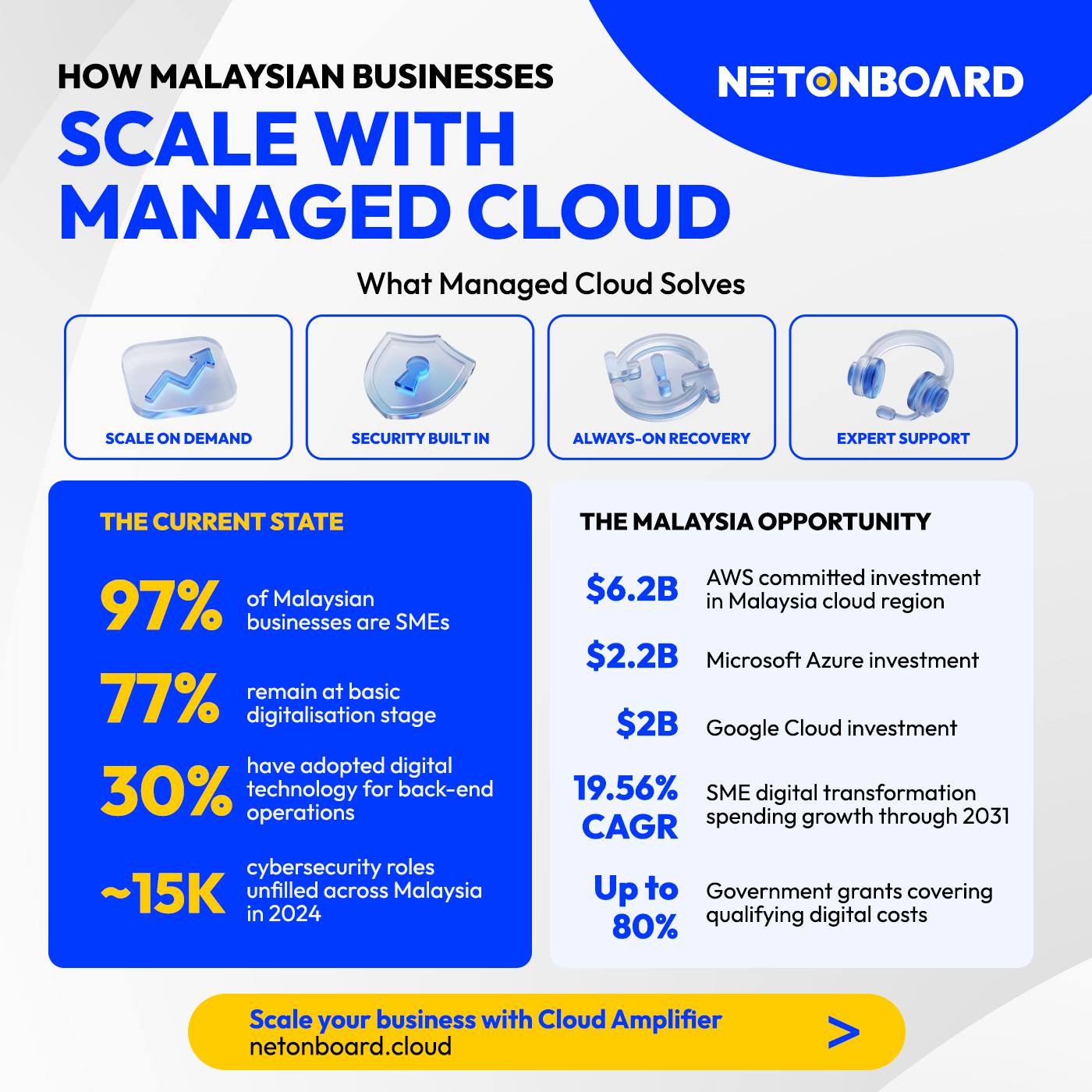
Here’s what that looks like in practice:
- Elastic capacity. Your cloud environment expands during peak periods (Raya campaigns, year-end reporting, seasonal demand spikes) and contracts when things settle. You pay for what you actually use, which means scaling up doesn’t require a significant decision every time.
- Managed security and compliance. As businesses grow, they collect more customer data, process more transactions, and face stricter regulatory scrutiny. A managed cloud provider handles patching, threat monitoring, access controls, and PDPA compliance as part of the service, so your security posture grows alongside your operations.
- Operational continuity. Downtime during a growth phase is expensive. Managed cloud includes backup architecture and disaster recovery planning, ensuring that a server failure or ransomware incident doesn’t undo months of your progress.
- Reduced IT staffing pressure. With roughly 15,000 cybersecurity roles unfilled across Malaysia in 2024, hiring qualified IT staff is both difficult and costly. Managed cloud offloads the operational burden to a team of specialists, giving growing businesses access to expertise they couldn’t afford to hire full-time.
Where Malaysian Businesses Feel the Impact Most
The benefits of cloud scaling vary by sector. Here are three areas where Malaysian businesses are seeing the most tangible results:
- Manufacturing and logistics. Real-time inventory tracking, supplier management, and compliance reporting require systems that handle growing data volumes without slowing down. Cloud-based ERP and supply chain tools let manufacturers add capacity as order volumes increase.
- Professional services. Accounting firms, legal practices, and consultancies often scale by adding offices or expanding headcount. Cloud infrastructure lets teams across multiple locations access shared systems securely, without the cost of deploying and maintaining physical servers in each office.
- Retail and e-commerce. Seasonal demand swings are the norm. A managed cloud setup means an online retailer running a monthly sale campaign doesn’t need to overprovision for a week of high traffic permanently. The infrastructure scales up for the event, then back down afterwards.
Ready to Hand Off the Heavy Lifting?
As one of the leading Malaysia cloud service providers, Net Onboard structures every engagement around your operational gaps and long-term direction.
From infrastructure and security to continuity planning and long-term transformation, our Cloud Amplifier framework covers the full scope of what a managed cloud support service should deliver.
Get in touch to find out how we manage your cloud environment. Speak to Net Onboard about your cloud environment.