
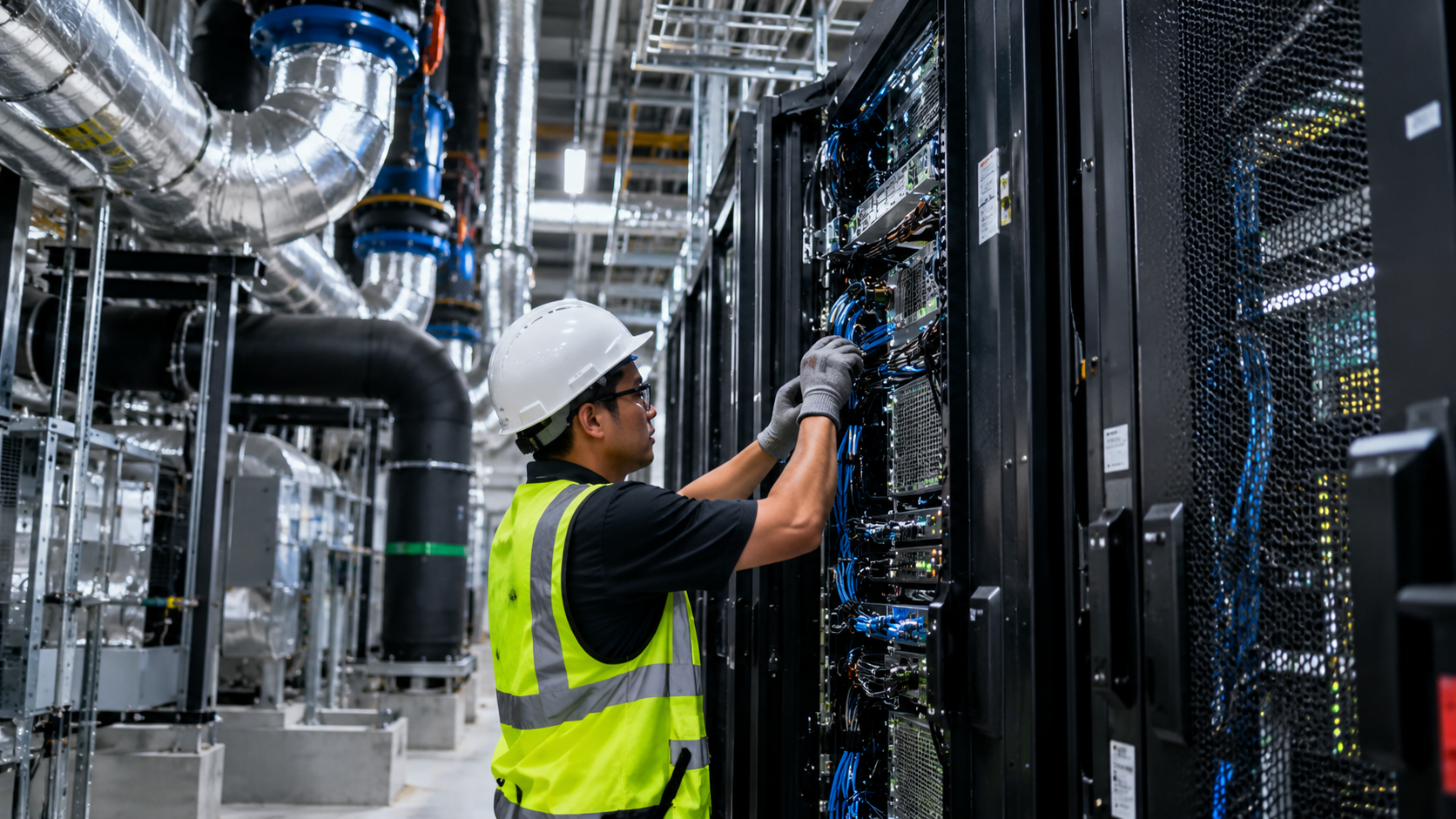
AI Servers Are Getting Hotter
Malaysia has attracted billions of ringgit in cloud and data-centre investment.
But AI is changing what goes inside these facilities.
Traditional servers may consume a few kilowatts per rack.
Modern AI infrastructure using powerful GPUs can require tens of kilowatts or more per rack, generating far more heat in a much smaller space.
That heat has to go somewhere.
And in Malaysia’s hot and humid environment, removing it requires significant energy.
Hot Weather Makes the Problem Worse
The Energy Commission said data centres reached 9.3% of Peninsular Malaysia’s electricity consumption during the second week of August, compared with an average of around 7% earlier in 2026.
Energy Commission CEO Siti Safinah Salleh said hotter weather meant cooling systems needed more electricity.
The problem was made worse by lower water levels reducing hydroelectric generation during the same hot period.
So warmer weather creates pressure from both sides:
Data centres need more electricity for cooling, while some electricity generation can also become less available.
Traditional Air Cooling May Not Be Enough
Most conventional server environments use air conditioning and fans to remove heat.
That works well at normal server densities.
But AI hardware is much more power-dense.
Operators are therefore exploring technologies such as:
- Direct liquid cooling
- Immersion cooling
- AI-controlled fan systems
- Computational airflow simulation
- More efficient mechanical and electrical systems
Immersion cooling, for example, places computer equipment inside a non-conductive cooling liquid rather than relying mainly on air.
The objective is simple:
remove more heat while using less electricity.
Malaysia’s Power Demand Will Keep Growing
The challenge will become larger if Malaysia continues expanding data-centre capacity.
The Energy Commission estimates that data centres could eventually consume as much as 31% of Peninsular Malaysia’s electricity demand by 2035.
Malaysia also expects to need around 9 GW of additional gas-fired generation capacity by 2032 as electricity demand grows while coal plants are gradually retired.
Officials have said the current situation does not indicate an immediate electricity shortage.
But longer-term planning is becoming much more important.
Cooling Is Becoming a Business Opportunity
This challenge also creates a new technology market.
Data centres will increasingly need companies that can provide:
- Efficient cooling systems
- Energy monitoring
- Environmental sensors
- AI-based optimisation
- Power management
- Renewable energy integration
- Infrastructure monitoring
For Malaysian engineering and technology companies, data-centre growth could therefore create opportunities far beyond selling servers or network equipment.
Why This Matters
Malaysia wants to become a major regional hub for AI and cloud computing.
But attracting the servers is only one part of the equation.
Those servers need:
electricity, cooling, water, connectivity and reliable infrastructure.
If Malaysia can make its facilities more energy-efficient, it can support more computing capacity without increasing electricity demand at the same rate.
That could become an important competitive advantage as other countries face similar energy constraints.
Closing Thoughts
The AI boom is creating an unusual challenge.
The faster our computers become, the harder they are to keep cool.
For Malaysia, the next phase of the data-centre boom may therefore be less about simply building more facilities — and more about making every megawatt of computing power work more efficiently.
Cooling may not sound as exciting as AI.
But without it, the AI servers cannot run.