
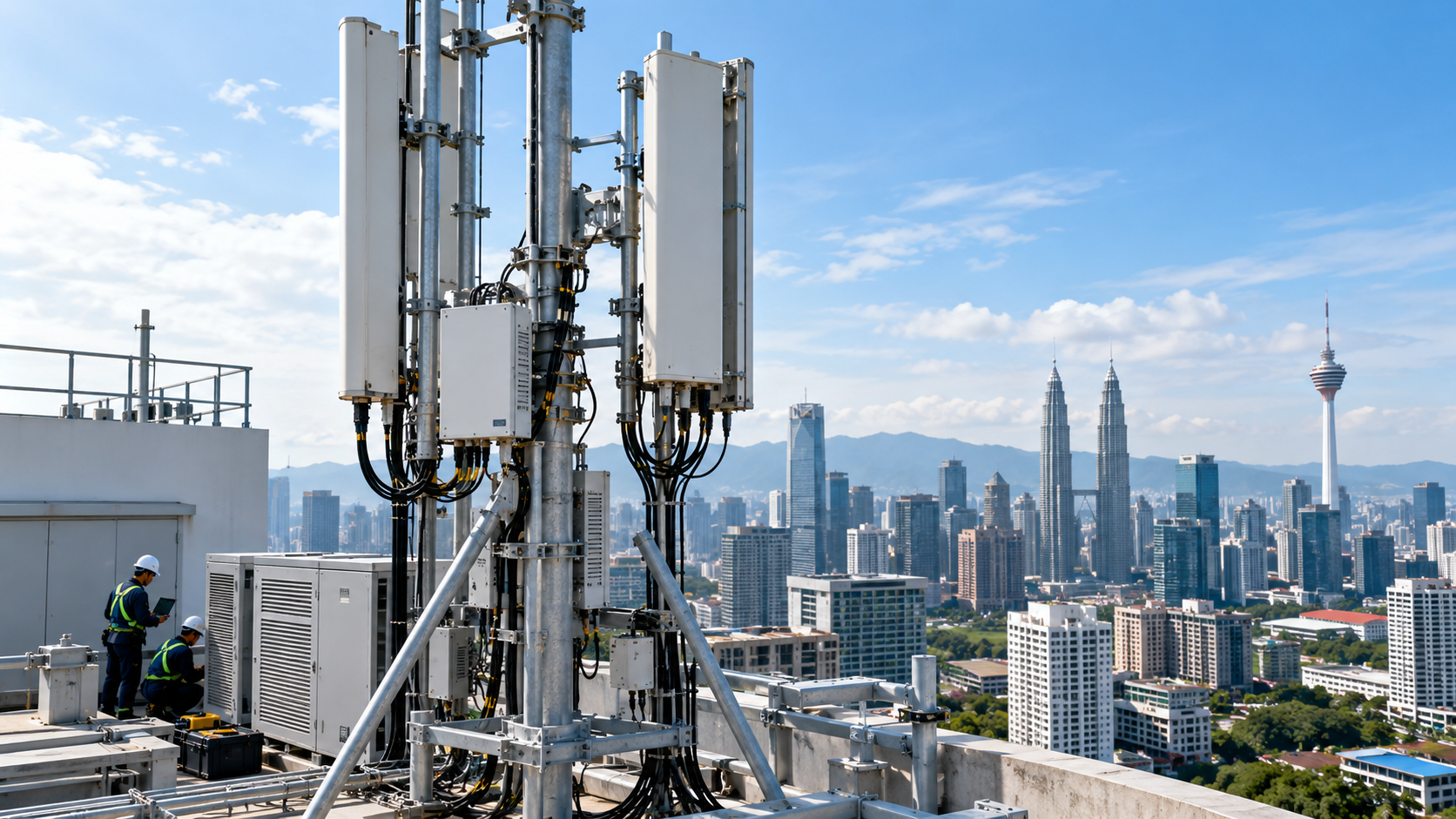
RM5.2 Billion to Support Malaysia’s Next 5G Phase
Digital Nasional Berhad has completed a RM5.2 billion syndicated Islamic term financing exercise, one of the largest syndicated financing arrangements for an unlisted Malaysian company.
The financing gives DNB a longer-term funding structure as Malaysia continues transitioning towards a dual 5G network.
It also refinances DNB’s previous Government Guarantee Revolving Credit Facility, which expired on 29 September 2026.
In simple terms, DNB is moving towards a more independent financial structure rather than continuing to rely on the previous government-backed facility.
DNB’s Ownership Is Also Changing
Another major change involves who owns DNB.
The Ministry of Finance Incorporated is expected to exit as an ordinary shareholder.
Ownership will then move towards equal participation among three mobile network operator shareholders:
- CelcomDigi
- Maxis
- YTL
The ownership transition is expected in early Q4 2026.
However, the government will not disappear completely from DNB.
MOF Inc will retain a special share, allowing the government to continue safeguarding important national and strategic interests.
DNB Also Gets More 5G Spectrum
The financing announcement came together with another important development.
DNB has received the full 100MHz of spectrum in the 3.3GHz to 3.4GHz band.
Its entire 240MHz spectrum holding has also been converted into a Spectrum Assignment.
Why does this matter?
Mobile spectrum is essentially the radio capacity used to deliver wireless services.
More suitable spectrum gives a mobile network more room to handle:
- More users
- Higher traffic
- Faster connections
- More connected devices
- Future 5G applications
As demand grows, this additional capacity becomes increasingly important.
What Is 5G Advanced?
One of the technologies DNB says the spectrum will support is 5G Advanced.
5G Advanced can be viewed as the next evolution of today’s 5G technology.
It is designed to improve areas such as:
- Network speed
- Capacity
- Reliability
- Energy efficiency
- Connected devices
- Industrial applications
- Network automation
It also prepares mobile networks for more advanced uses involving AI, smart manufacturing, autonomous systems and large numbers of Internet of Things devices.
AI Is Coming Into the Mobile Network Too
An interesting part of DNB’s announcement is the reference to AI-driven network capabilities.
AI is increasingly being used inside telecommunications networks to help operators understand traffic patterns and manage infrastructure automatically.
For example, AI can potentially help a network:
Predict where demand will increase.
Allocate capacity more efficiently.
Identify unusual network behaviour.
Optimise energy consumption.
Detect technical problems earlier.
Instead of engineers manually responding to every network change, more optimisation can happen automatically.
This could become increasingly important as Malaysia connects millions more devices to 5G.
Malaysia Is Moving to a Dual 5G Network
Malaysia originally introduced 5G using DNB as a single wholesale network.
The country is now moving towards a dual network model.
DNB will continue operating one network, while U Mobile is responsible for developing Malaysia’s second 5G network.
The idea behind having two networks is to introduce greater competition while also improving resilience.
If more infrastructure and capacity become available, telecommunications companies should have more options for delivering 5G services to customers.
But consumers should not assume that the structural change will automatically mean cheaper mobile plans immediately.
Pricing will still depend on individual telcos, competition and commercial decisions.
What Could This Mean for Businesses?
For businesses, stronger 5G infrastructure is about much more than faster smartphone downloads.
5G can support technologies such as:
- Smart manufacturing
- IoT sensors
- Connected vehicles
- Remote monitoring
- Smart logistics
- Private networks
- Edge computing
- AI-enabled devices
For example, a factory could connect hundreds or thousands of sensors and machines without depending entirely on traditional wired infrastructure.
Businesses operating across multiple locations could also gain better connectivity for real-time applications.
As 5G Advanced develops, these enterprise applications may become more important than consumer speed alone.
Why This Matters for Malaysia
Malaysia’s digital economy increasingly depends on reliable connectivity.
Cloud computing, AI, data centres and digital services all need strong networks connecting users to the infrastructure behind them.
DNB’s additional spectrum and longer-term financing therefore provide a stronger foundation for continued 5G investment.
The bigger question now is not simply how much of Malaysia has 5G coverage.
It is:
What will Malaysian businesses actually build and operate using that connectivity?
That is where the longer-term economic value of 5G will come from.
Closing Thoughts
Malaysia’s 5G story is moving beyond simply building coverage.
The next stage is about capacity, competition, reliability and practical use.
DNB now has a longer-term financing structure, additional spectrum and greater clarity over its future ownership.
The infrastructure is becoming more mature.
The next challenge is making sure Malaysian businesses can turn faster connectivity into real improvements in productivity, automation and digital services.