

Running IT on a single cloud made sense when the workload was simple. Then the business grew, compliance requirements tightened, and some systems turned out to be too sensitive (or too costly) to move into a public cloud at all.
That is the conversation most growing businesses eventually have: not whether or not to use cloud, but which setup actually works. Two architectures come up most often: hybrid cloud vs. multicloud.
This article breaks down both approaches, the benefits of hybrid cloud architecture, when multi-cloud makes sense, and how Malaysian businesses can decide which path fits their compliance position and operational needs.
What Is Hybrid Cloud and What Is Multicloud?
A hybrid cloud connects your private infrastructure with a public cloud platform. ‘Private infrastructure’ means on-premises servers, a private cloud environment, or colocation facilities (something your organisation controls directly). That environment links to a public cloud like Microsoft Azure or AWS, and the two work together as one integrated system. Workloads sit where they belong: regulated or sensitive data stays on-premises, and scalable workloads run in the cloud.A multicloud setup uses two or more public cloud platforms at the same time. No private environment is required. A business might run analytics on AWS, core applications on Azure, and collaboration tools on a third provider. The platforms do not have to be tightly connected, yet they coexist, each handling the workload it suits best.
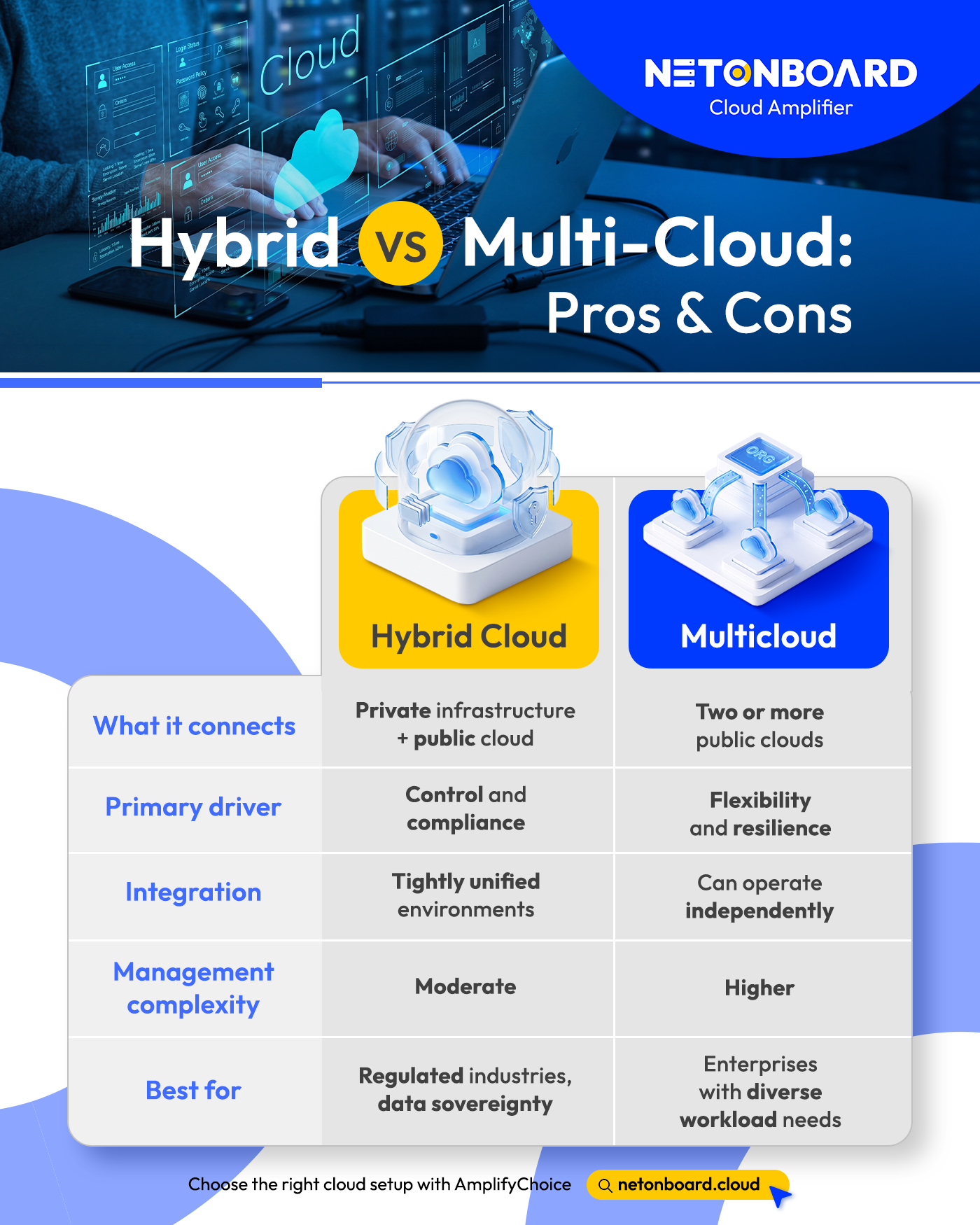
| Hybrid Cloud | Multicloud | |
| What it connects | Private infrastructure + public cloud | Two or more public clouds |
| Primary driver | Control and compliance | Flexibility and resilience |
| Integration | Tightly unified environments | Can operate independently |
| Management complexity | Moderate | Higher |
| Best for | Regulated industries, data sovereignty | Enterprises with diverse workload needs |
The Benefits of Hybrid Cloud Architecture

Malaysia’s regulatory environment makes this concrete. Bank Negara’s RMiT guidelines set specific requirements around data residency and operational resilience for financial institutions. The PDPA Amendment Act 2024 added stricter rules on data storage, breach notification within 72 hours, and cross-border data transfers. For businesses in these sectors, keeping certain data on-premises is the only compliant path.
Hybrid cloud resolves this without forcing a choice between compliance and cloud capability. Here is what those benefits of hybrid cloud architecture look like in practice:
- Data sovereignty. Regulated or sensitive data stays on-premises or in a private cloud. Everything else uses public cloud infrastructure, which scales on demand and costs significantly less to run.
- Cost control. Stable, predictable workloads run on-premises at fixed cost. Variable workloads use pay-as-you-go cloud pricing. Businesses stop overpaying for idle capacity and stop under-provisioning for peaks.
- Disaster recovery. The public cloud acts as a failover environment. If primary systems go down, cloud-hosted backups restore operations faster than traditional DR setups. Net Onboard’s AmplifyContinuity service is built specifically around this hybrid recovery model.
- Gradual migration. Businesses that are not ready to move everything at once can shift workloads incrementally, validating each step before committing further.
The May 2025 launch of Microsoft Azure’s Malaysia West region — part of a US$2.2 billion (approximately RM10.3 billion) investment in Malaysia’s cloud and AI infrastructure — improved the equation further. With in-country Azure infrastructure now available, hybrid setups can keep data within Malaysia’s jurisdiction while accessing full public cloud capability.
Hybrid Cloud vs Multicloud: How to Choose
There’s no universal answer. The decision depends on what the business is actually trying to solve.
Hybrid cloud fits better when:
- Workloads include regulated data that cannot move to a public cloud
- Compliance requirements dictate where data is stored and processed
- The business wants to migrate gradually rather than in one move
- Cost predictability for stable, core workloads is a priority
Multicloud fits better when:
- Different workloads genuinely need what different platforms offer
- Vendor dependency is an operational or contractual risk
- The business has the capacity — internal or through a managed partner — to govern two environments
- Scale justifies the added management overhead
Some businesses end up running both — a hybrid foundation for regulated and core systems, with a secondary cloud platform handling specific analytics or machine learning workloads. Plenty of organisations operate this way, and it works when there is a clear reason for each environment.
The risk is adding environments faster than you add governance. Remember: two cloud platforms means two billing structures, two sets of security policies, and two places for costs to quietly spiral.
Find the Right Fit
Choosing between hybrid and multi-cloud starts with an honest view of your workloads, your compliance obligations, and what your team can realistically manage.
Net Onboard’s AmplifyChoice service is designed for exactly this: assessing what you run, where your data needs to live, and which cloud architecture matches the reality of how your business operates.
Speak to the Net Onboard team if you are:
- Running regulated or sensitive workloads that cannot fully move to a public cloud
- Wanting to build a multi-cloud strategy for enterprises
- Experiencing cost overruns or visibility gaps across your current cloud environment
- Planning a cloud migration and unsure which architecture fits your compliance position
AmplifyChoice covers cloud platform selection, architecture planning, and managed deployment across Azure, AWS, hybrid, and multicloud environments. Explore hybrid cloud solutions Malaysia and more with Net Onboard.