

In Malaysia, SMEs account for 97% of all businesses and provide 48% of national employment. They’re the engine of the economy, and yet most of them are trying to grow on IT systems that weren’t built for growth.
A Visa survey of 800 Malaysian SMEs found that the top business challenges right now are rising operational costs (57%), labour expenses (52%), and inflation pressure (55%). When you’re dealing with all three at once, investing in IT infrastructure feels like a luxury. But the irony is that outdated IT often makes those exact problems worse, because manual processes, siloed data, and rigid systems slow everything down.
This is where managed cloud services for growing businesses in Malaysia come in. Managed cloud gives you access to scalable, enterprise-grade infrastructure without the upfront cost or complexity of building it yourself. Let’s delve further.
The Scaling Problem Malaysian Businesses Face
Growth should be exciting. But for many Malaysian businesses, especially those in the RM1 million to RM50 million revenue band, it exposes every weakness in their IT setup.
Around 77% of SMEs remain at the basic digitalisation stage. The World Bank paints a similar picture: only about 30% of Malaysian businesses have adopted digital technology for back-end operations like inventory management, procurement, and internal reporting. The front end might look digital, with e-commerce sites and social media presence, but the systems behind them are often still manual or semi-manual.
That creates a ceiling; for example, a food manufacturer lands a contract with a national supermarket chain, and suddenly needs to track production batches, manage supplier invoices, and report compliance data in formats they’ve never had to produce before. Their current system, a mix of spreadsheets and one accounting software licence, can’t handle it. They’re stuck choosing between scaling and stability.
This is the gap that scalable IT infrastructure for SMEs in Malaysia is designed to fill.
How Managed Cloud Removes the Bottleneck
Now, how do managed cloud services help Malaysian businesses scale? It turns IT from a fixed constraint into something that flexes with the business.
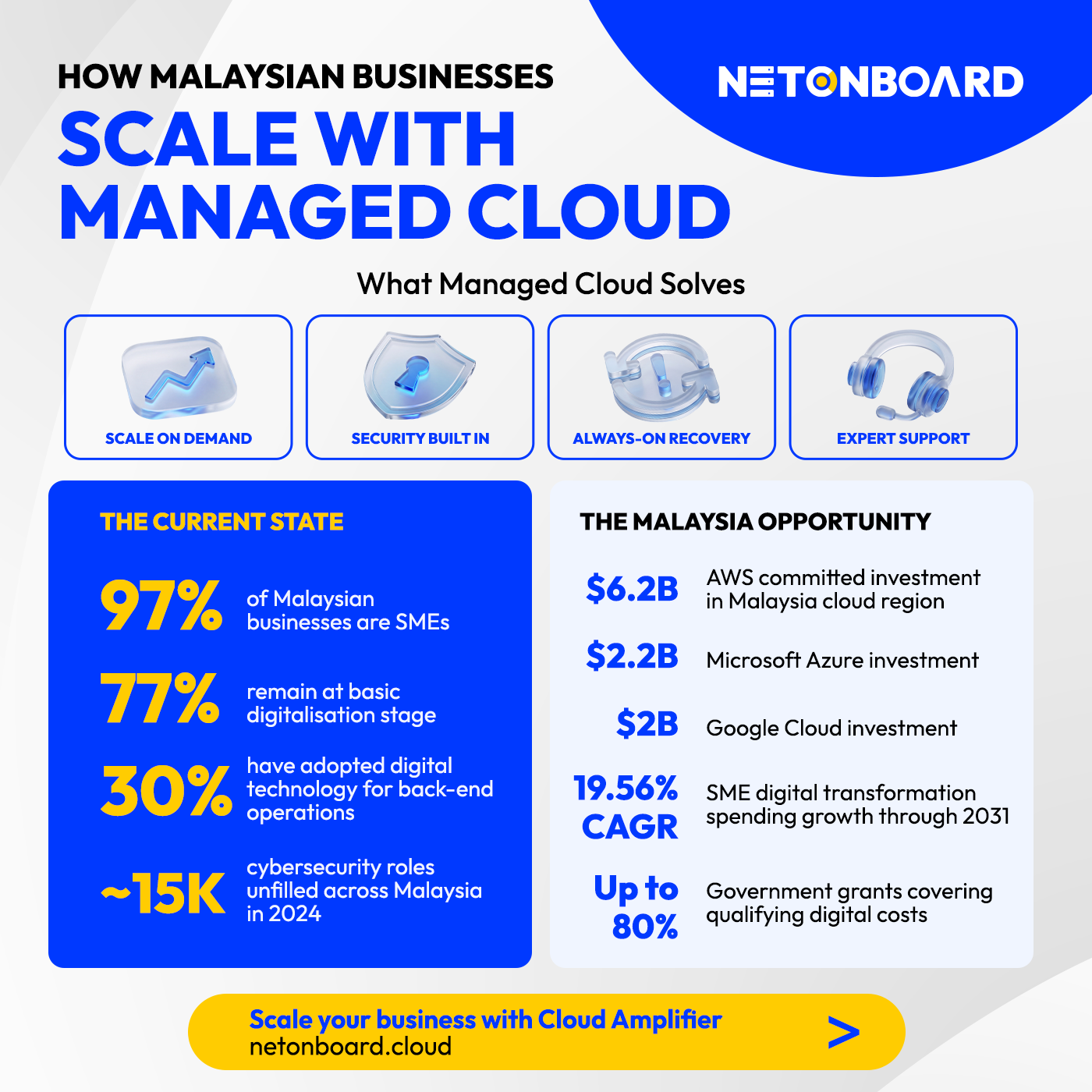
Here’s what that looks like in practice:
- Elastic capacity. Your cloud environment expands during peak periods (Raya campaigns, year-end reporting, seasonal demand spikes) and contracts when things settle. You pay for what you actually use, which means scaling up doesn’t require a significant decision every time.
- Managed security and compliance. As businesses grow, they collect more customer data, process more transactions, and face stricter regulatory scrutiny. A managed cloud provider handles patching, threat monitoring, access controls, and PDPA compliance as part of the service, so your security posture grows alongside your operations.
- Operational continuity. Downtime during a growth phase is expensive. Managed cloud includes backup architecture and disaster recovery planning, ensuring that a server failure or ransomware incident doesn’t undo months of your progress.
- Reduced IT staffing pressure. With roughly 15,000 cybersecurity roles unfilled across Malaysia in 2024, hiring qualified IT staff is both difficult and costly. Managed cloud offloads the operational burden to a team of specialists, giving growing businesses access to expertise they couldn’t afford to hire full-time.
This is the core value of cloud infrastructure for business expansion: it removes the need to choose between growing the business and keeping your infrastructure stable.
Where Malaysian Businesses Feel the Impact Most
The benefits of cloud scaling vary by sector. Here are three areas where Malaysian businesses are seeing the most tangible results:
- Manufacturing and logistics. Real-time inventory tracking, supplier management, and compliance reporting require systems that handle growing data volumes without slowing down. Cloud-based ERP and supply chain tools let manufacturers add capacity as order volumes increase.
- Professional services. Accounting firms, legal practices, and consultancies often scale by adding offices or expanding headcount. Cloud infrastructure lets teams across multiple locations access shared systems securely, without the cost of deploying and maintaining physical servers in each office.
- Retail and e-commerce. Seasonal demand swings are the norm. A managed cloud setup means an online retailer running a monthly sale campaign doesn’t need to overprovision for a week of high traffic permanently. The infrastructure scales up for the event, then back down afterwards.
What Makes Malaysia’s Cloud Landscape Different Now
A few years ago, the main barrier to cloud adoption for Malaysian SMEs was access. Enterprise-grade cloud infrastructure meant routing traffic through data centres in Singapore or Hong Kong, which introduced latency and data-residency concerns. That’s changed significantly.
AWS launched its Malaysia cloud region in 2024 with a committed USD 6.2 billion investment. Microsoft and Google committed USD 2.2 billion and USD 2 billion, respectively. All three now operate local availability zones, meaning Malaysian businesses can keep data in-country while still accessing global-tier cloud capabilities.
On the policy side, support is growing as well:
- SME digital transformation spending is growing at a 19.56% CAGR through 2031, with grants covering up to 80% of qualifying costs
- Budget 2026 allocated RM1 billion in financing and grants for SME automation and digitalisation
- The RM53 million Digital Acceleration Grant targets cloud, AI, and blockchain adoption specifically
The access barrier is gone. If you’ve been evaluating enterprise cloud services in Malaysia, the infrastructure and funding environment has never been stronger.
How to Choose the Right Managed Cloud Partner
The difference between a cloud provider and a managed cloud partner is the depth of involvement. A provider gives you access to infrastructure. A managed partner helps you figure out what to put on it, how to configure it for your growth trajectory, and how to keep it running well as things change.
When evaluating partners, these are the things worth looking at:
- Pre-migration assessment. Do they audit your current environment and workloads before recommending a solution, or do they jump straight to a quote?
- Platform flexibility. Can they work across AWS, Azure, and other platforms, or are they locked into a single ecosystem? Different workloads often perform better on different platforms.
- Ongoing operations. What happens after migration? A strong partner provides continuous monitoring, performance optimisation, and a clear escalation path when things need attention.
- Local expertise. Cloud architecture decisions have compliance implications, so your chosen partner must be familiar with the local context and understand Malaysia’s regulatory landscape regarding PDPA, data residency, and e-invoicing compliance.
Scale Smarter With the Right Cloud Foundation
Scaling a business in Malaysia means dealing with rising costs, tighter compliance requirements, and growing operational complexity all at once. The field is constantly evolving, but with managed cloud services, you can address these pressures with infrastructure that scales with demand, stays secure, and is backed by specialists who keep it running at its best.
At Net Onboard, our Cloud Amplifier framework is built around this: matching your business to the right cloud platforms, managing the migration, and providing ongoing operational support that evolves as your business grows.
Looking for enterprise cloud services in Malaysia that businesses trust for long-term scaling? Talk to us at Net Onboard today. We can help you build the right infrastructure for your business.