

A Malaysian enterprise runs firewalls at the perimeter, has antivirus on every device, and still gets breached by a phishing email that an employee clicked. How?
Usually, it’s because endpoint security and network security were treated as interchangeable rather than complementary. They defend different layers, and attackers exploit the gaps between them.
In this guide, we’ll explain the differences between endpoint and network security in practical terms, and where endpoint threat detection services in Malaysia fit into a modern defence-in-depth strategy.
What Endpoint Security Protects
Endpoint security protects the devices that connect to your network. Laptops, desktops, servers, mobile phones, tablets, and IoT devices all qualify as endpoints. Each one is a potential entry point for an attacker.
The modern endpoint stack has three layers:
- Endpoint Protection Platform (EPP). The baseline layer. Next-generation antivirus, device firewall, and application control work together to block known malware, exploits, and unauthorised software before they execute.
- Endpoint Detection and Response (EDR). Behavioural monitoring that catches what EPP misses. EDR records endpoint activity continuously, flags anomalies, and provides analysts with a forensic trail to investigate. When a threat is confirmed, EDR can automatically isolate the device.
- Extended Detection and Response (XDR). The unified layer. XDR correlates endpoint data with network, identity, and cloud signals so analysts see the full attack path rather than isolated fragments.
Why does endpoint matter so much? Because endpoints sit where users operate. A phishing email doesn’t breach a firewall, but it compromises a user, who then does everything the attacker needs from inside the network. MyCERT’s Q1 2025 report found phishing made up 68% of fraud incidents reported in Malaysia, which underlines the exposure at the device level.
What Network Security Protects
Network security protects the traffic and infrastructure that connects systems. It sits between users, applications, and data stores, controlling what can move and where.
The core network stack:
- Next-Generation Firewalls (NGFW). Beyond traditional port and protocol filtering, NGFWs inspect traffic at the application layer, identify specific applications regardless of port, and block known malicious destinations.
- Intrusion Detection and Prevention Systems (IDS/IPS). Traffic analysis that looks for attack patterns such as exploitation attempts, brute-force login activity, and command-and-control communication.
- Virtual Private Networks (VPN) and Zero Trust Network Access (ZTNA). Secure channels for remote access. ZTNA increasingly replaces traditional VPNs by verifying every connection against identity and device posture rather than trusting network location.
- Network segmentation. Splitting the network into zones so a compromised device in one area can’t reach critical systems elsewhere. Microsegmentation applies the same logic inside cloud environments.
Network security’s strength is scope. One NGFW rule can protect every device behind it, which makes it efficient. But its weakness is that traffic within the perimeter often goes uninspected, and the modern perimeter now spans cloud platforms, SaaS applications, and remote users.
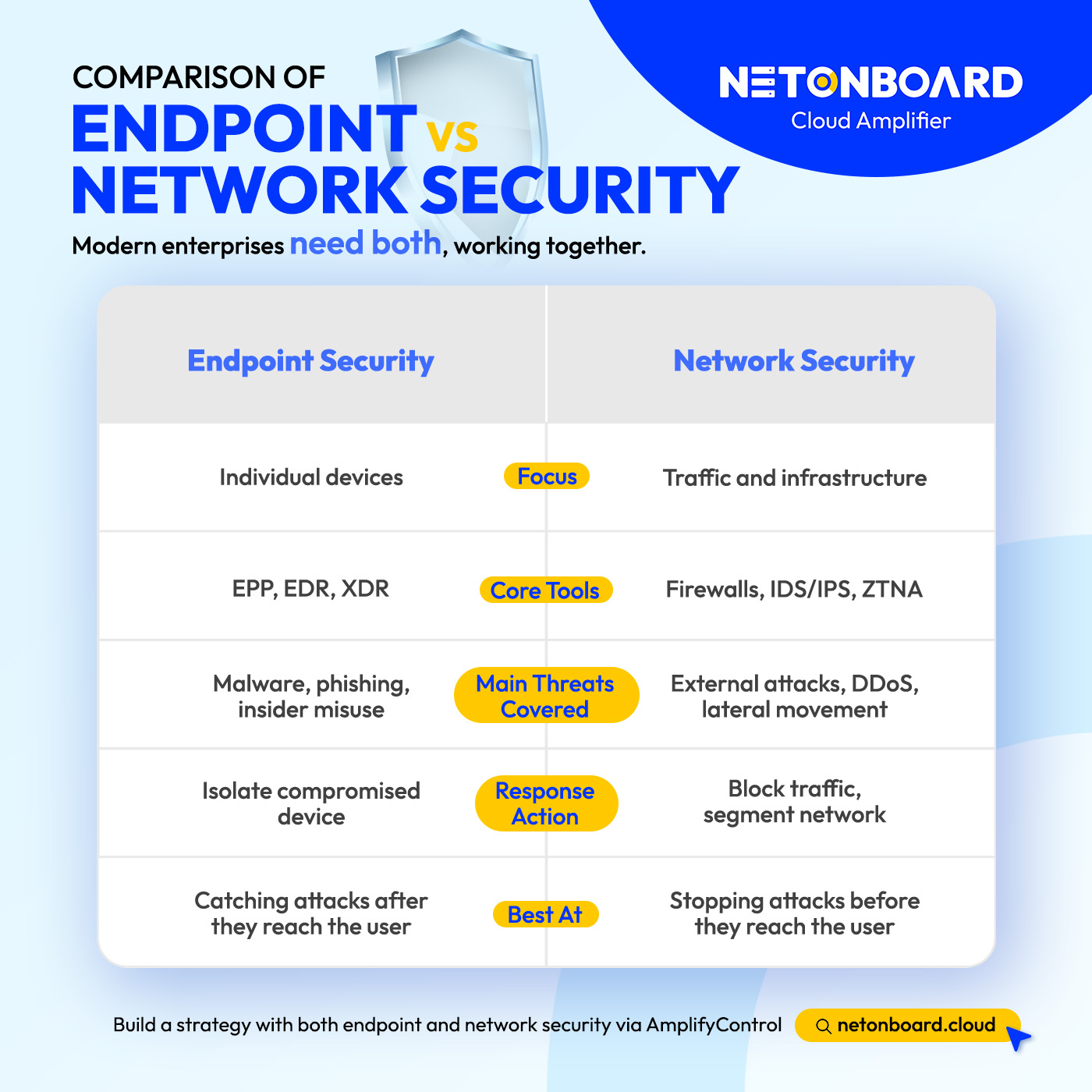
Endpoint vs Network Security Differences Explained
Seeing them side by side makes the relationship clearer
Which Is More Important: Endpoint or Network Security?

The short answer: neither, on its own. An enterprise weighted heavily toward one creates exactly the gaps attackers rely on.
That said, the practical centre of gravity has shifted. Five years ago, the network perimeter was the main line of defence because most work happened inside it. Today, with remote work, BYOD, and SaaS adoption, most enterprise activity happens outside the traditional perimeter. Endpoints are where users live, and where breaches now start.
Three realities drive this:
- The perimeter has dissolved. Users connect from cafés, homes, and mobile networks. Cloud applications bypass the corporate network entirely. NGFWs can’t inspect traffic they never see.
- Phishing remains the top attack vector. Network controls can’t prevent an employee from clicking a malicious link in their email. Only endpoint controls can catch what happens after the click.
- Lateral movement starts at the endpoint. Once an attacker has a foothold on one device, they move inward using legitimate credentials. Network segmentation slows this down, but EDR on the endpoint is what spots it.
So while both layers matter, a 2026 enterprise security budget that under-invests in endpoint leaves the most exposed surface uncovered.
Building an Enterprise Security Strategy That Covers Both
The goal isn’t picking a winner. It’s about ensuring neither layer has blind spots and that telemetry from both feeds flows into the same investigation surface.
If your endpoint stack relies solely on antivirus, your network controls don’t inspect east-west traffic inside the cloud, or your SOC is working off siloed tools that can’t correlate endpoint and network signals, it’s best to consolidate under a single defence-in-depth approach sooner rather than later.
Here at Net Onboard, that’s where our AmplifyControl pillar can help you do just that, covering both sides of the equation. Our Endpoint Operations Security handles EDR and XDR deployment, device hardening, and patch management. This works alongside Security Operations, which integrates endpoint and network telemetry into a single SOC view, built around the Cybersecurity Act 2024 and PDPA Amendment 2024 obligations from the start.
Learn more about how our endpoint threat detection services in Malaysia can strengthen the layer where most breaches now begin today. Our team is also here to help, so feel free to reach out to us to know more.