
For years, most advanced AI infrastructure was concentrated in the United States and Europe.
Companies in Asia could still access it through cloud platforms, but the physical servers might be thousands of kilometres away.
That is beginning to change.
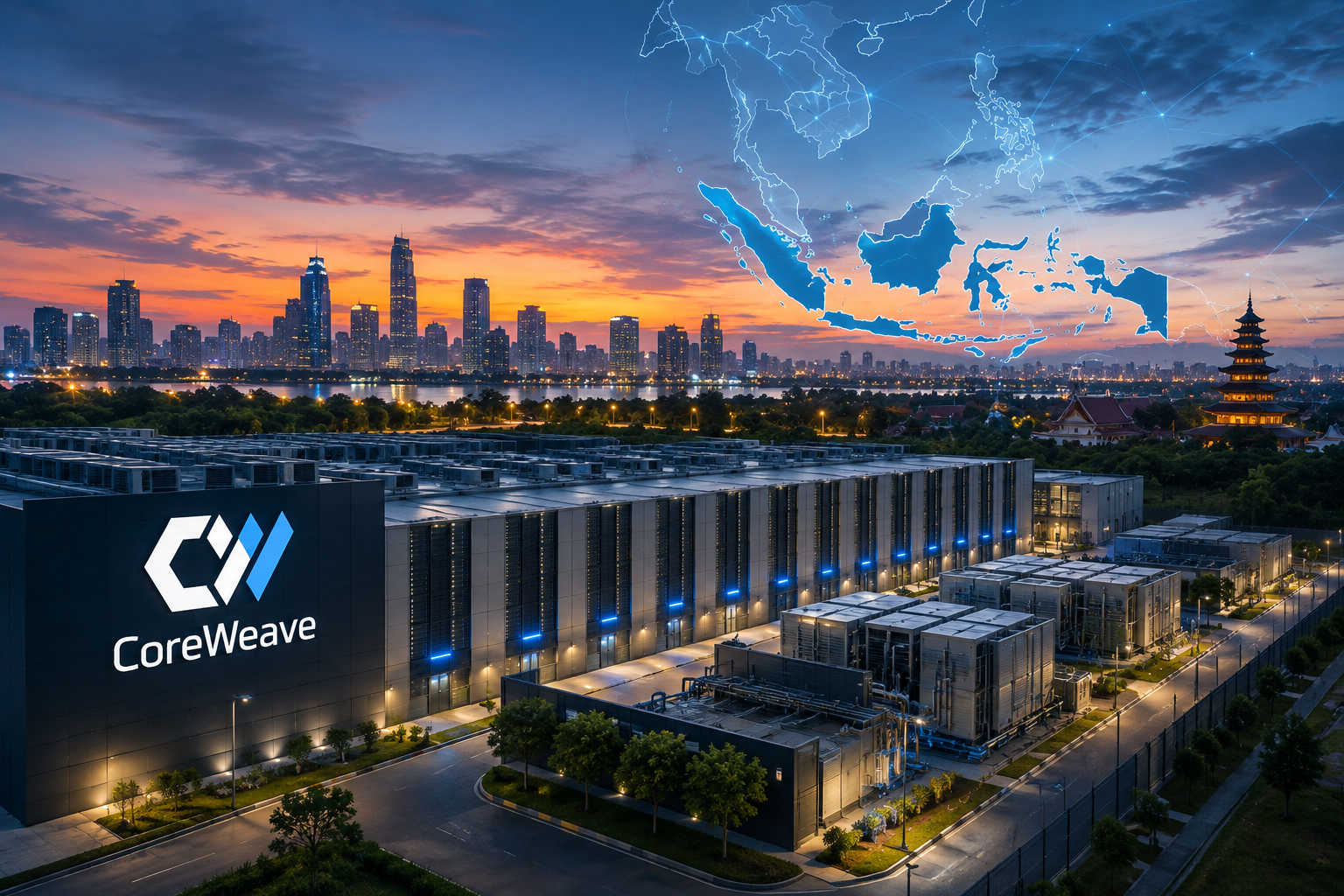
CoreWeave announced on 4 August 2026 that it will establish three data centres in Indonesia, marking the AI cloud provider’s first physical presence in the Asia-Pacific region.
The facilities will provide a combined 360 megawatts of contracted IT power and are expected to come online in 2028. CoreWeave says it will own and operate all three locations.
This is not only an expansion story.
It shows how quickly demand for AI computing is spreading across Asia.
What Is CoreWeave?
CoreWeave is a specialised cloud provider focused heavily on high-performance and AI workloads.
Unlike a general cloud platform designed to support almost every type of application, its infrastructure is built around services such as GPU computing, AI model training and AI inference.
The company said it operated 49 data centres worldwide as of March 2026. It has also entered large, long-term cloud-capacity agreements with companies including Meta and Anthropic.
CoreWeave previously said that most of its new capacity for 2026 had already been allocated under long-term customer commitments. According to the company, customers are increasingly moving AI projects from experimentation into production.
That helps explain why it is expanding into a new region.
Why Indonesia?
CoreWeave said Asian businesses, AI companies and governments increasingly want computing capacity located closer to their users and data.
The company highlighted two main reasons:
- Workloads that are sensitive to network latency
- Requirements concerning where data is stored or processed
CoreWeave also plans to recruit and train a local team to operate the Indonesian facilities.
Indonesia offers a large domestic digital market and a strategic position within Southeast Asia. Its selection also shows that regional AI infrastructure development is no longer limited to established hubs such as Singapore.
More countries are competing to host the physical infrastructure behind AI services.
Why Location Matters for AI Workloads
Cloud services can be accessed from almost anywhere, but distance still affects performance.
Data must travel between the user, application and data centre.
For ordinary email or document storage, a small delay may not be noticeable.
For real-time AI services, the effect can be more important.
Examples include:
- Live customer-service assistants
- Voice-based AI applications
- Fraud detection
- Video analysis
- Factory automation
- Interactive AI agents
- Applications processing large datasets
Hosting computing capacity closer to users can reduce network delay and make the experience feel more responsive.
Location can also matter when a company has customer, industry or regulatory requirements concerning where sensitive data is stored.
What This Means for Southeast Asian Businesses
Most companies will not rent hundreds of GPUs or build their own AI models.
They may still benefit from the expansion of regional AI infrastructure.
More nearby capacity could eventually support:
- Better availability of AI cloud resources
- Lower network latency
- More regional service options
- Greater competition among cloud providers
- Additional choices for data location
- Faster deployment of AI-powered applications
However, the announcement does not mean every business should immediately move into a specialised AI cloud.
The facilities are not expected to begin operating until 2028, and AI infrastructure should still be selected according to the actual workload.
Do You Actually Need an AI Cloud?
An AI cloud is useful when a workload requires large amounts of accelerated computing.
This may include:
- Training a machine-learning model
- Running a private large language model
- Processing images or video at scale
- Providing high-volume AI inference
- Supporting engineering or scientific simulation
Many business AI use cases do not require dedicated infrastructure.
A company using AI to draft emails, summarise documents or assist a small support team may be better served by an existing software subscription or API.
Before selecting infrastructure, ask:
- What problem are we solving?
- How many users will use the system?
- What data will be processed?
- Does the workload require a GPU?
- Is the usage continuous or occasional?
- Can the application use an existing managed AI service?
- What happens if usage grows unexpectedly?
Do not purchase expensive capacity simply because it is described as AI-ready.
Four Areas Businesses Should Review
1. Data Location
Confirm where prompts, uploaded files, output, logs and backups will be stored.
The main computing region may be local while other parts of the service are processed elsewhere.
2. Total Cost
AI cloud pricing may include GPU time, storage, API usage and data transfer.
Calculate the cost per useful result, not only the hourly infrastructure rate.
3. Security
Review account access, encryption, logging and data-retention policies.
Confidential customer or company data should not be entered into a platform without understanding how it is handled.
4. Portability
Know whether the model, data and applications can be moved to another provider.
An AI project can become difficult to migrate when it depends too heavily on one provider’s proprietary services.
The Malaysia Perspective
CoreWeave’s first Asia-Pacific facilities are being built in Indonesia, not Malaysia.
However, the expansion is still relevant to Malaysian businesses.
It demonstrates that Southeast Asia is becoming a serious market for high-performance cloud and AI infrastructure.
Over time, greater regional capacity may give Malaysian companies more choices when comparing local, regional and international cloud services.
The best option will still depend on latency, data location, support, cost and recovery requirements.
A nearby data centre is useful.
A well-designed cloud environment is more important.
Closing Thoughts
CoreWeave’s expansion into Indonesia is another sign that AI infrastructure is becoming more regional.
The company plans to add three facilities with 360 megawatts of contracted IT power, creating its first data-centre presence in Asia-Pacific.
For businesses, the main lesson is not that every company needs specialised AI infrastructure.
It is that location, capacity and data control will become more important as AI applications move into production.
Start with the business problem.
Understand the workload.
Protect the data.
Calculate the total cost.
Then choose the cloud environment that fits the requirement.
At Net Onboard, we help businesses plan and manage cloud hosting, dedicated infrastructure, cybersecurity, backup and business-continuity environments.