
When businesses discuss AI infrastructure, the conversation usually begins with processors.
Which GPU should we use?
How many CPU cores do we need?
How powerful is the server?
These are reasonable questions.
But they leave out one of the most important parts of the system.
Memory.
A processor can perform calculations very quickly. But it still needs data to work with. If that data cannot be delivered quickly enough, the processor may spend part of its time waiting.
That is why memory capacity and memory bandwidth are becoming increasingly important as companies deploy AI, analytics and other data-intensive workloads.
The significance of memory was visible in China’s stock market on 27 July 2026.
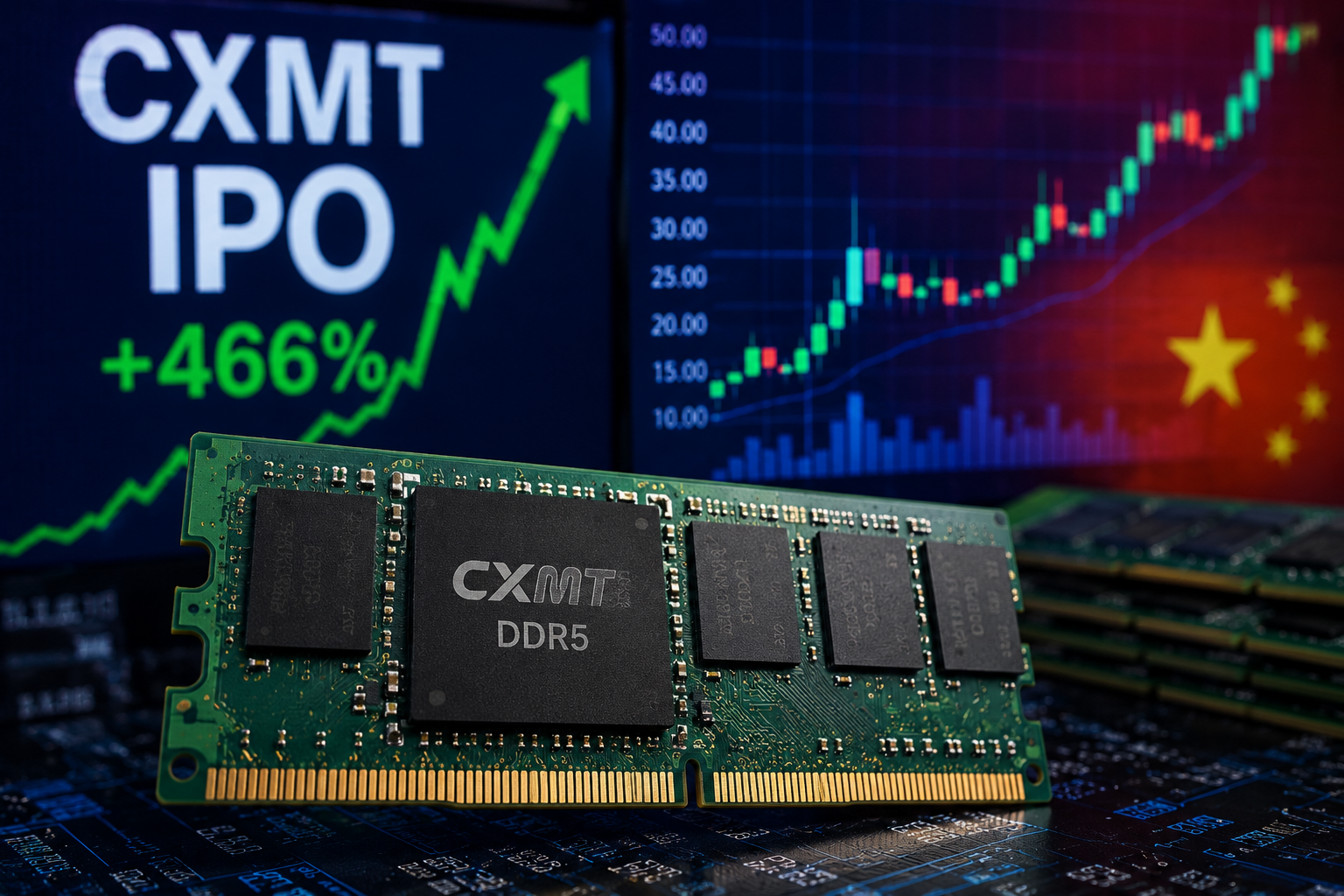
Shares of CXMT Corporation, China’s largest producer of dynamic random-access memory, surged 466% during their first day of trading in Shanghai. The company closed at 49 yuan per share after being sold to IPO investors at 8.66 yuan. The rally gave CXMT a market capitalisation of approximately 3.3 trillion yuan, or $487.7 billion, temporarily making it the most valuable company listed on mainland China’s stock market.
The dramatic debut attracted attention because of the numbers.
But the more useful business story is underneath them.
AI is creating enormous demand not only for processors, but also for the memory required to keep those processors productive.
What Is CXMT?
CXMT was previously known as ChangXin Memory Technologies.
The company specialises in DRAM, a type of memory used across computers, mobile devices, servers and many other electronic systems.
It was established in 2016 and has become China’s largest manufacturer focused on DRAM research, development, design and production. Its products include DDR memory for computers and servers, as well as lower-power memory for mobile devices.
DRAM is temporary working memory.
When a computer opens an application, processes a database query or runs a virtual machine, much of the active information is held in DRAM so the processor can reach it quickly.
This is different from storage.
An SSD keeps files and information even after the device is switched off.
RAM holds the information that the system is actively working with.
Both are important, but they perform different jobs.
What Happened During the IPO?
CXMT raised 57.92 billion yuan, or approximately $8.6 billion, from its initial public offering.
Reuters described it as the largest semiconductor IPO ever completed in mainland China. The amount could increase to 66.61 billion yuan if an over-allotment option is fully exercised.
The company’s shares then climbed sharply during their first trading session.
They reached an intraday high of 55.03 yuan before closing at 49 yuan, representing a 466% gain from the IPO price.
This extraordinary result reflects several factors:
- Strong investor interest in AI-related companies
- High demand for memory chips
- China’s push to strengthen its domestic semiconductor industry
- Expectations of rapid CXMT revenue growth
- A relatively small number of shares available for trading on the first day
Only 6.73% of CXMT’s enlarged share capital was freely tradable at listing because most shares remained subject to lock-up restrictions. A limited supply of tradable shares can magnify demand and create larger price movements.
This matters because the first-day valuation should not be treated as a simple measurement of the company’s permanent business value.
It reflects what buyers were willing to pay for the limited shares available during one highly anticipated trading session.
A Huge Share-Price Increase Does Not Remove the Risk
The stock-market debut was impressive.
It was also highly speculative.
Analysts quoted by Reuters warned that the memory industry remains cyclical and that the first-day price may have moved beyond a sustainable valuation. Concerns include future supply increases, possible slowing of AI investment and continuing restrictions on China’s access to advanced semiconductor manufacturing technology.
Memory prices do not rise forever.
When demand grows faster than production capacity, prices can increase sharply.
Manufacturers then invest in additional capacity.
If too much new supply enters the market, prices may fall again.
CXMT itself warned in its prospectus that the current memory upswing could weaken if AI investment slows or competitors add too much production capacity.
The lesson for businesses is not to speculate on semiconductor shares.
It is to recognise that memory pricing and availability can change.
A server budget prepared today may not remain accurate when hardware is purchased several months later.
Why AI Needs So Much Memory
AI systems work with large amounts of data.
A model may contain billions of parameters.
It may also need to process documents, images, conversations, databases or sensor information in real time.
The processor performs the calculations.
Memory keeps the relevant model data and working information close enough for the processor to use.
If the required information does not fit into available memory, the system may need to move data repeatedly between faster memory and slower storage.
That can reduce performance.
The problem becomes even more serious when several processors or accelerators are working together.
They need to receive large amounts of data quickly and consistently.
This is why AI infrastructure requires more than raw computing power.
It also requires:
- Sufficient memory capacity
- High memory bandwidth
- Low latency
- Efficient data movement
- Adequate storage performance
- Fast network connectivity
- Suitable power and cooling
Micron said the rapid growth of large language models, AI agents, real-time inference and high-core-count CPU workloads is increasing demand for higher server memory capacity, greater bandwidth and better power efficiency. Its latest 256GB DDR5 server module is designed to help data-centre operators place more memory into each server while controlling power consumption.
Capacity and Bandwidth Are Different
Memory capacity and memory bandwidth are often confused.
They are related, but they describe different things.
Memory Capacity
Capacity is the amount of data that can be held in memory at one time.
A server with 256GB of RAM can hold more active information than a server with 32GB.
More capacity may be needed when running:
- Many virtual machines
- Large databases
- Business intelligence platforms
- In-memory analytics
- AI models
- Large application environments
- Several users or processes at once
Memory Bandwidth
Bandwidth describes how quickly data can move between memory and the processor.
A server may have a large amount of RAM but still experience performance limitations when data cannot move quickly enough.
Intel recently described memory bandwidth as an overlooked AI performance metric. The company said processors and AI accelerators may lose valuable processing time when the rest of the system cannot supply data fast enough.
The difference can be explained with a simple example.
Capacity is the size of a water tank.
Bandwidth is the size of the pipe.
A large tank can hold a lot of water.
But if the pipe is too narrow, the water still flows slowly.
AI infrastructure needs both.
What Is High-Bandwidth Memory?
High-Bandwidth Memory, commonly called HBM, is a specialised type of memory used alongside advanced GPUs and AI accelerators.
Instead of placing memory chips separately across a normal circuit board, HBM stacks multiple memory layers vertically and connects them through extremely short internal pathways.
This design allows much more data to move between the memory and the processor.
Samsung describes HBM as a stacked memory architecture designed to provide the high-throughput data movement required by AI training and high-performance computing. Its latest HBM products are designed to deliver several terabytes of memory bandwidth per second from a single stack.
HBM is not the same as the normal RAM installed in an office desktop or a standard business server.
It is more complex.
It is also more expensive and difficult to manufacture.
However, the demand for HBM affects the wider memory market because manufacturers must decide how to allocate factories, equipment and materials between different products.
Why GPUs Alone Do Not Guarantee AI Performance
A company may buy an expensive GPU and expect immediate performance improvement.
That does not always happen.
The result depends on the complete system.
A powerful GPU may still be limited by:
- Insufficient GPU memory
- Insufficient system RAM
- Slow storage
- Weak CPU performance
- Limited network bandwidth
- Poor application design
- Inefficient data pipelines
- Thermal limitations
- Software that does not use the hardware properly
This is why infrastructure should be designed around the workload.
A business running occasional AI-assisted document searches does not need the same architecture as a company training a large model.
A Power BI server does not need the same memory design as a generative AI platform.
A database server may benefit from more RAM, while another application may be limited by storage IOPS or CPU performance.
The most expensive component is not automatically the most important one.
The bottleneck determines the result.
What Businesses Should Learn From the CXMT Story
The CXMT IPO shows that investors expect memory to remain strategically important during the AI infrastructure expansion.
Businesses do not need to follow the stock market to benefit from that lesson.
They should pay more attention to memory when planning servers, cloud environments and AI projects.
1. Do Not Compare Servers by CPU Alone
Server quotations often begin with CPU cores.
For example:
- 8 cores
- 16 cores
- 32 cores
Core count matters.
But it does not provide a complete picture.
A 16-core server with too little RAM may perform worse than a properly balanced 8-core server for certain workloads.
The business should also review:
- Memory capacity
- Memory channels
- Memory speed
- Storage type
- Storage latency
- Storage IOPS
- Network bandwidth
- Application design
A balanced system normally provides better value than one oversized component surrounded by weaker parts.
2. Understand the Difference Between RAM and Storage
More SSD space does not replace RAM.
An SSD may store several terabytes of information.
But when the application is actively processing that information, it still needs working memory.
Businesses sometimes request a large storage volume but allocate very little RAM.
This can create slower performance when the application repeatedly reads from storage instead of keeping frequently used data in memory.
3. Plan for Growth
A server that is sufficient today may become constrained later.
Usage can increase because of:
- More employees
- More customers
- Larger databases
- Longer data-retention periods
- More complex reports
- Additional applications
- AI functions
- Increased log collection
- New integrations
Businesses should consider whether memory can be upgraded later.
For physical servers, check:
- Available memory slots
- Maximum supported capacity
- Compatible module sizes
- Whether existing modules must be replaced
- Whether downtime is required
For cloud servers, check whether RAM can be increased and whether the upgrade requires a restart or migration.
4. Measure Before Upgrading
A slow application does not always need more RAM.
The company should first identify the actual bottleneck.
Useful measurements include:
- CPU utilisation
- Available memory
- Memory paging
- Disk latency
- IOPS
- Database wait time
- Network usage
- Application response time
If memory utilisation remains low, adding more RAM may not improve performance.
If the system is constantly paging data to disk, additional memory may help significantly.
The decision should be based on evidence.
5. Watch Hardware Pricing
Memory is a globally traded semiconductor product.
Prices may move because of:
- AI demand
- Smartphone and computer demand
- Factory disruptions
- Supply expansion
- Export controls
- Currency movements
- Changes in manufacturer production plans
A hardware quotation may therefore have a limited validity period.
Businesses planning a large server purchase should confirm pricing closer to the order date instead of assuming that an old quotation will remain available.
6. Consider Supplier Diversity
Reuters reported that memory customers are seeking to diversify suppliers while the market remains tight. A broader supplier base may help reduce dependence on one manufacturer or region.
Most businesses will not negotiate directly with semiconductor factories.
But they can still ask their hardware vendor:
- Which memory brand is being supplied?
- Is the model enterprise-grade?
- Is it supported by the server manufacturer?
- Can an equivalent module be sourced later?
- Is replacement stock available?
- Does mixing different modules affect support?
Compatibility and warranty matter more than choosing the cheapest available RAM.
What This Means for Cloud Customers
Cloud customers do not normally see the physical memory modules inside the provider’s servers.
They choose a package such as:
- 4 virtual CPUs and 8GB RAM
- 8 virtual CPUs and 32GB RAM
- 16 virtual CPUs and 64GB RAM
The package looks simple.
The infrastructure behind it is not.
Cloud performance may depend on:
- Physical server generation
- Memory speed
- Resource sharing
- Storage performance
- Processor oversubscription
- Network architecture
- Virtualisation configuration
- Host-system load
Two providers may advertise the same CPU and RAM allocation while delivering different performance.
This is why businesses should not compare cloud services only by the quantity listed on the quotation.
They should also consider:
- Performance consistency
- Monitoring
- Support
- Backup
- Recovery assistance
- Resource scalability
- Infrastructure location
- Service-level commitments
For important workloads, a trial or performance test may be useful before committing to a longer contract.
What This Means for AI Projects
Many companies are now experimenting with AI.
The first project may be small.
A chatbot.
A document-search tool.
A reporting assistant.
A security application.
As usage grows, infrastructure requirements can increase quickly.
Before purchasing hardware, the project team should understand:
- Which AI model will be used
- Whether the model will run locally or through an API
- How much memory the model requires
- How many simultaneous users are expected
- How much data will be processed
- Whether a GPU is required
- Whether sensitive data can leave the company
- Whether the workload is continuous or occasional
- How the system will be backed up
- What happens when the AI service is unavailable
A cloud API may be more practical for a small trial.
Dedicated hardware may make sense when usage, privacy or performance requirements become more demanding.
The correct choice depends on the workload.
Do Not Buy AI Hardware Before Defining the Use Case
AI infrastructure can become expensive very quickly.
A company may be tempted to buy a powerful GPU server because it wants to “prepare for AI.”
That is not enough of a requirement.
The business should first define:
- What problem the AI system will solve
- Which department will use it
- What data it needs
- How often it will run
- What result is expected
- What level of accuracy is acceptable
- How the return will be measured
Only then should the technical team select the infrastructure.
Without a defined use case, the company may buy expensive hardware that remains underused.
The Asia Technology Supply Chain Is Becoming More Important
CXMT’s listing is part of a wider effort by China to strengthen its domestic semiconductor capabilities.
The company has become an important part of China’s attempt to reduce reliance on foreign suppliers for strategic technologies such as AI and advanced computing.
Asia already plays a central role in the global semiconductor supply chain.
South Korea is a major producer of memory.
Taiwan is central to advanced chip manufacturing.
Japan supplies important materials and equipment.
China is investing heavily in domestic production.
Malaysia is involved in semiconductor assembly, testing, equipment and supporting supply-chain activities.
For businesses, this means developments in Asia can affect technology prices and availability around the world.
A factory expansion, export restriction or major increase in AI demand may eventually influence server, laptop, smartphone and cloud costs.
Should Businesses Stock Up on RAM?
Usually, no.
Buying large quantities of memory purely because prices may rise can create other risks.
Hardware standards change.
Warranty periods continue running.
Compatibility requirements differ between server models.
Unused components may become obsolete.
A better approach is to maintain a realistic capacity plan.
Businesses should know:
- Current memory usage
- Expected growth
- Upgrade lead time
- Compatible components
- Vendor availability
- Budget approval process
For critical systems, holding a small number of approved spare components may make sense.
For ordinary environments, reliable supplier arrangements are usually more practical than speculative stockpiling.
Management Does Not Need to Understand Every Memory Standard
Technology teams may discuss DDR5, RDIMM, MRDIMM, ECC and HBM.
Management does not need to master every term.
It should understand the business questions behind them.
- Is the system sized for the workload?
- Can it support future growth?
- Is the hardware supported?
- Is the design balanced?
- Can failed memory be replaced quickly?
- Is performance being monitored?
- What happens when capacity is reached?
- Does the budget include future upgrades?
These questions help management make better infrastructure decisions without needing to design the server itself.
The Bigger Lesson
The AI boom is often represented by images of GPUs and giant data centres.
But AI infrastructure is a chain.
Processors perform the calculations.
Memory keeps data close to those processors.
Storage holds the larger datasets.
Networks move information between systems.
Power and cooling keep everything operating.
Software coordinates the workload.
If one part is weak, the whole system may underperform.
CXMT’s extraordinary stock-market debut shows how strongly investors currently value one part of that chain.
Whether the share price remains at the same level is uncertain.
The importance of memory is not.
Closing Thoughts
CXMT’s shares rose 466% during their Shanghai debut after the company completed the largest mainland Chinese semiconductor IPO on record.
The result reflects investor excitement about AI, China’s semiconductor ambitions and the current shortage of memory products. It may also reflect speculation and the limited number of shares initially available for trading.
For businesses, the useful lesson is not found in the share price.
It is found in the technology.
AI and cloud systems need more than powerful processors.
They need sufficient memory capacity.
They need bandwidth.
They need fast storage.
They need reliable networks.
They need a balanced design.
Before purchasing a server or expanding a cloud environment, businesses should measure the workload and identify the actual bottleneck.
Do not add CPU because the application feels slow.
Do not add RAM because memory is in the news.
Do not buy a GPU because the company wants to use AI someday.
Start with the business requirement.
Measure the environment.
Then build the infrastructure around the workload.
At Net Onboard, we help businesses design and manage cloud and dedicated-server environments based on practical performance, security, backup and business-continuity requirements.
If your company is planning a server upgrade, Power BI environment, cloud migration or AI workload, the infrastructure should be sized as one complete system rather than a collection of individual specifications.