
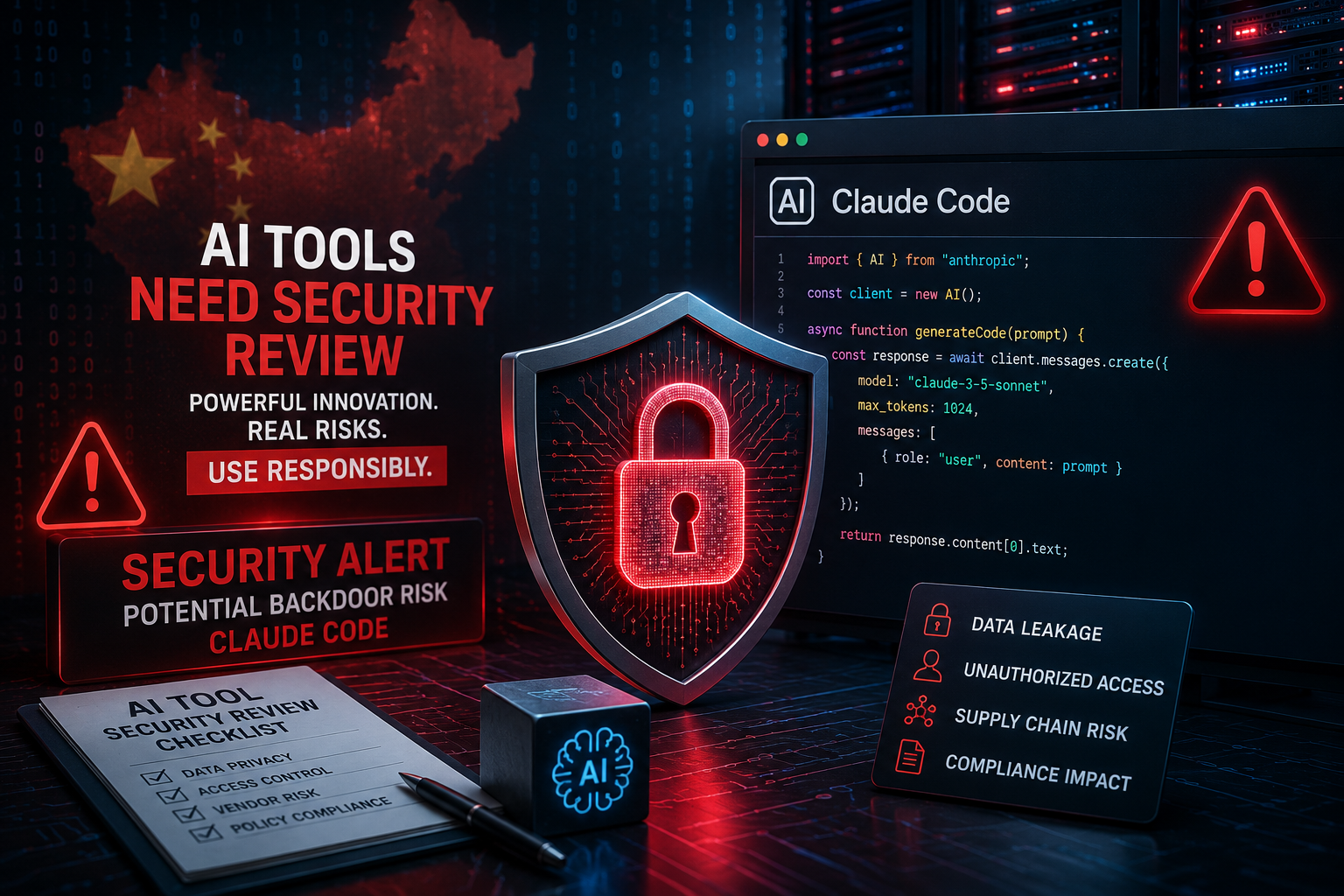
AI tools are moving faster than most company policies.
That is the problem.
A new AI tool can become popular within weeks. Employees may start using it before IT, management or compliance teams have reviewed it. Developers may test it for coding. Marketing teams may test it for content. Operations teams may use it to summarise documents. Managers may use it for reports.
This can be useful.
But it can also create risk.
On 8 July 2026, Reuters reported that China’s Ministry of Industry issued a cybersecurity alert through its national platform warning about a serious “backdoor” risk in Anthropic’s Claude Code, an AI coding tool. The public warning did not provide detailed technical evidence, but it marked another example of growing scrutiny around AI tools and software supply chain security.
For businesses, the issue is not only about Claude Code.
The bigger question is simple:
Do you know which AI tools your company is using, and whether they are safe for business data?
What Happened?
China issued a security alert about Claude Code, an AI coding assistant developed by Anthropic.
According to Reuters, the alert warned of a serious “backdoor” risk. However, the report noted that the warning did not provide detailed technical explanation in public.
This follows earlier attention around Claude Code after Alibaba reportedly told employees not to use the tool at work. That earlier case involved concerns around security, model access, user identification and competition between AI companies.
Now, the issue has moved beyond one company’s internal policy.
It has become part of a wider national cybersecurity discussion.
That matters because AI tools are no longer just productivity apps.
They are becoming part of software development, cloud operations, automation, customer service, data analysis and business decision-making.
Why AI Coding Tools Need Extra Review
AI coding tools are powerful because they work close to technical systems.
A developer may use an AI assistant to write scripts, review code, troubleshoot errors or generate configuration files.
That can save time.
But it also creates exposure.
A coding assistant may see:
- Source code
- API references
- System architecture
- Error logs
- Internal comments
- Database structure
- Cloud configuration
- Deployment scripts
- Security-related information
Even when the tool is legitimate, the company still needs to understand how the tool handles data.
Does it store prompts?
Does it use submitted data for training?
Can administrators review usage?
Is the data encrypted?
Where is the service hosted?
Can access be controlled by company policy?
Can sensitive data be blocked?
These questions are important because coding data is often sensitive.
A company’s source code can reveal how its systems work.
Configuration files can reveal internal structure.
Logs can contain tokens, customer data or system details.
If this information is copied into an unapproved AI tool, the company may lose control over it.
The Bigger Issue Is AI Tool Governance
Most companies already have rules for software.
For example, staff may not be allowed to install random programs on company laptops. Cloud services may need approval. Finance systems may need access control. Customer data may need to stay in approved platforms.
AI tools should be treated the same way.
They should not be used casually without review.
This does not mean every AI tool is dangerous.
It means every business-use AI tool should go through basic checks.
A simple AI tool review should cover:
- Purpose of the tool
- Type of data entered into the tool
- Data storage policy
- Security and privacy terms
- Account access control
- Admin visibility
- Compliance requirements
- Business impact if the tool is unavailable
- Risk if data is leaked or misused
This is not bureaucracy.
It is basic risk management.
Why Businesses Should Not Wait for Regulators
Large companies may be forced by regulators or internal compliance teams to review AI usage.
Smaller companies and private businesses may not face the same pressure yet.
But the risk still exists.
A company may already have employees using AI tools without approval.
This can happen in many departments:
- Developers using AI to write code
- Sales teams using AI to prepare proposals
- HR teams using AI to summarise resumes
- Finance teams using AI to explain reports
- Support teams using AI to respond to tickets
- Marketing teams using AI to generate campaigns
- Management teams using AI to summarise documents
The problem is not AI itself.
The problem is uncontrolled AI usage.
If employees are pasting confidential documents, customer details or internal data into public tools, the company may create a data protection issue without realising it.
AI Is Becoming a Software Supply Chain Risk
Software supply chain risk means the risk that comes from third-party tools, vendors, libraries, platforms or services connected to your business.
AI tools are now part of that supply chain.
A company may not host the AI model itself.
But if employees use the tool for business work, the tool becomes part of the company’s workflow.
That means the company should understand:
- Who owns the platform
- How the platform is updated
- What data flows into it
- Whether output can be trusted
- Whether the tool can access files or systems
- Whether there are plugins or extensions
- Whether the tool connects to company repositories or cloud accounts
This is especially important for AI coding tools because they may connect directly to development environments.
If an AI assistant can read, edit or suggest code, it must be reviewed carefully.
Human Review Is Still Required
AI tools can produce useful output.
They can also make mistakes.
For coding, this matters.
AI-generated code may look correct but contain bugs.
It may introduce security weaknesses.
It may use outdated libraries.
It may misunderstand business logic.
It may create code that works in testing but fails in production.
This is why AI coding output should not be accepted blindly.
Companies should require human review, code review and testing before AI-generated code is deployed.
AI should help developers.
It should not remove responsibility.
What Companies Should Do Now
Businesses do not need to ban all AI tools.
That may not be practical.
But they should create clear controls.
1. List AI Tools Currently Used
Start by asking teams what AI tools they are already using.
Do this across IT, sales, marketing, support, finance, HR and management.
The goal is visibility, not punishment.
2. Classify AI Tools by Risk
Not all tools carry the same risk.
A tool used for grammar checking is different from a tool connected to source code.
A tool used with public information is different from a tool used with customer data.
Classify tools based on what data they touch.
3. Create an Approved AI Tool List
Decide which tools are allowed for company work.
Approved tools should meet basic security, privacy and business requirements.
Unapproved tools should not be used with company data.
4. Define What Data Cannot Be Shared
Employees should be told clearly what cannot be entered into AI tools.
This should include:
- Customer data
- Passwords
- API keys
- Source code
- Financial records
- Contracts
- Internal strategy
- Confidential documents
- Personal data
- Security logs
Clear rules reduce accidental mistakes.
5. Review AI Coding Tools Separately
AI coding tools need special attention.
They may touch source code, repositories, system logs and deployment information.
Companies should review access permissions, repository connections, data handling terms and code review requirements.
6. Require Human Review
AI-generated work should be checked before use.
This is especially important for code, legal wording, customer communication, finance-related analysis and cybersecurity decisions.
7. Strengthen Access Control
Company AI tools should use managed accounts where possible.
Avoid using personal accounts for business work.
Enable multi-factor authentication and remove access when staff leave the company.
8. Train Employees in Simple Language
AI policy should be easy to understand.
A practical rule can be as simple as:
“Do not paste customer data, passwords, source code, contracts or confidential company documents into unapproved AI tools.”
This is clear and useful.
The Business Lesson
The China Claude Code alert is another reminder that AI tools are now part of business risk.
Companies can no longer treat them as harmless browser tools.
They can affect data protection, software security, vendor risk, compliance, productivity and trust.
This does not mean companies should avoid AI.
It means companies should manage AI properly.
The businesses that benefit most from AI will likely be those that combine adoption with control.
They will move faster, but with rules.
They will use AI, but protect data.
They will automate work, but keep human review.
They will test new tools, but review them before full business use.
Closing Thoughts
AI is becoming part of daily work.
That makes AI governance important.
China’s warning about Claude Code shows how quickly an AI tool can move from productivity discussion to cybersecurity discussion.
For companies, the lesson is simple.
Know what AI tools your teams are using.
Review them before business use.
Protect sensitive data.
Control access.
Train employees.
Require human review.
AI can help businesses work faster, but only when it is used safely.
At Net Onboard, we help businesses build secure, reliable and scalable cloud environments through managed cloud hosting, cybersecurity, backup and business continuity solutions.
If your company is using AI tools and wants to strengthen cloud security, data protection or internal IT controls, speak to our team today.