
For most business owners, submarine cables are not something they think about every day.
They do not appear on invoices. They are not seen in the office. They are not part of normal IT discussions.
But almost every cloud system, video call, online payment, backup platform and AI tool depends on them.
That is why the new I-2SEA submarine cable system matters.
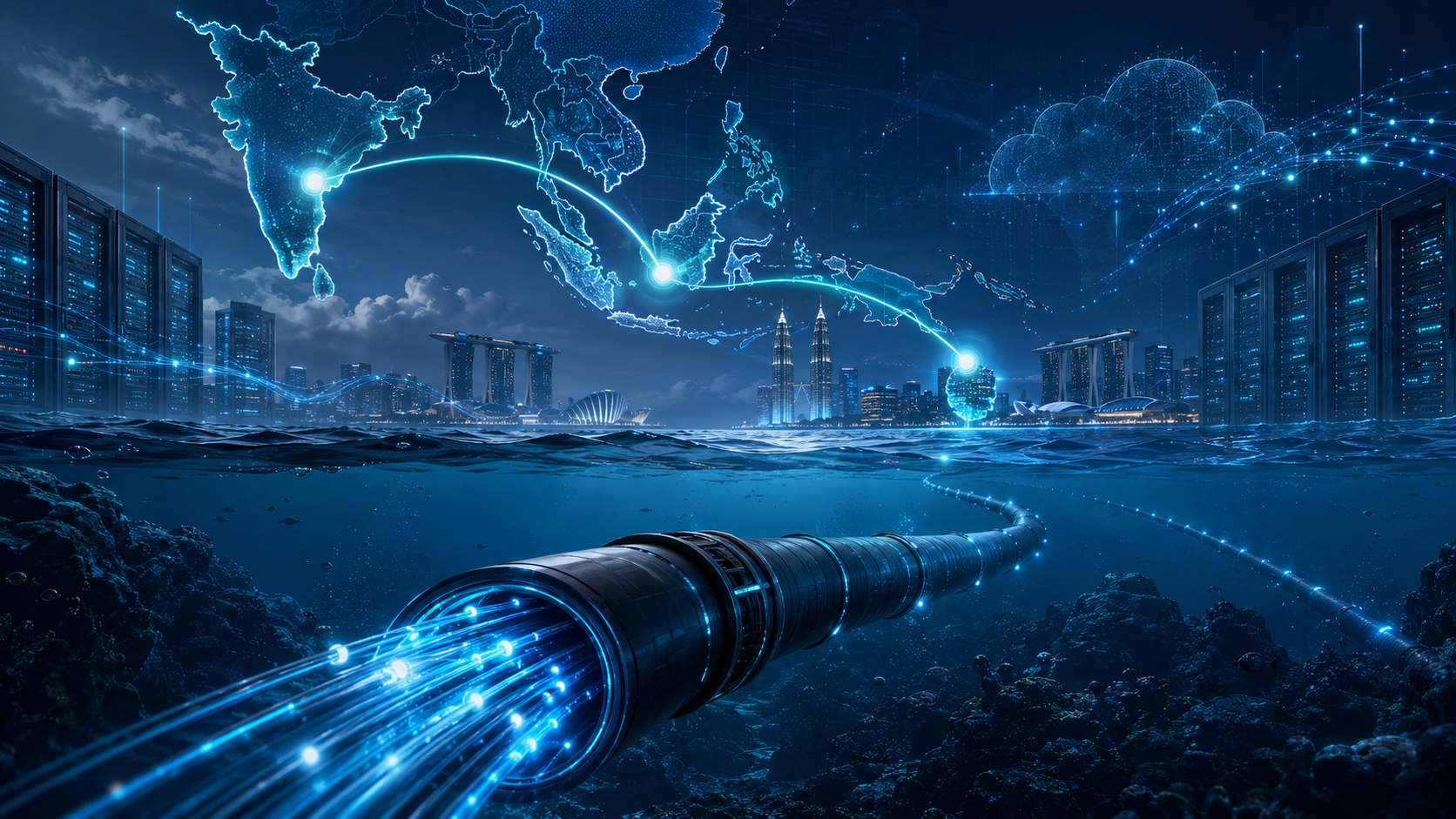
Lightstorm, Microsoft, Singtel and Tata Communications have announced plans to build a new cable linking India, Malaysia and Singapore. The system is designed to support the growing demand for AI, cloud, GPU infrastructure and hyperscale data workloads across the India–Southeast Asia corridor.
This may sound like infrastructure news for large technology companies. But the impact will eventually reach normal businesses too.
What Is I-2SEA?
I-2SEA stands for India–Southeast Asia.
It is a new submarine cable system that will connect India’s east coast to Singapore and Malaysia. According to Lightstorm, the system will link AI and data centre clusters in Hyderabad and Chennai to Singapore and Kuala Lumpur.
The cable is expected to span around 3,600 km and is targeted to be ready for service by Q4 2029.
The project also includes major industry players. Microsoft, Singtel and Tata Communications are part of the joint build agreement. NEC Corporation has been appointed as the system supplier, while ASEAN Cableship will handle marine installation work.
In simple words, this is not just another internet cable.
It is being built for the next stage of cloud computing.
Why AI Needs Better Connectivity
AI does not only depend on powerful chips.
It also depends on fast, stable and reliable connectivity.
When companies run AI workloads, they often need to move large amounts of data between data centres, cloud platforms and users. This includes training data, model output, backup data, logs, images, videos and business records.
If the network is slow, AI becomes slow.
If the connection is unstable, cloud services become harder to depend on.
If there are not enough routes between regions, businesses may face higher latency or weaker resilience.
This is why large technology companies are investing heavily in regional connectivity. AI workloads are no longer sitting in one location. They are spread across cloud zones, data centres and edge locations.
For Asia, this is especially important.
India is growing quickly as a digital and AI market. Singapore remains a major cloud and connectivity hub. Malaysia is becoming more important as a data centre and regional infrastructure location.
I-2SEA connects these three points directly.
Why This Matters for Malaysia
Malaysia is not just a passing point in this project.
It is part of the corridor.
That matters because Malaysia has been growing as a data centre and cloud infrastructure location. More cloud, AI and digital service demand will require stronger international connectivity.
For Malaysian businesses, this trend points to a bigger reality:
Cloud performance is no longer only about CPU, RAM and storage.
It is also about network route, latency, redundancy, data location and recovery design.
A company may have a powerful server, but if the connection between users, applications and data is weak, the experience will still suffer.
This affects many everyday business systems, including:
- Accounting systems
- ERP platforms
- Customer portals
- E-commerce websites
- Backup and disaster recovery platforms
- Video conferencing
- AI-powered customer service tools
- Remote desktop and cloud workspace environments
As more businesses depend on cloud applications, infrastructure quality becomes a business issue, not just an IT issue.
The Cloud Conversation Is Changing
A few years ago, many businesses asked simple questions about cloud hosting.
“How much storage do I get?”
“How many CPU cores are included?”
“How much is the monthly fee?”
Those questions are still important. But they are no longer enough.
Today, businesses need to ask better questions:
- Where is my data hosted?
- How stable is the network route?
- Is there redundancy if one connection fails?
- Can my backup be restored quickly?
- Does my cloud provider understand regional connectivity?
- Can the platform support future AI or data-heavy workloads?
The I-2SEA announcement is a reminder that cloud infrastructure is becoming more regional, more connected and more performance-driven.
For SMEs, this does not mean every business must start using AI immediately.
It means the foundation needs to be ready.
What Businesses Should Prepare For
Most SMEs do not need to manage submarine cables or hyperscale infrastructure directly.
But they do need to make better cloud decisions.
Here are five areas to review.
1. Review Where Your Workloads Are Hosted
If most of your customers are in Malaysia or Southeast Asia, hosting location matters.
A nearby data centre can often improve response time and user experience. It may also help with compliance, support and operational control.
2. Check Your Backup and Recovery Plan
Better connectivity helps, but it does not replace backup planning.
Businesses should still have clear backup retention, recovery point objective and recovery time objective planning. In simple terms, you need to know how much data you can afford to lose and how fast you need to recover.
3. Avoid Depending on One Single Point
Cloud systems should not depend on one server, one internet line or one location only.
As infrastructure becomes more connected, businesses should also think about redundancy. This may include offsite backup, secondary connectivity, disaster recovery or managed cloud failover.
4. Prepare for AI Workloads Slowly
Not every business needs advanced AI today.
But many will start using AI in smaller ways, such as document search, customer support, reporting, content generation or data analysis.
These tools will need clean data, secure access and stable cloud infrastructure.
5. Work With a Cloud Partner Who Understands the Business Impact
Infrastructure decisions should not be made based only on the cheapest monthly price.
A good cloud partner should be able to explain performance, security, backup, support, compliance and future scalability in practical business language.
The Bigger Picture
The I-2SEA cable will not change business operations overnight.
It is targeted for Q4 2029, so the impact will build over time.
But the direction is already clear.
Asia’s cloud infrastructure is becoming more important because AI, data centres and digital businesses are growing quickly across the region. Malaysia and Singapore are part of that growth path, not outside of it.
For business owners, the lesson is simple.
The future of cloud is not only about buying more resources.
It is about building a stronger foundation.
A stable cloud environment should support daily operations, protect business data, recover from disruption and scale when the business grows.
That is where infrastructure decisions become strategic.
Closing Thoughts
The new India–Malaysia–Singapore I-2SEA cable is a good reminder that digital infrastructure is becoming the backbone of modern business.
Customers expect systems to be fast. Teams expect access from anywhere. Business owners expect data to be safe. AI tools expect strong connectivity and reliable cloud platforms.
All of this depends on the foundation underneath.
For Malaysian businesses, now is a good time to review whether their current cloud setup is ready for the next stage of digital growth.
At Net Onboard, we help businesses build secure, reliable and scalable cloud environments through managed cloud hosting, backup, cybersecurity and business continuity solutions.
If your business is planning to modernise its IT infrastructure, improve cloud reliability or prepare for future AI-ready workloads, speak to our team today.