
Cloud computing may feel invisible.
A company opens a browser, logs into a platform and starts using computing resources almost immediately.
But the infrastructure behind that service is very physical.
Processors must be manufactured.
Memory must be packaged.
Storage devices must be assembled.
Server racks must be built.
Networking equipment must be tested.
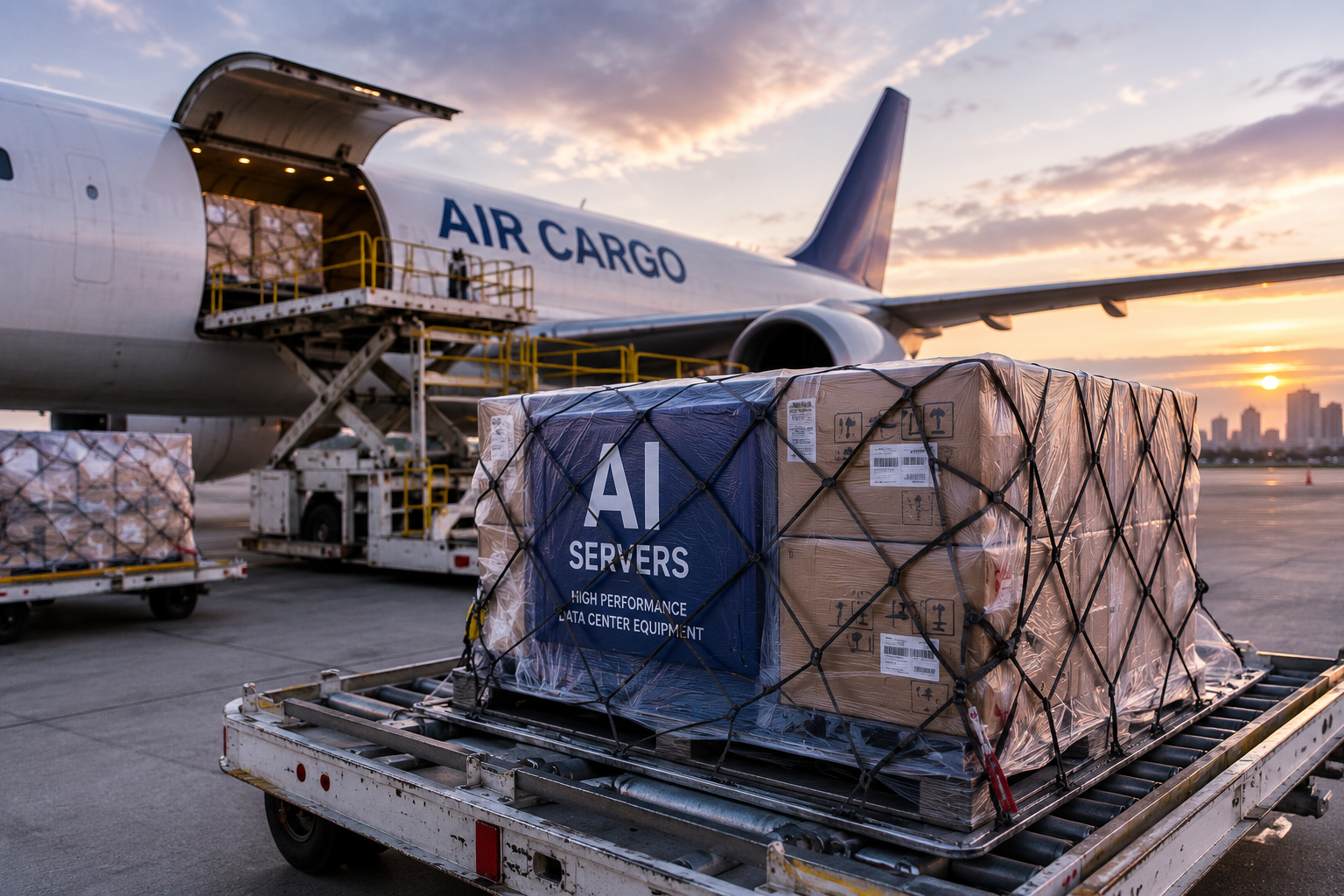
The finished hardware then needs to reach a data centre, often on the other side of the world.
Increasingly, that journey is happening by air.
Reuters reported on 29 July 2026 that the global AI infrastructure race is reshaping Asia’s air-cargo market. Airlines are adjusting their networks around semiconductor and server-manufacturing hubs as demand for low-value e-commerce parcels slows.
This may sound like an aviation story.
For businesses planning server upgrades, cloud infrastructure or AI projects, it is also a technology procurement story.
When valuable hardware competes for limited freight capacity, the effect can eventually appear in delivery schedules, equipment prices and supplier quotation terms.
What Is Changing in Asia’s Air-Cargo Market?
For several years, cross-border e-commerce was one of the strongest sources of air-freight growth.
Large numbers of low-cost consumer parcels moved from Asian factories and online marketplaces to customers in the United States and Europe.
That growth is now slowing.
Stricter import treatment for low-value goods in the United States and Europe has reduced some of the advantage previously enjoyed by cross-border e-commerce shipments.
At the same time, AI-related hardware demand is increasing.
Reuters reported that airlines are now carrying more:
- Advanced memory chips
- AI processors
- Graphics processors
- Semiconductor manufacturing equipment
- Complete server racks
- Data-centre infrastructure
- High-value electronic components
Korean Air provides one of the clearest examples. Its cargo revenue rose 46% in the second quarter to 1.54 trillion won, with the airline identifying AI chips, server racks and data-centre infrastructure as its main growth driver.
The products may be different, but the reason they travel by air is familiar.
Speed matters.
Why AI Hardware Is Usually Shipped by Air
Air freight is considerably more expensive than sea freight.
Businesses normally choose it when the value of faster delivery is greater than the additional transport cost.
AI hardware fits that requirement.
A shipment of advanced processors may be small enough to fit on a few pallets but valuable enough to be worth millions of dollars.
A delayed shipment can also affect much more than the equipment itself.
For example, a data-centre project may already have:
- Racks installed
- Power capacity reserved
- Cooling systems prepared
- Engineers scheduled
- Customers waiting
- Software deployment dates committed
- Construction contractors completing final work
If the processors, memory or networking equipment arrive late, the whole project may be delayed.
That makes the air-freight premium easier to justify.
Reuters reported that AI-related products represented only around 7% of total air-cargo volume in 2025 but 53.5% of the value carried. The contrast reflects how compact, expensive and time-sensitive these shipments can be.
IATA also expects air cargo to remain important for high-value and time-sensitive products, particularly semiconductors. It forecasts 6% cargo traffic growth for Asia-Pacific in 2026, compared with 2.6% for the global industry.
AI Hardware Requires Different Handling
A box of clothing and a rack full of servers do not present the same transport risk.
High-value technology shipments may be vulnerable to:
- Shock and vibration
- Static electricity
- Moisture
- Temperature changes
- Mishandling
- Theft
- Incorrect stacking
- Delayed customs clearance
- Inadequate insurance
Some semiconductor equipment is highly sensitive and difficult to replace quickly.
A complete server rack may contain processors, memory, storage, switches, cables and other components that have already been configured for a particular project.
If the equipment is damaged, the customer may not be able to purchase an identical replacement immediately.
Reuters reported that airlines and logistics providers are changing their cargo-handling processes for delicate semiconductor equipment, GPUs and complete server racks. Cathay Pacific, for example, has introduced software to determine how sensitive technology cargo should be loaded and secured inside aircraft.
This is an important reminder for hardware buyers.
Delivery is not complete when the equipment leaves the supplier.
The shipping method, insurance, packaging and receiving process also matter.
Asia’s Technology Trade Routes Are Changing
AI hardware does not come from one country.
The supply chain is spread across Asia.
Different locations play different roles.
Japan is a major source of semiconductor manufacturing equipment.
South Korea produces advanced memory.
Taiwan remains central to leading-edge semiconductor manufacturing.
Southeast Asian countries are becoming more important for server production, assembly, testing and supporting components.
Reuters identified Vietnam, Malaysia, Thailand and Singapore as increasingly important manufacturing and assembly hubs for AI servers headed to North America and Europe.
Airlines are adjusting their routes around these flows.
Japan Airlines has expanded freighter services connecting technology hubs such as Taipei, Bangkok and Hanoi with Tokyo’s Narita Airport. China Airlines has added Southeast Asian cargo flights, while EVA Air said AI-related shipments now account for as much as half of its cargo revenue.
For Malaysia, this trend is relevant in two ways.
Malaysia participates in the regional electronics and server supply chain.
Malaysian businesses are also buyers of the same processors, storage, firewalls and server components being shipped to much larger global projects.
When demand increases sharply elsewhere, local buyers may experience longer lead times even when purchasing only one or two units.
Why a Large Global Order Can Affect a Smaller Buyer
A business purchasing one server may assume that hyperscale AI projects have little connection to its order.
In reality, both buyers may depend on the same component suppliers.
A large AI data-centre project may consume significant quantities of:
- Enterprise SSDs
- High-capacity memory
- Power supplies
- Network switches
- Fibre modules
- Rack equipment
- Cooling components
- CPUs and GPUs
Manufacturers usually prioritise production according to contracts, volume commitments and available capacity.
When major customers place multi-year orders, smaller buyers may face:
- Longer manufacturing lead times
- Fewer immediately available configurations
- Higher prices for selected components
- Shorter quotation-validity periods
- More frequent model substitutions
- Higher freight charges for urgent delivery
This does not mean every server or firewall will become difficult to obtain.
The effect depends on the model, manufacturer and component.
However, businesses should avoid assuming that hardware will always be available at the same price with immediate delivery.
A Quotation Is Not the Same as Reserved Stock
This is one of the most important points for hardware buyers.
Receiving a quotation does not always mean the equipment has been reserved.
A distributor may prepare a quotation based on:
- Current supplier inventory
- Estimated incoming stock
- Current exchange rate
- Current freight charges
- Manufacturer pricing
- Distributor allocation
If the customer waits several weeks before confirming, any of those conditions may change.
The stock may be sold to another buyer.
The manufacturer may change pricing.
The exchange rate may move.
The distributor may receive a revised delivery date.
This is why hardware quotations often have a limited validity period.
For equipment affected by tight supply, customers should also ask whether the quotation refers to:
- Physical stock currently available
- Stock allocated but not yet received
- An estimated supplier lead time
- A special-order item
- A substitute or equivalent model
The answer affects how confidently the business can plan its deployment date.
How Businesses Should Plan Hardware Purchases
A better procurement process begins before requesting the quotation.
1. Define the Actual Workload
Do not begin with a preferred server model.
Begin with what the server needs to do.
Document:
- Applications to be hosted
- Number of users
- CPU requirement
- Memory requirement
- Storage capacity
- Storage performance
- Network requirement
- Backup requirement
- Expected growth
- Required operating system
- Availability requirement
This gives the supplier enough information to recommend an alternative if the original configuration is unavailable.
2. Separate Mandatory and Preferred Requirements
Some requirements are fixed.
Others may be flexible.
For example, the business may require:
- At least 16 processor cores
- At least 64GB RAM
- RAID 1 for the operating system
- Four terabytes of usable storage
- A specific warranty period
The exact processor model or SSD brand may be less important.
Separating mandatory requirements from preferred specifications makes it easier to find an acceptable alternative without redesigning the whole project.
3. Confirm the Stock Position
Ask the supplier to state clearly whether the equipment is:
- Ready stock
- Incoming stock
- Build-to-order
- Subject to manufacturer allocation
- Available only after payment
- Estimated rather than confirmed
Do not plan installation based only on a product being listed in a catalogue.
4. Check the Complete Lead Time
Delivery time is more than freight transit time.
The full timeline may include:
- Order processing
- Credit approval
- Manufacturer assembly
- Distributor allocation
- International shipping
- Customs clearance
- Local delivery
- Configuration
- Testing
- Installation
A supplier saying that air freight takes three days does not mean the server will be ready in three days.
5. Include a Buffer
Avoid scheduling the old server’s shutdown for the same day the new hardware is expected to arrive.
A safer plan allows time for:
- Physical inspection
- Firmware updates
- Burn-in testing
- Operating-system installation
- Network configuration
- Backup configuration
- Application migration
- User testing
- Rollback
Even when the delivery arrives on time, deployment work may uncover an unexpected issue.
6. Agree on Acceptable Alternatives
Before placing the order, discuss what can be substituted if necessary.
Possible alternatives may include:
- A newer processor generation
- A different approved SSD model
- Higher-capacity memory modules
- A similar firewall appliance
- A different chassis
- A temporary cloud server
Any substitution should still meet the technical and warranty requirements.
Do not accept a replacement merely because it is available.
7. Confirm Warranty and Local Support
Imported hardware may be cheaper but difficult to support.
Check:
- Warranty location
- Replacement procedure
- Expected turnaround
- Whether onsite support is included
- Whether the serial number is recognised locally
- Whether spare parts are available
- Who handles the warranty claim
A low purchase price may not be worthwhile if a failed component takes weeks to replace.
When Cloud Can Reduce Hardware-Delivery Risk
Physical infrastructure is not always the only option.
A temporary or permanent cloud server may help when hardware lead times do not match the project schedule.
For example, a company may:
- Deploy the application on cloud infrastructure first.
- Begin testing and user onboarding.
- Receive and configure the physical server later.
- Migrate the application when the environment is ready.
This can reduce project delay.
However, the cloud environment must be designed properly.
The business still needs to consider:
- Monthly cost
- Storage performance
- Data transfer
- Security
- Backup
- Licensing
- Migration effort
- Hosting location
- Long-term scalability
A temporary cloud deployment can become expensive if it continues for much longer than planned.
The company should decide in advance whether the cloud environment is temporary, permanent or part of a hybrid design.
When Dedicated Hardware May Still Be Better
Cloud is not automatically the best answer.
Dedicated hardware may make more sense when the workload requires:
- Predictable long-term cost
- Consistent physical resources
- Large local storage capacity
- Special hardware
- USB device passthrough
- High sustained performance
- Specific licensing
- Strict infrastructure control
- Long-term continuous operation
The right choice depends on the workload.
A delayed physical server may justify temporary cloud capacity.
It does not automatically justify moving the entire project permanently to the cloud.
Will Higher Air-Cargo Demand Increase Server Prices?
Possibly, but not by itself.
Server pricing depends on several factors:
- Processor cost
- Memory cost
- Storage cost
- Manufacturer availability
- Exchange rates
- Distributor margin
- Freight
- Insurance
- Customs and taxes
- Warranty
- Local installation
Air freight is only one part of the final price.
A compact shipment of processors may have a high value but a relatively small freight cost compared with the hardware itself.
A full rack or several large servers may experience a more noticeable logistics cost.
The greater risk may be availability rather than freight.
When a component is urgently required and standard shipping cannot meet the deadline, the buyer may need to pay more for expedited delivery or accept a different configuration.
Why Businesses Should Avoid Last-Minute Procurement
Emergency hardware purchases usually reduce the buyer’s options.
The business may have to accept:
- Whatever model is available
- Higher freight charges
- Shorter testing time
- Less favourable pricing
- A weaker warranty arrangement
- A configuration that is difficult to expand
- Greater migration risk
Technology procurement should be linked to the company’s capacity plan.
Management should know when important systems are approaching limits.
Warning signs may include:
- Memory frequently above 80%
- Storage nearing capacity
- Unsupported operating systems
- Expiring warranties
- Slow reporting
- Increasing backup windows
- Repeated hardware errors
- No spare capacity for growth
Replacing equipment before it becomes an emergency normally provides better pricing and a safer deployment.
Should Businesses Buy Hardware Early?
Sometimes.
Buying earlier may be sensible when:
- The project is approved
- The specification is stable
- The deployment date is known
- The equipment has a long lead time
- The warranty does not begin too early
- Storage and security are available
- The hardware will not become obsolete before use
Buying equipment purely because shortages might occur is less advisable.
Unused hardware can create its own problems.
Technology changes.
Warranty periods continue.
Project requirements change.
Equipment may need secure storage.
The better approach is planned procurement rather than speculative purchasing.
Delivery Insurance and Inspection Matter
High-value technology equipment should be insured appropriately during delivery.
The receiving team should also inspect the shipment before accepting it as fully complete.
Check for:
- Damaged packaging
- Signs of water exposure
- Broken seals
- Bent chassis
- Missing accessories
- Incorrect part numbers
- Wrong memory or storage configuration
- Serial-number mismatch
Photograph the packaging and hardware when necessary.
Report visible damage immediately.
Do not wait until the installation date if the equipment arrived several days earlier.
Carrier and insurance claims often have notification deadlines.
Hardware Should Be Tested Before Production Use
New equipment should not move directly from the delivery box into production.
A basic acceptance process may include:
- Verifying the specification
- Checking firmware
- Testing memory
- Testing storage
- Confirming RAID status
- Reviewing hardware logs
- Testing network interfaces
- Running a burn-in test
- Updating the operating system
- Confirming warranty registration
The test period gives the technical team an opportunity to identify faults before customer data or production workloads are involved.
This becomes especially important when the hardware has travelled through several logistics hubs.
The Wider Air-Cargo Outlook
IATA expects air-cargo demand to grow by 2.6% globally in 2026, with Asia-Pacific leading regional growth at approximately 6%. The organisation expects semiconductor demand, supply-chain uncertainty and the need for reliable delivery to continue supporting the market.
Cargo revenue is forecast to reach approximately $158 billion in 2026. IATA also expects capacity constraints and demand for time-sensitive goods to keep freight yields above pre-pandemic levels.
Reuters reported that Taiwan’s Taipei air-cargo hub reached capacity in July as AI and semiconductor shipments filled available space. Freight capacity remained tight on some routes to the United States and within Asia.
This does not mean every route will face the same pressure.
But it shows that AI infrastructure investment is affecting much more than chipmakers and cloud providers.
It is changing the movement of goods across the region.
What Management Should Ask Before Approving a Hardware Order
Management does not need to understand every server component.
It should understand the business risk.
Before approving a major purchase, ask:
- Is the specification based on measured requirements?
- Is the item physically available?
- Is the delivery date confirmed or estimated?
- How long is the quotation valid?
- What happens if the model becomes unavailable?
- Is an alternative configuration approved?
- Does the price include freight and delivery?
- Where is the warranty supported?
- Has installation time been included?
- Is backup ready before migration?
- Is there a rollback plan?
- Can temporary cloud capacity reduce project risk?
These questions help prevent the hardware purchase from becoming the weakest part of the project.
The Bigger Lesson
The AI boom is often discussed in terms of software.
Chatbots.
Automation.
Analytics.
Coding assistants.
Behind all of them is a physical supply chain.
A model cannot run without processors.
Processors cannot work efficiently without memory.
Servers need storage, networking, power and cooling.
All of that equipment must be manufactured and delivered.
Asia sits at the centre of much of this supply chain.
The shift from e-commerce parcels to high-value AI hardware shows how quickly technology demand can reshape an entirely different industry.
For businesses, the lesson is straightforward.
Hardware procurement should not be treated as a simple administrative purchase.
It is part of project planning, risk management and business continuity.
Closing Thoughts
AI chips, server racks and data-centre equipment are becoming some of the most valuable products moving through Asia’s air-cargo network.
Airlines are changing routes and cargo processes around semiconductor and server-manufacturing hubs. Korean Air says AI infrastructure has overtaken Chinese e-commerce shipments as its main cargo growth driver, while technology products are accounting for a growing share of freight across Taiwan, Japan, South Korea and Southeast Asia.
For businesses buying technology, this change may appear in practical ways:
Longer lead times.
Shorter quotation validity.
Higher urgent-delivery charges.
More model substitutions.
Tighter supply of selected components.
The answer is not to panic or purchase unnecessary hardware.
The answer is to plan earlier.
Define the workload.
Confirm stock.
Allow time for testing.
Agree on alternatives.
Review warranty support.
Prepare backup and rollback.
Consider temporary cloud capacity when physical delivery cannot meet the project schedule.
At Net Onboard, we help businesses plan and deploy cloud, dedicated-server, colocation, backup and managed infrastructure solutions based on practical performance and continuity requirements.
A successful infrastructure project does not begin when the hardware arrives.
It begins with a realistic plan for specification, procurement, delivery, testing, migration and recovery.