

Azure AI Foundry, AWS Bedrock, and Google Vertex AI all run production workloads for enterprises today. All three market themselves as the obvious choice. None of them actually is for every business.
The right pick usually tracks which cloud a business already runs for its core systems, which models the workload needs, and how Malaysia data residency plays into the compliance story. This article walks through the real differences, the pricing cliffs that surprise finance teams, and when a multi-cloud AI setup earns its complexity.
What an AI Cloud Platform Actually Provides
An AI cloud platform is more than a model you can call. It bundles a model catalogue, inference infrastructure, agent and fine-tuning tooling, guardrails, data connectors to your existing systems, and identity controls that fit your organisation. Each platform wraps all of that in its own developer surface.
The practical implication: switching between platforms is an identity, data, and governance project, not a model swap. Which is why the choice matters.
The Three Platforms Side by Side
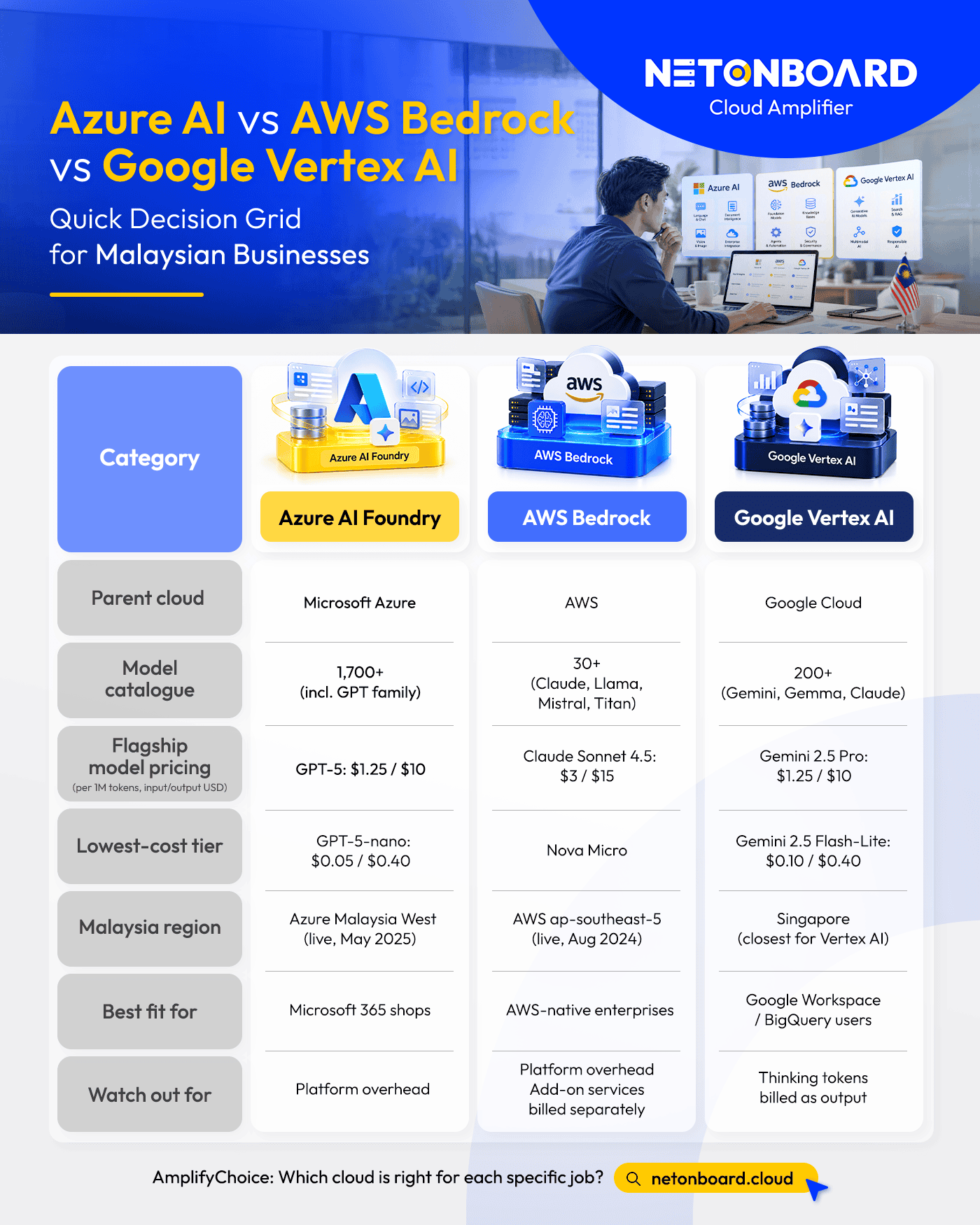
Azure AI Foundry. Microsoft’s platform offers the broadest catalogue, with over 1,700 models including exclusive access to the GPT family. Identity runs on Microsoft Entra ID, governance on Microsoft Purview, and the whole stack integrates deeply with Microsoft 365. It fits businesses already running Microsoft workloads, which includes most Malaysian enterprises on Office 365 and Dynamics.
AWS Bedrock. Amazon’s platform runs 30-plus foundation models through one API, with strong Anthropic Claude access. Identity sits in AWS IAM, governance in CloudTrail and Macie. It fits businesses already on AWS, particularly those with heavy data in S3 or workloads in RDS.
Google Vertex AI. Google’s platform leads on Gemini, Gemma, and multimodal capabilities, with Claude available through partnership. It integrates with BigQuery and Google Workspace. It fits engineering-led organisations already running on Google Cloud, and typically prices lowest on the Flash tier for high-volume inference.
Pricing and the Cost Cliffs in the Fine Print
All three run pay-per-token pricing. Between platforms, the spread on comparable models is small, usually within a 0-10% band. Within one platform, the gap between the cheapest and most expensive model is the real decision point, often a 50- to 100-fold difference.:
- Azure AI Foundry – GPT-5: USD 1.25 / USD 10. GPT-5-nano down at USD 0.05 / USD 0.40 for cost-sensitive workloads.
- AWS Bedrock – Claude Sonnet 4.5: USD 3 / USD 15. Matches Anthropic’s direct API pricing.
- Google Vertex AI – Gemini 2.5 Pro: USD 1.25 / USD 10. Flash-Lite at USD 0.10 / USD 0.40 for high-volume inference.
Two cliffs catch unprepared teams:
- Long-context input doubles: Gemini 2.5 Pro’s input pricing doubles above the 200,000 token mark, which a long-document retrieval pipeline can trip on every request.
- Reasoning tokens billed as output: Vertex AI’s reasoning models bill internal “thinking” tokens as output, so a 500-word answer after 4,000 tokens of reasoning charges for 4,500 output tokens.
Source: Pricing per million tokens input/output, as of October 2026.
Malaysia Data Residency and PDPA Questions
Data residency is a region question, not a platform question. All three platforms support restricting model inference to specific regions, but the practical in-country options for Malaysia differ:
- AWS Asia Pacific (Malaysia), ap-southeast-5: opened on 22 August 2024, backed by a USD 6 billion investment. Bedrock workloads can run entirely in-country.
- Microsoft Malaysia West: Azure region launched in May 2025, backed by USD 2.2 billion. Azure AI Foundry workloads can be restricted to this region for inference and data storage.
- Google Vertex AI: no in-country Malaysia region. The nearest primary region remains Singapore.
Four PDPA questions to put to any provider before signing:
- Where does training data sit? Covers both model training and any fine-tuning you upload.
- Where does inference run? Decides whether live queries leave Malaysian borders.
- Where do logs live? Logs often sit in a different region to inference and carry the same residency obligations.
- Who in the provider’s organisation can read either? Access controls on the provider side matter as much as yours.
The 2024 PDPA amendments require 72-hour breach notification from awareness, which means monitoring and audit trails must be in place before go-live.
When Multi-Cloud AI Makes Sense (and When It Just Adds Cost)
A multi-cloud AI setup makes sense when workloads need different models and the gain outweighs the integration cost. A business using Azure AI Foundry for GPT-driven document processing, Bedrock for Claude-driven coding assistants, and Vertex AI for Gemini-driven multimodal search is placing each workload where it fits.
Multi-cloud adds cost when teams use it to hedge against lock-in without a workload reason. Duplicate identity systems. Separate billing. Different observability stacks. The integration tax is real and often cancels any model-price savings. The right call is workload-by-workload placement, not a blanket vendor hedge.
Which AI Cloud Platform Fits Which Scenario?
Short answer: start where your business already runs. If finance and operations live in Microsoft 365, Azure AI Foundry is the lowest-friction build. If engineering already runs on AWS with data in S3, AWS Bedrock wins on integration. If the business is Google Workspace native with BigQuery as the data warehouse, Vertex AI is the natural pick.
The multi-cloud choice comes later, once a specific workload needs a model the primary platform cannot deliver cost-effectively.
Picking an AI cloud platform is the first step. Sizing the token spend, matching regions to PDPA obligations, and avoiding spend sprawl across multiple vendors is the harder part. Before standardising on any one platform, review our guide on how to escape cloud vendor lock-in in Malaysia to pressure-test your long-term flexibility.
Speak to the Net Onboard team if you are weighing Azure AI against AWS Bedrock for a specific workload, if PDPA data residency is driving the decision, or if the business already runs on more than one cloud and nobody has agreed where the AI builds should land.
Net Onboard’s AmplifyChoice team maps workloads against platforms, sizes the cost for your actual token volume, and configures identity and residency to meet PDPA from day one. Book a consultation to plan a multi-cloud strategy in Malaysia that places each workload where it belongs and keeps the governance story clean.