

Look up the world’s largest cloud provider, and AWS is bound to appear. With over 200 fully featured services and operations across 36 geographic regions, AWS holds roughly 29-31% of the global infrastructure market, which is significant because it provides the broadest set of tools for building, running, and scaling enterprise workloads.
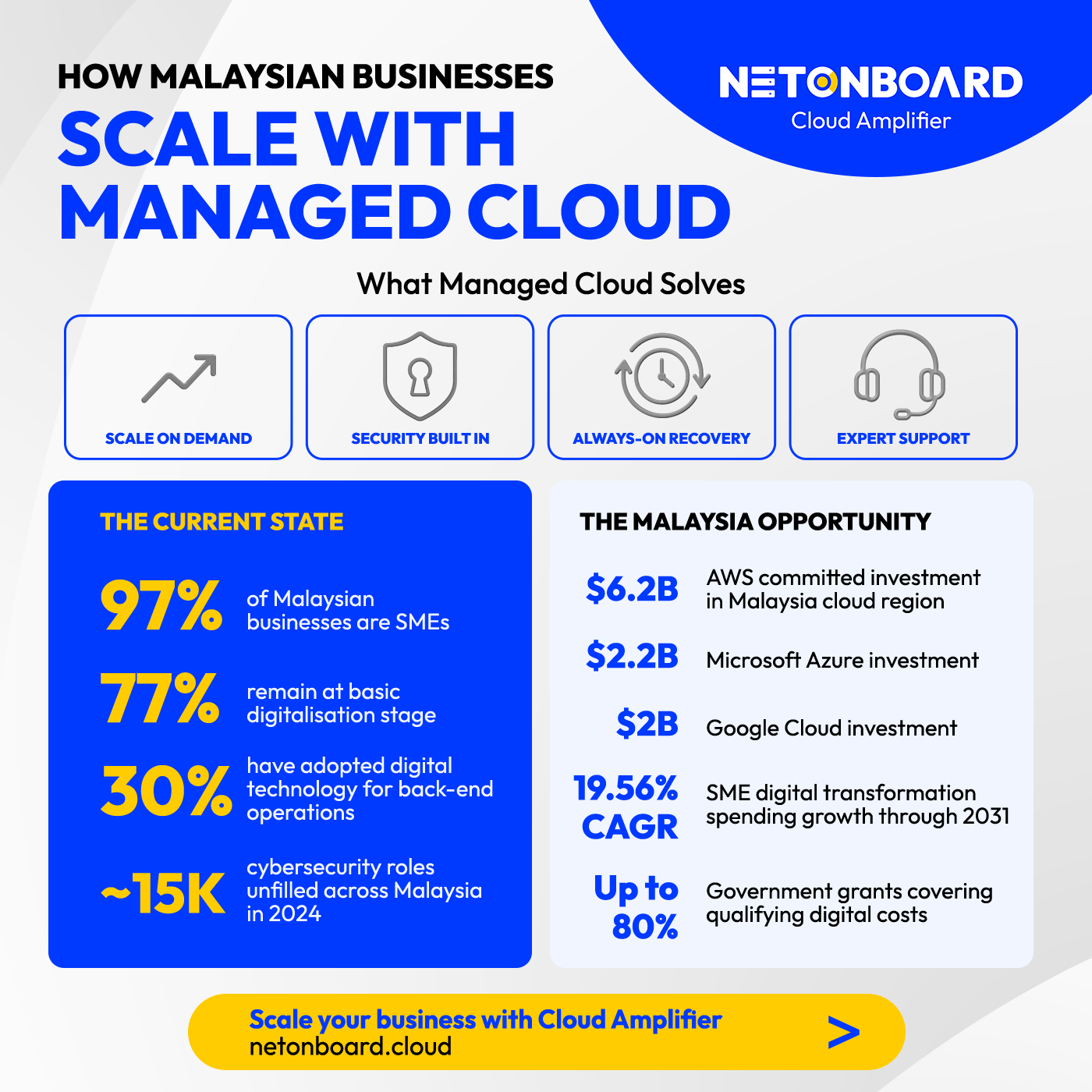
For Malaysian enterprises, the picture got significantly better in August 2024, when AWS launched its Asia Pacific (Malaysia) Region with three availability zones and a committed USD 6.2 billion investment through 2038. That means local data residency, lower latency, and direct access to the same infrastructure that global enterprises have relied on for years.
So why do enterprises choose AWS for cloud infrastructure? It comes down to breadth, flexibility, and a platform that doesn’t force you into a single way of doing things.
What Makes AWS Different at Enterprise Scale
The core reason enterprises gravitate towards AWS Enterprise Cloud Infrastructure in Malaysia is its broad service portfolio. Where other platforms might offer a strong set of tools in specific areas, AWS covers virtually every category: compute, storage, databases, networking, analytics, machine learning, IoT, security, and developer tools.
For enterprises, this means a few things:
- Widest range of compute options. From general-purpose EC2 instances to Graviton-based processors for cost-optimised workloads, GPU instances for AI training, and Lambda for serverless architecture. Enterprises can match each workload to the exact compute type it needs.
- Container and microservices leadership. Amazon EKS (Kubernetes), ECS, and Fargate give enterprises flexible options for containerised workloads. This is significant for businesses modernising legacy applications into microservices.
- Mature ecosystem. AWS has the largest partner network and third-party integration library of any cloud provider. Enterprise software from SAP, MongoDB, Red Hat, and others runs natively on AWS with well-documented deployment patterns.
- Pay-as-you-go flexibility. Spot instances, reserved capacity, and savings plans let enterprises optimise costs based on workload predictability. Variable workloads mean you pay only for what you use, while stable workloads allow you to lock in discounts.
AWS Now Runs Locally in Malaysia
The AWS Asia Pacific (Malaysia) Region operates from Kuala Lumpur with three availability zones and over 200 services available locally. AWS estimates the region will contribute USD 12.1 billion to Malaysia’s GDP and support 3,500+ full-time jobs annually through 2038.
Early adoption has been strong, with Maxis having migrated core telecom operations to the local region in early 2026, validating that it can handle enterprise-scale workloads. Other Malaysian organisations on the platform include Bursa Malaysia, PayNet, CelcomDigi, PETRONAS, Tenaga Nasional, Pos Malaysia, and GXBank, alongside startups like Carsome and Aerodyne.
AWS also signed a Cloud Framework Agreement with the Malaysian government to accelerate public-sector adoption and has trained over 100,000 Malaysians in cloud skills since 2017.
For businesses evaluating AWS for enterprise workloads in Malaysia, the local region eliminates the need to route traffic through Singapore, reducing latency and data residency concerns.
Where AWS Fits (and Where It Doesn’t)
AWS is a strong default for many enterprise workloads, but that doesn’t mean every application belongs there. It tends to be the best fit for:
- Variable or unpredictable workloads that benefit from elastic scaling
- Containerised and serverless applications using EKS or Lambda
- Data-intensive operations requiring specialised storage and compute
- Multi-cloud architectures where AWS serves as the primary infrastructure layer.
Enterprises that are deeply embedded in the Microsoft ecosystem (Office 365, Active Directory, SQL Server) often find Azure’s integration advantages more valuable. Meanwhile, data analytics and ML research projects sometimes perform better on Google Cloud’s BigQuery and Vertex AI.
Decisions about which is the best scalable cloud platform for large businesses should all start with understanding what each workload actually needs.
Choosing the Right Partner for AWS
AWS’s breadth is its biggest strength, but it also creates complexity. With 200+ services, multiple pricing models, and configuration options that vary by workload, getting the architecture right from the start saves you high cost and rework down the line.
Through Net Onboard’s AmplifyChoice framework, you get a structured workload assessment that determines which applications belong on AWS, how to size and configure them, and where other platforms might be a better fit. This includes optimising reserved capacity, rightsizing instances, and planning disaster recovery within the Malaysia region.
Build Your Enterprise on the Right Cloud Platform
AWS gives enterprises the broadest service catalogue, the most mature ecosystem, and now local infrastructure in Malaysia. It’s a strong platform to build on when you have workloads that need elastic scaling, deep compute flexibility, and a wide partner network. But that’s provided you have the right partner to help you leverage its strengths.
At Net Onboard, our AmplifyChoice framework helps businesses assess and implement AWS alongside other platforms, ensuring every workload of yours runs where it performs best.for its specific requirements. business grows.
If you’re evaluating AWS cloud services in Malaysia for your enterprise, talk to our team at Net Onboard today to learn more about AmplifyChoice and how it can benefit your business.