
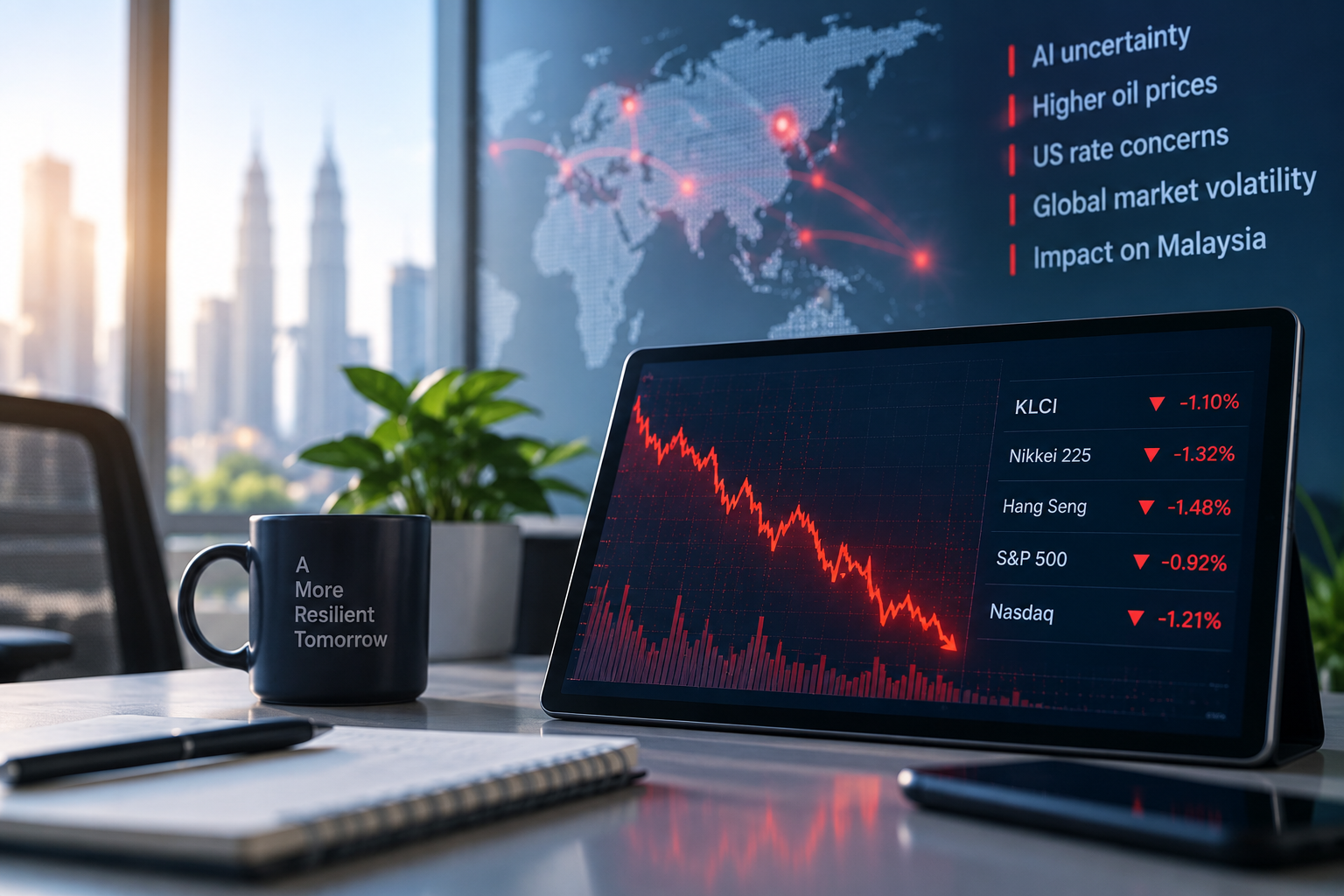
Why Malaysia’s Market Fell
Malaysia may not be home to companies such as NVIDIA or OpenAI, but global AI sentiment still affects our market.
Asian technology stocks came under selling pressure after several leading AI executives raised concerns about how quickly frontier AI technology is developing.
That caused investors to become more cautious about companies benefiting from the AI investment boom.
At the same time, oil prices remained elevated and US Treasury yields increased, creating additional uncertainty for global markets.
Malaysia was not immune.
The FBM KLCI closed 1.1% lower at 1,679.21, with 780 declining stocks compared with just 355 gainers.
The Ringgit Was Also Under Pressure
The impact was not limited to stocks.
The Malaysian ringgit weakened by nearly 0.2% to around RM4.08 against the US dollar, reaching its weakest level in about a month.
One reason is higher US interest-rate expectations.
When US interest rates rise, investors can receive better returns from US-dollar assets.
That can pull money away from emerging markets and strengthen the dollar against currencies such as the ringgit.
Why Oil Prices Matter to Malaysia
Malaysia is an oil and gas producer, so higher energy prices can provide additional government and Petronas-related revenue.
But expensive oil can also increase:
- Transportation costs
- Electricity and operating expenses
- Manufacturing costs
- Inflation
- Business financing pressure
So the effect is mixed.
Energy companies may benefit, while businesses that consume large amounts of fuel or electricity can face higher costs.
This is particularly important as Malaysia expands energy-intensive sectors such as data centres, cloud computing and advanced manufacturing.
Is the AI Boom Ending?
Not necessarily.
The recent market reaction is mainly about uncertainty over how quickly AI development and investment will continue.
Businesses are still spending heavily on:
- AI servers
- Semiconductors
- Cloud computing
- Data centres
- Cybersecurity
- AI software
But investors are beginning to ask whether every company benefiting from the AI boom can justify its current valuation.
That creates more volatility.
Why This Matters to Malaysian Businesses
Even companies that do not invest in the stock market can eventually feel these changes.
A weaker ringgit can make imported technology more expensive.
That can affect the cost of:
- Servers
- Networking equipment
- Cybersecurity hardware
- Software licences priced in USD
- Cloud services
- Semiconductor components
For Malaysian technology companies, currency movements can therefore directly affect project costs and selling prices.
Closing Thoughts
The current market movement shows how closely Malaysia is connected to the global technology economy.
Concerns about AI companies in the US can quickly affect Asian markets.
Higher oil prices can affect Malaysian operating costs.
And US interest-rate decisions can move the ringgit.
For Malaysian businesses, AI is therefore no longer only a technology story.
It is increasingly becoming an investment, currency and business-cost story too.