
Malaysia Wants to Become an AI Builder
Malaysia has spent the past few years attracting cloud infrastructure, data centres, semiconductor investment and global technology companies.
But building infrastructure is only the beginning.
The next question is:
What will Malaysia build on top of it?
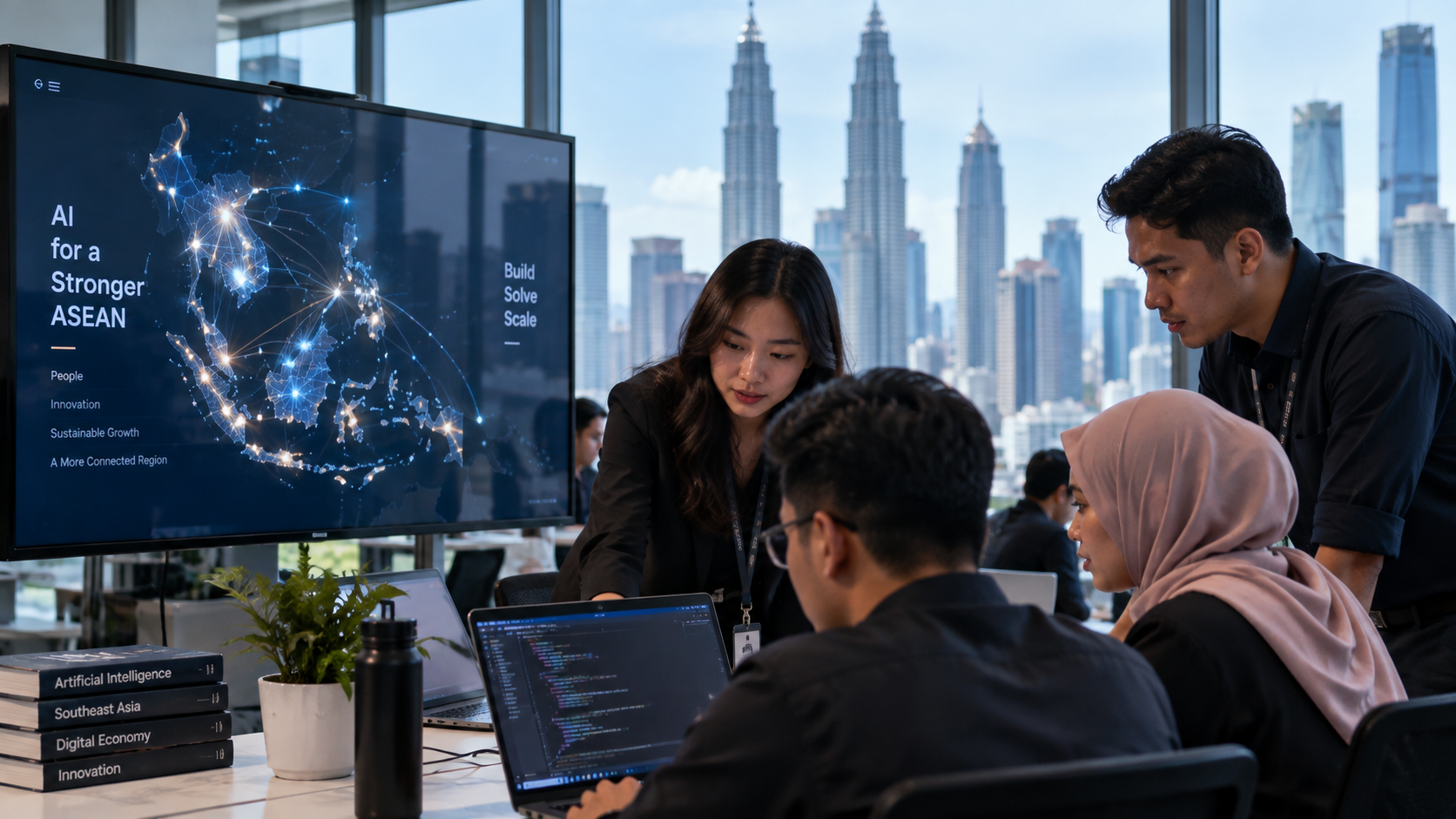
Speaking at M360 ASEAN 2026 in Kuala Lumpur, Deputy Communications Minister Teo Nie Ching said Malaysia needs to move beyond simply consuming artificial intelligence technology.
Instead, the country needs to create an environment where Malaysian corporations, SMEs and startups can develop, deploy and scale their own AI solutions — not only for Malaysia, but potentially across ASEAN.
That represents an important shift.
Using AI is becoming normal.
Creating commercially valuable AI technology is much harder.
AI Adoption Alone Is Not Enough
Today, almost any company can subscribe to an AI service.
Employees can use AI to write documents, analyse information, generate images, assist with coding or automate repetitive work.
That can improve productivity.
But if Malaysian businesses only consume AI services created elsewhere, much of the economic value generated by the technology ultimately remains outside the country.
Malaysia therefore wants to move further up the value chain.
Instead of asking only:
“How can Malaysian companies use AI?”
The bigger question becomes:
“What AI products can Malaysian companies create?”
That could include AI applications for manufacturing, financial services, agriculture, healthcare, cybersecurity, logistics, government services and many other industries.
Malaysia’s National AI Action Plan specifically identifies locally developed “Made by Malaysia” AI solutions as part of the country’s long-term strategy.
But AI Needs Infrastructure Behind It
Building AI applications still requires a strong technological foundation.
Teo highlighted several components Malaysia needs:
- Reliable connectivity
- Computing capacity
- Cloud infrastructure
- Data infrastructure
- Intelligent networks
- Resilient networks
- Secure digital systems
Malaysia already has a strong connectivity base.
Internet coverage in populated areas reached 99.75% as of 31 July 2026 under JENDELA, while continued 5G deployment and additional submarine cable capacity are strengthening the country’s digital infrastructure.
This matters because AI does not operate independently.
An AI application may depend on cloud computing, databases, APIs, cybersecurity, high-speed networks and powerful computing infrastructure working together.
The AI application may be what users see.
But a large technology stack sits behind it.
Cloud Computing Becomes Even More Important
Many Malaysian SMEs will never own thousands of GPUs.
They don’t need to.
Cloud computing makes advanced computing resources available without businesses having to purchase and maintain all of the underlying hardware themselves.
A Malaysian startup could therefore build an AI service using cloud infrastructure, develop its own application layer and eventually offer that service to customers across Southeast Asia.
This is one reason Malaysia’s AI ambitions are closely connected with its rapidly expanding cloud and digital infrastructure ecosystem.
Cloud infrastructure can effectively lower the barrier for smaller companies to develop sophisticated technology.
But access alone is not enough.
Businesses still need engineers, developers, data specialists, cybersecurity professionals and people who understand how to convert AI capabilities into commercially useful products.
The National AI Plan Has 28 Initiatives
Malaysia’s National AI Action Plan 2026–2030 is intended to coordinate this transition.
According to AI Malaysia, the roadmap consists of 28 national initiatives.
They are divided into:
- 14 sector-focused Impact Engines
- 14 supporting Foundation Enablers
The foundation areas include talent, research, data and computing capacity, governance and sustainable financing.
The plan targets sectors including healthcare, manufacturing, financial services, public services and smart cities.
Rather than treating AI as a standalone technology industry, the strategy aims to spread AI capabilities across the wider economy.
Malaysia Is Targeting Up to 500,000 AI-Related Jobs
The targets are ambitious.
AI Malaysia says the national plan aims to create approximately 300,000 to 500,000 AI-related jobs while contributing an additional 0.8 to 1.2 percentage points to GDP growth each year.
That translates to an estimated RM13 billion to RM20 billion annually.
Malaysia also aims to reach the top 20 globally in AI readiness by 2028 and the top 10 by 2030.
Achieving those targets will require much more than simply encouraging employees to use AI assistants.
Malaysia needs people capable of developing, deploying, managing and securing AI systems.
SMEs Could Be One of the Biggest Opportunities
Large companies usually have more resources to experiment with emerging technology.
SMEs face a different situation.
Many have limited IT teams, limited budgets and little experience implementing AI.
Yet SMEs represent an enormous part of Malaysia’s economy.
If AI becomes accessible only to large enterprises, Malaysia risks creating a technology gap where the companies already equipped to innovate become even more productive while smaller businesses fall further behind.
Teo specifically highlighted the importance of enabling SMEs and communities to participate in the AI transformation.
This could create opportunities for Malaysian technology providers.
Instead of every SME trying to build its own AI system, local technology companies could develop specialised solutions for particular industries.
For example:
An AI system designed specifically for Malaysian retailers.
An AI service for local logistics companies.
Automated customer-service platforms supporting Bahasa Malaysia and regional languages.
Cybersecurity tools designed for Malaysian SMEs.
AI-assisted manufacturing software for local factories.
The opportunity may not necessarily be building another global general-purpose chatbot.
It could be solving thousands of smaller business problems extremely well.
ASEAN Makes the Market Much Bigger
Malaysia’s domestic market is significant.
ASEAN is much larger.
The region has more than 600 million people and contains economies at very different stages of digital transformation.
Many ASEAN countries also share similar challenges:
SMEs need to digitise.
Businesses need cybersecurity.
Companies need better automation.
Governments need more efficient digital services.
Businesses operate across multiple languages.
Supply chains span multiple countries.
Malaysian technology companies capable of solving these problems locally may therefore have opportunities to take those products into neighbouring markets.
That is why Malaysia’s ambition is increasingly regional rather than purely domestic.
Teo said Malaysia should create the foundations allowing local companies to build solutions for Malaysia and the wider ASEAN market.
Local Language AI Could Become an Advantage
One area where regional companies may have an advantage is language.
Global AI systems are generally strongest in languages with enormous quantities of training data.
Southeast Asia is much more linguistically complex.
Malaysia alone regularly uses Bahasa Malaysia, English, Mandarin, Tamil and numerous other languages and dialects.
AI that understands how people actually communicate in Malaysia and neighbouring markets could therefore provide better experiences for local users.
That does not necessarily mean developing an entirely new foundation model.
Companies could combine existing AI models with local datasets, industry-specific information and specialised software to create applications better suited to Southeast Asian users.
Local context can itself become a competitive advantage.
AI Also Needs Trust and Cybersecurity
Moving quickly with AI introduces risks.
Companies may feed confidential information into AI systems.
AI applications may connect directly with company databases.
Automated agents may eventually be allowed to perform actions inside business systems.
This means AI adoption increasingly becomes a cybersecurity and governance issue as well.
Malaysia’s national strategy therefore includes trusted AI governance and has established the Malaysia AI Safety Institute (MY-AISafe) to strengthen evaluation, standards, safety and technical assurance.
For businesses, this means AI implementation cannot be separated from areas such as:
- Access control
- Data protection
- Cloud security
- Network security
- Monitoring
- Backup
- Governance
- Employee training
The more authority businesses give AI systems, the more important those controls become.
“Made by Malaysia” Is the Bigger Goal
Malaysia has historically been successful at attracting multinational technology companies.
Its semiconductor industry is a good example.
For decades, Malaysia has played an important role in global electrical and electronics manufacturing.
Now the country wants to develop more intellectual property and technology of its own.
This is the idea behind the government’s increasing emphasis on “Made by Malaysia.”
The Ministry of Digital has explicitly described Malaysia’s digital strategy as moving from being a technology consumer towards becoming a producer of local innovation.
AI could provide an opportunity to accelerate that transition because the barriers to creating software can be lower than building a semiconductor fabrication plant or another capital-intensive technology business.
A small Malaysian development team with the right expertise can potentially build an AI application and sell it internationally.
Closing Thoughts
Malaysia already has much of the infrastructure required for the next stage of digital growth.
Connectivity is strong.
Cloud investment is expanding.
Data infrastructure is growing.
The semiconductor ecosystem continues to develop.
And AI adoption is accelerating.
The next challenge is turning those foundations into technology that Malaysian companies actually own and sell.
Using AI will soon become normal for almost every business.
That alone will not create a sustainable competitive advantage.
The bigger opportunity is when Malaysian companies begin creating AI products specifically for local industries — and then taking those products beyond Malaysia.
If that happens, Malaysia’s role in the AI economy could shift significantly.
Not simply from a country that uses AI.
But to one that increasingly builds it.