
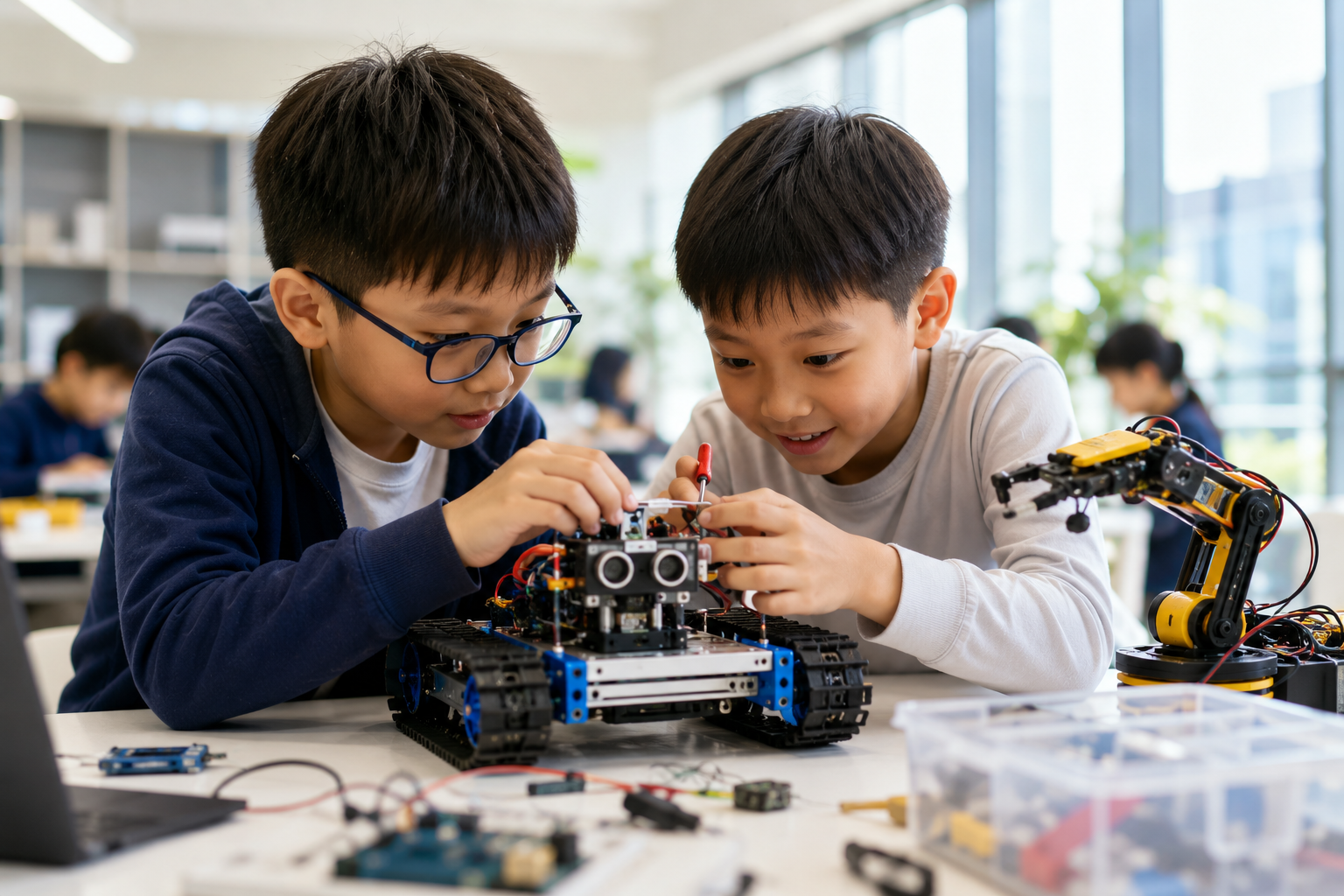
Malaysian Kids Want to Build Robots
For many children, technology used to mean playing games or watching videos on a screen.
Increasingly, some Malaysian students want to build the technology themselves.
At the International Youth Robot Competition ASEAN 2026 in Selangor, students were challenged to design, construct and programme robots capable of completing tasks such as navigating obstacles and transporting objects.
Other students went a step further by developing projects inspired by real-world Malaysian problems.
Two 11-year-old students from Johor, for example, developed a Smart Scarecrow equipped with sensors designed to detect animals around paddy fields. Another student team demonstrated a smart palm-oil monitoring system that measured factors including soil moisture and temperature.
These may be school projects today, but the skills behind them — sensors, programming, automation and problem-solving — are increasingly relevant to modern industries.
Interest Is Growing Quickly
Robotics education is also attracting more Malaysian families.
RoboThink Malaysia told The Star that it had recorded approximately 50% more new student registrations than a year ago.
At one primary-school programme in Kuala Lumpur, participation increased from around 20 students in the previous year to 60 students this year.
Some programmes accept children from as young as four years old, initially focusing on understanding instructions, assembling components and developing basic problem-solving skills before moving into programming and more advanced robotics.
The objective is not necessarily to turn every child into a robotics engineer.
Learning how to build something, test it, discover why it failed and try again develops skills that can be valuable across many technology careers.
Malaysia Will Need More Robotics Talent
The growing interest comes at an important time.
Malaysia’s National Robotics Roadmap 2021–2030 identifies robotics as an important technology for improving productivity, reducing dependence on low-skilled labour and strengthening the country’s technology capabilities.
One challenge is talent.
In 2025, the Ministry of Science, Technology and Innovation launched the Robotics Talent Development Academy (RoTDA) as a one-stop platform connecting academia, industry and government organisations involved in robotics.
MOSTI said initiatives under the roadmap’s talent strategy are expected to produce at least 1,000 new robotics talents annually.
That talent could eventually support industries ranging from manufacturing and logistics to agriculture, healthcare and intelligent automation.
Robotics and AI Are Starting to Merge
The distinction between robotics and artificial intelligence is also becoming smaller.
Traditional robots were usually programmed to perform a fixed series of movements.
Newer systems can increasingly combine cameras, sensors and AI models to analyse their surroundings and make decisions.
Malaysia’s wider AI strategy similarly focuses on developing local AI talent and increasing the country’s ability to create technology rather than simply consume it. AI Malaysia’s current national roadmap covers the period from 2026 to 2030.
For young Malaysians learning robotics today, understanding software, AI and physical machines together could therefore become increasingly valuable.
The Bigger Challenge Comes After School
Getting children interested in technology is one part of the equation.
Malaysia also needs enough universities, research opportunities, technology companies and high-skilled jobs to keep that talent within the industry.
Educators interviewed by The Star highlighted the need for stronger research and development support so promising student projects can progress beyond competitions and demonstration days towards further development and potentially commercialisation.
That may ultimately determine whether Malaysia becomes mainly a user of advanced robotics or develops more of the technology locally.
Closing Thoughts
Malaysia’s future technology industry will not be built by infrastructure alone.
It will also depend on people who know how to design, programme and improve the systems running inside it.
Seeing Malaysian children experimenting with sensors, coding and robotics may look like another extracurricular activity today.
But some of those students could eventually become the engineers developing Malaysia’s next generation of automation, AI and robotics technology.
And that makes getting them interested early much more important than simply learning how to build a robot.