
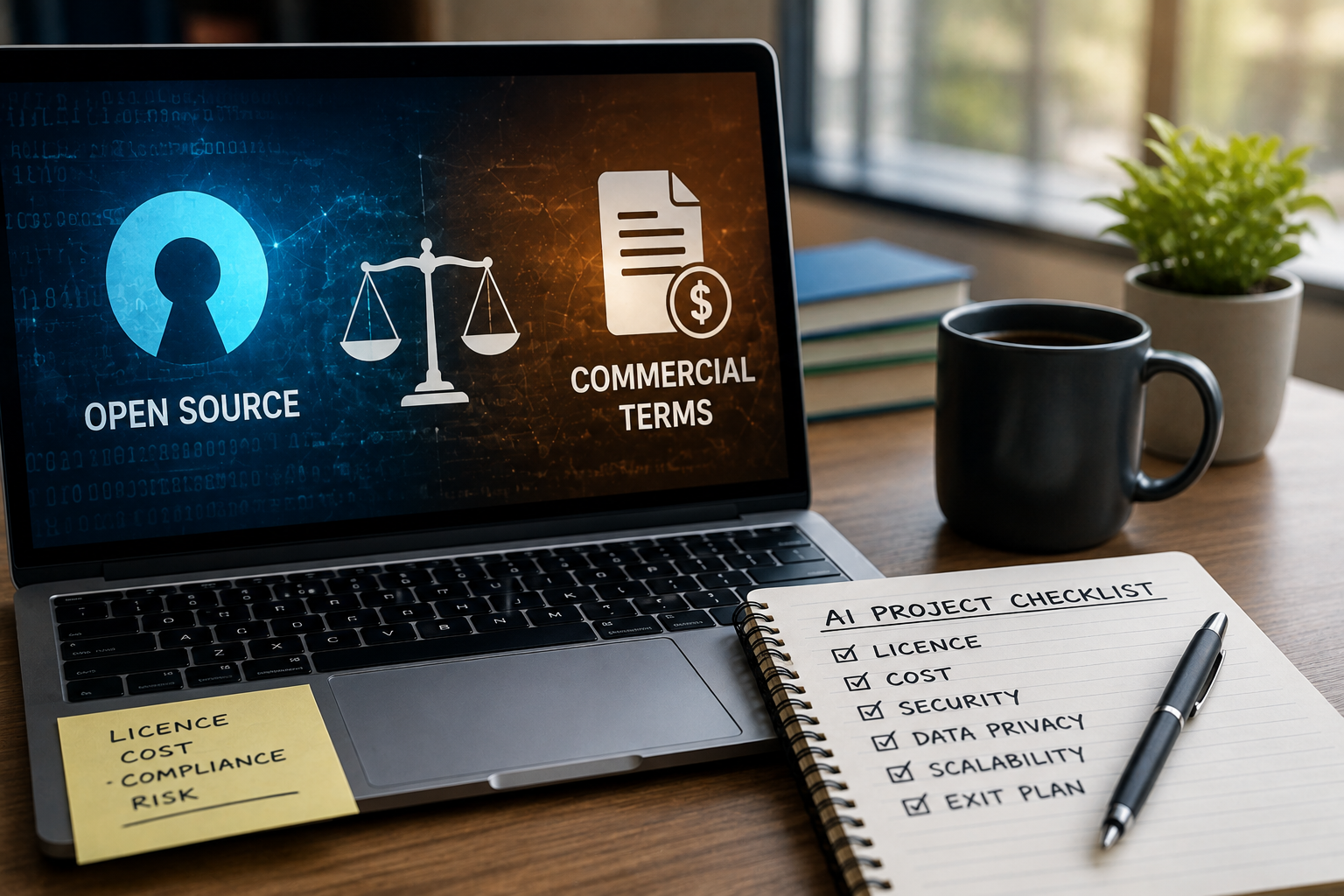
“Open source” is an attractive phrase.
For businesses exploring AI, it can sound like this:
Download the model.
Run it yourself.
Avoid expensive API fees.
Build whatever you want.
The reality can be more complicated.
Reuters reported on 7 August 2026 that Alibaba plans to introduce new commercial terms for major users of the next version of its Qwen open-source AI model. According to people familiar with the plans, large companies generating revenue from the model may be asked to share part of that revenue with Alibaba.
The exact rate has not yet been disclosed, and Reuters noted that Alibaba’s plans are not yet public and could still change.
For businesses, the important lesson is broader than Alibaba.
Do not assume that open-source AI means zero long-term cost.
What Is Changing?
Alibaba has become one of the major players in open-weight AI through its Qwen model family.
Open-weight models allow developers to access the model’s learned parameters and run or adapt the system using their own infrastructure.
Until now, Alibaba has generally charged customers when its models are used through Alibaba Cloud, while many open-source Qwen models could be deployed independently without paying Alibaba directly.
Reuters reports that this may change for large commercial users of Alibaba’s upcoming Qwen3.8-Max model.
The proposed model would remain open-weight, but companies making significant money from providing services built around it could be required to enter a commercial agreement with Alibaba.
This is similar to an approach already being taken by another Chinese AI developer, Moonshot.
Its Kimi K3 licence reportedly requires organisations generating more than $20 million annually from offering the model as a service to negotiate a commercial arrangement. Reuters reported that some agreements could involve revenue sharing of up to 30%.
Open Source Does Not Always Mean Free
This is where companies need to be careful.
“Open source” can describe how software or model weights are made available.
It does not automatically mean:
- Unlimited commercial usage
- No licence conditions
- No revenue limits
- No attribution requirements
- No restrictions on redistribution
- No future licensing changes
Every model has its own licence.
Alibaba Cloud itself advises users of open-source models to check and comply with the relevant open-source agreement and licence terms.
For a developer experimenting internally, this may not create much concern.
For a company building a commercial AI service expected to generate millions in revenue, it matters much more.
Why AI Companies Are Changing Their Business Models
Training advanced AI models is expensive.
The developer needs:
- GPUs and computing infrastructure
- Large datasets
- Engineers and researchers
- Model training
- Security testing
- Continuous improvements
- Cloud infrastructure
- Technical support
Giving the model away can help it gain users quickly.
Developers begin building applications around it.
Cloud providers start offering it.
Companies integrate it into their systems.
Once usage grows, the AI company has opportunities to generate revenue through hosting, enterprise support, commercial agreements or premium services.
DigitalOcean CEO Paddy Srinivasan described this to Reuters as a familiar open-source “freemium” model: access helps adoption first, while commercial services generate revenue later.
There is nothing unusual about this approach.
Businesses simply need to understand it before becoming heavily dependent on a particular model.
The Real Cost of Self-Hosting AI
Even when the model licence itself costs nothing, running the model is not free.
A company may still need to pay for:
GPU Computing
Large AI models may require expensive GPU servers or cloud GPU capacity.
Memory
Larger models require substantial system and GPU memory.
Storage
Model files, datasets, logs and generated information require storage.
Electricity and Cooling
Companies operating their own servers must account for power and cooling.
Engineering
Someone needs to deploy, maintain, update and troubleshoot the model.
Cybersecurity
AI infrastructure still requires access control, monitoring, patching and protection.
Backup
Important configuration and business data must still be protected.
This is why comparing “free open-source AI” against a paid API using only the model licence can give management the wrong picture.
The correct comparison is total cost of ownership.
Cloud API or Self-Hosted AI?
Neither option is always better.
A cloud API may be more practical when usage is still small.
The company pays according to consumption and avoids buying expensive infrastructure.
For example, Alibaba currently publishes usage-based API pricing for Qwen models through Model Studio.
Self-hosting may become more attractive when the company has:
- High and predictable usage
- Sensitive data requirements
- Existing GPU infrastructure
- Technical staff capable of managing the environment
- A need for greater model control
- Low-latency requirements
The decision should be based on actual workload.
Do not self-host AI simply because the model download is free.
What Businesses Should Check Before Choosing an AI Model
Before integrating an AI model deeply into a product or workflow, review five areas.
1. Licence
Understand what is allowed for commercial use.
Check whether conditions change when revenue, users or deployment scale increases.
2. Infrastructure Cost
Estimate GPU, RAM, storage, bandwidth and support requirements.
Run a trial before purchasing long-term infrastructure.
3. Data Protection
Understand what information the model will process and where that data will be stored.
This becomes particularly important when customer or confidential business information is involved.
4. Model Portability
Ask whether the application can move to another model later.
Avoid designing the entire system around one provider’s proprietary features unless there is a strong reason.
5. Exit Plan
Know what happens if:
- The licence changes
- Pricing increases
- The model is discontinued
- Performance becomes unsuitable
- A better model appears
Changing AI models should not require rebuilding the entire application.
Why This Matters for Malaysian Businesses
Malaysian companies are increasingly testing AI for customer service, document processing, coding, analytics and internal knowledge systems.
Open-source models can be particularly attractive because businesses may deploy them inside their own cloud or dedicated-server environments.
That can provide greater control over data and infrastructure.
But the licence still matters.
A model suitable for an internal proof-of-concept today could later become part of a commercial product.
At that stage, different licensing conditions may apply.
Businesses should therefore keep a record of:
- Which AI model is being used
- Which model version is deployed
- Which licence applies
- Where the model came from
- Whether it has been modified
- Which applications depend on it
This is basic AI asset management.
It becomes increasingly important as companies adopt more models.
Closing Thoughts
Alibaba’s reported plan for its next Qwen model shows how the economics of open-source AI are evolving.
Open models will continue to be important.
They give businesses more flexibility, encourage competition and make advanced AI accessible to more developers.
But open does not necessarily mean free forever or free at every level of commercial usage.
Before building a business around an AI model:
Read the licence.
Understand the infrastructure cost.
Check how commercial usage is treated.
Protect your data.
Keep the application portable.
And have an alternative model available if conditions change.
AI technology moves quickly.
Your architecture should be able to move with it.
At Net Onboard, we help businesses build and manage cloud, dedicated-server, cybersecurity, backup and business-continuity environments for modern applications and AI workloads.