
Most people do not think about where cloud computing comes from.
They open an application.
Upload a file.
Join an online meeting.
Run a website.
Restore a backup.
Ask an AI assistant a question.
The service feels digital and almost invisible.
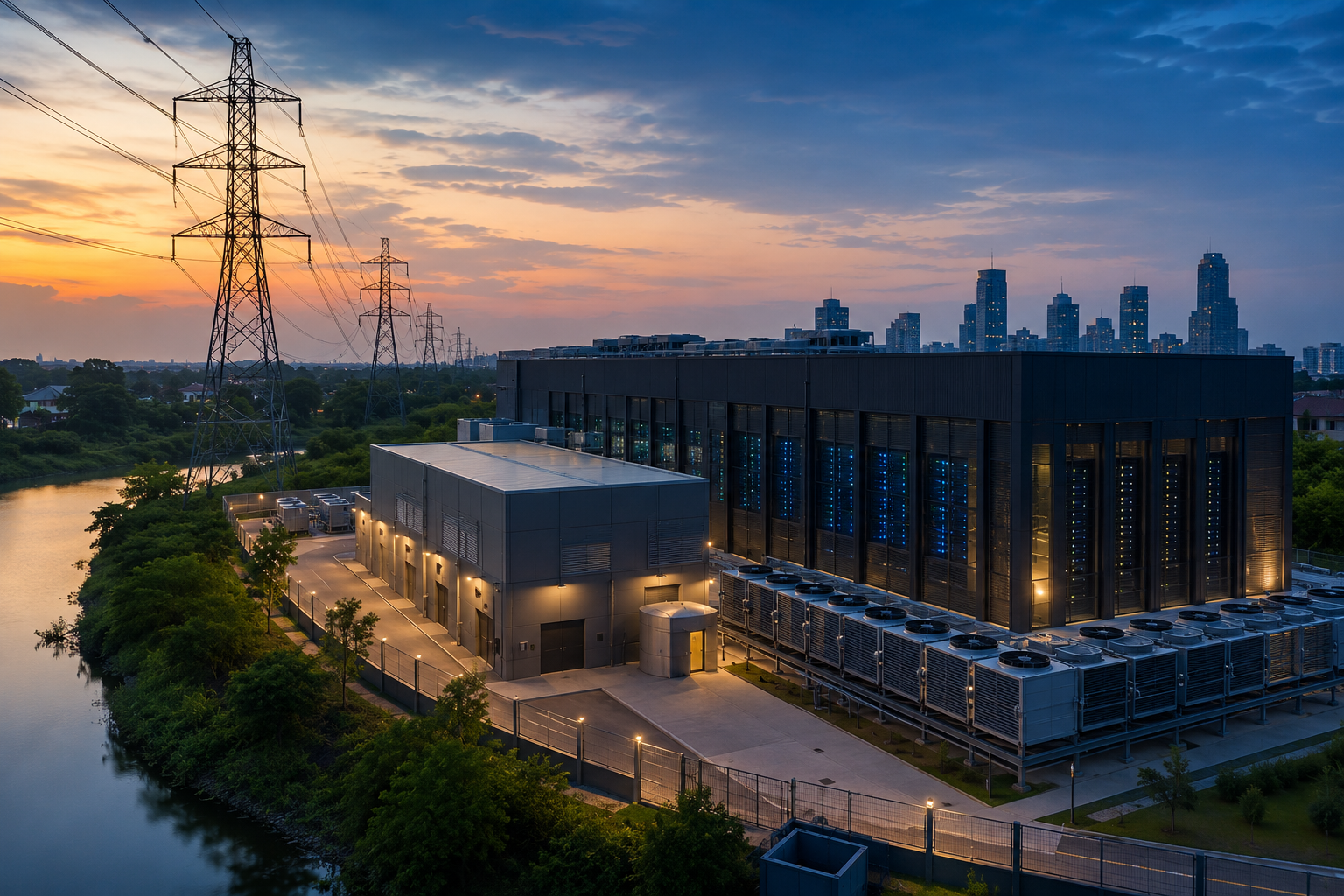
But behind every cloud platform and AI tool is physical infrastructure.
Servers.
Cooling equipment.
Network connections.
Electricity.
Water.
Land.
Backup generators.
As AI usage grows, the amount of infrastructure required to support it is growing too.
That expansion is now facing public and political resistance.
On 20 July 2026, US Congressman Byron Donalds announced proposed legislation intended to prevent AI data centres from increasing utility costs for ordinary households. The proposal would require data centres to obtain their electricity and water from private sources instead of relying on public power grids and water systems. The proposal is not yet law, but it reflects growing pressure on the industry to pay more directly for the infrastructure it consumes.
For businesses, this may sound like a local political issue in the United States.
It is not.
The same questions are being asked around the world:
Who should pay for the electricity required by AI?
Should data centres receive priority access to power?
How much water should be used for cooling?
What happens when infrastructure cannot keep up?
And will higher operating costs eventually affect cloud customers?
Why AI Data Centres Need So Much Infrastructure
A traditional business application may run on a small number of virtual servers.
AI workloads can be very different.
Training and operating large AI models may require thousands of specialised processors working together. These systems produce substantial heat and require large amounts of electricity, cooling and network capacity.
The data centre does not only need power for the computing equipment.
It also needs power for:
- Cooling
- Pumps
- Lighting
- Networking
- Security systems
- Backup equipment
- Power conversion
- Supporting infrastructure
Depending on the cooling design and local climate, water may also be required to remove heat from the facility.
This is why data-centre development cannot be treated only as a technology project.
It is also an energy, water, land and public-infrastructure project.
Public Opposition Is Becoming More Organised
The latest US proposal follows a wider public backlash against rapid data-centre construction.
Reuters reported that opponents of data-centre expansion held 142 protests across 42 US states on 18 July 2026. Organisers called for greater transparency, stronger protection of local resources, community benefits and more accountability from developers. A Reuters/Ipsos poll cited in the report found that only 14% of respondents supported an AI data centre being built in their own community.
The concern is not limited to one political group.
Some communities are worried about household electricity bills.
Others are worried about water.
Some object to noise, land use, diesel generators or construction disruption.
Others question whether the number of permanent jobs created justifies the amount of infrastructure required.
The debate does not necessarily mean communities reject cloud computing or AI.
It means people want a clearer explanation of who benefits, who pays and how local resources will be protected.
Governments Are Starting to Apply Restrictions
Several authorities have already introduced restrictions or special conditions for new data-centre developments.
Reuters reported that New York imposed a one-year moratorium on permits for data centres using 50 megawatts or more while environmental standards are developed. Amsterdam has restricted new data-centre construction or expansion until at least 2030, while new connections around Dublin now need to provide their own onsite power generation. Denmark has also proposed giving data centres the lowest priority for new grid connections when capacity is limited.
These measures differ from country to country.
Some are temporary.
Some apply only to very large facilities.
Others focus on location, electricity supply or environmental impact.
But the direction is becoming clear.
Data-centre developers can no longer assume that power, water and grid access will always be available on demand.
Malaysia Is Asking the Same Questions
This discussion is highly relevant to Malaysia.
Malaysia has attracted major data-centre and cloud investments because of its location, connectivity, land availability and growing digital economy.
But the government is also becoming more selective about how new projects are approved.
On 16 July 2026, Malaysia’s Ministry of Investment, Trade and Industry said new data-centre projects would only be approved after confirming that electricity and water capacity is sufficient for residents and local industries. The Data Centre Task Force will assess applications based on available power and water resources, with water supply for residents receiving priority.
This is an important position.
Malaysia still wants data-centre investment.
But growth must be matched with infrastructure capacity.
That is a reasonable approach.
A data centre can support cloud services, AI development, digital businesses and local technology ecosystems.
But if development happens faster than electricity and water infrastructure can support, the wider economy may face pressure.
Malaysia Already Has Sustainability Guidelines
Malaysia’s sustainable data-centre guidelines use several measurements to evaluate efficiency.
One is Power Usage Effectiveness, or PUE.
PUE compares the total electricity consumed by a data centre with the electricity used directly by its IT equipment. A lower figure generally means less energy is being lost to cooling and supporting infrastructure. Malaysia’s guidelines require operators to declare their design PUE based on the relevant international standard.
Another measurement is Water Usage Effectiveness, or WUE.
WUE compares water consumption with the energy used by IT equipment.
Malaysia’s guidelines recommend that new facilities avoid water-stressed areas, use water-efficiency practices and consider reclaimed or reused water. The recommended design WUE is 2.2 cubic metres per megawatt-hour or lower, with operators encouraged to improve further over time.
These measurements may sound technical.
But they answer simple business questions.
How much electricity is being used beyond the servers themselves?
How much water is needed to support the computing workload?
How efficiently is the facility being operated?
Does This Mean Data Centres Are Bad?
No.
Modern businesses depend on data centres.
Without them, many daily services would not work.
Examples include:
- Websites
- Cloud storage
- Online banking
- Digital payments
- Customer portals
- Business applications
- Video conferencing
- Cybersecurity monitoring
- Backup and disaster recovery
- AI services
- E-commerce platforms
The problem is not the existence of data centres.
The problem is unmanaged growth.
A well-designed data centre can be efficient, secure and highly reliable.
A poorly planned development may place unnecessary pressure on electricity, water and surrounding communities.
The right discussion is therefore not:
“Should data centres be allowed?”
A better question is:
“How should they be designed, located and operated responsibly?”
Will Cloud Prices Increase?
Not necessarily in the immediate term.
Cloud pricing depends on many factors, including:
- Electricity
- Hardware
- Memory and storage costs
- Land
- Network connectivity
- Software licensing
- Staffing
- Taxes
- Financing
- Competition
- Currency movements
Higher energy costs or stricter development conditions may place pressure on providers.
However, larger providers may also improve efficiency, negotiate long-term energy arrangements or spread costs across many customers.
The most reasonable conclusion is that power and infrastructure are becoming a more important part of cloud pricing.
That may affect future service costs, especially for AI workloads that require large amounts of computing capacity.
Businesses should therefore avoid planning cloud budgets based only on today’s prices.
They should also consider how usage may grow.
AI Workloads Can Create Unexpected Cloud Bills
Traditional cloud usage is often easier to estimate.
A business may know how many servers it needs, how much storage it uses and how much data is transferred each month.
AI workloads may be less predictable.
Cost may increase because of:
- Higher processing requirements
- GPU usage
- Larger datasets
- More storage
- Increased API requests
- Model training
- Real-time AI responses
- Logging and monitoring
- Data transfer
- Backup of AI-related data
A small proof-of-concept may be affordable.
A full production deployment serving thousands of users may be very different.
Companies should understand how an AI service charges before allowing usage to grow without control.
What This Means for Ordinary Cloud Customers
Most businesses do not build their own data centres.
They rent cloud servers, subscribe to software platforms or use managed hosting.
That does not mean the data-centre debate is irrelevant to them.
The quality of the underlying infrastructure affects:
- Service availability
- Future pricing
- Expansion capacity
- Hosting location
- Environmental reporting
- Customer compliance
- Disaster recovery
- Provider stability
For example, a cloud provider may promise that a business can scale quickly.
But can the provider actually obtain enough power and infrastructure to support future expansion?
A provider may offer low pricing today.
But does the price depend on unsustainable energy arrangements?
A company may choose a region because it is nearby.
But is that region facing grid or water constraints?
These questions do not always have simple answers.
But businesses should at least know what they depend on.
Reliability and Sustainability Are Connected
Sustainability is sometimes treated as a marketing topic.
For data centres, it is also an operational issue.
A facility that uses electricity and water efficiently may be easier to operate and expand.
A facility that depends on already strained infrastructure may face delays, restrictions or higher costs.
This does not mean an inefficient data centre will suddenly go offline.
It means infrastructure planning can affect the provider’s long-term ability to grow reliably.
For customers running important systems, long-term capacity matters.
A cloud environment should not only work today.
It should continue supporting the business as demand increases.
What Businesses Should Ask Their Cloud Provider
Companies do not need to conduct a full environmental audit.
But they should ask practical questions before placing important systems with a provider.
1. Where Is the Data Hosted?
Ask for the actual hosting location.
Do not assume that a local sales company means the infrastructure is local.
The answer may affect:
- Performance
- Data protection
- Legal requirements
- Support
- Backup
- Disaster recovery
2. How Is the Data Centre Powered?
Businesses may ask whether the facility relies entirely on grid electricity, uses renewable energy or has other power arrangements.
The provider does not need to disclose every commercial detail.
But it should be able to explain how power availability and resilience are managed.
3. Is the Facility Designed for Energy Efficiency?
Ask whether the provider monitors PUE or uses recognised efficiency standards.
A credible provider should understand how much energy is used by the IT equipment and how much is used by cooling and other supporting systems.
4. How Is Cooling Managed?
Different facilities use different cooling designs.
Some use more water.
Others may use more electricity.
The key question is whether the design is suitable for the location and workload.
5. What Happens During a Power Failure?
Ask about:
- Uninterruptible power supply
- Backup generators
- Fuel arrangements
- Maintenance
- Redundant power paths
- Testing
- Expected failover process
A backup generator mentioned in a brochure is not enough.
The provider should have a tested operating procedure.
6. Is Backup Stored in the Same Facility?
If production systems and backup are stored in the same location, one serious incident may affect both.
For critical systems, businesses should consider a backup copy kept in another facility, region or separately controlled environment.
7. Can the Provider Support Future Growth?
A business may need more CPU, memory, storage, bandwidth or backup capacity later.
Ask whether resources can be expanded and whether there are any known limitations.
8. Are Energy-Related Costs Fixed?
Review whether the contract allows price adjustments linked to electricity, utility surcharges, currency or other operating expenses.
A low introductory price may not remain unchanged forever.
9. What Is Included in the SLA?
Check whether the service-level agreement covers:
- Infrastructure availability
- Network availability
- Support response
- Service credits
- Planned maintenance
- Incident notification
- Backup
- Recovery
Do not assume every service is included under one uptime percentage.
10. What Is the Exit Plan?
Businesses should know how to retrieve their data and move to another provider if needed.
Ask about:
- Data export
- Migration assistance
- Transfer cost
- Contract termination
- Data deletion
- Supported formats
- Estimated migration time
A cloud strategy should include a way out.
The Cheapest Cloud Is Not Always the Lowest-Cost Choice
Two providers may appear to offer the same server specification.
For example:
- Four virtual CPUs
- Sixteen gigabytes of RAM
- Five hundred gigabytes of storage
But the service quality may be very different.
One provider may include:
- Proactive monitoring
- Backup
- Security updates
- Incident response
- Local support
- Recovery assistance
- Managed firewall
- Clear escalation procedures
Another may provide only the virtual machine.
The second provider may look cheaper.
But the customer will still need to arrange the missing services.
When comparing cloud costs, businesses should consider the full environment.
Not only the server.
Cloud Efficiency Also Depends on the Customer
Cloud providers are not the only ones responsible for resource efficiency.
Customers can also reduce unnecessary usage.
Common areas to review include:
- Old virtual machines that are no longer used
- Oversized servers
- Unnecessary storage
- Duplicate backup copies
- Excessive log retention
- Test systems left running
- Unused cloud accounts
- Applications that are poorly optimised
- Data stored without a retention policy
Removing waste can reduce cost and infrastructure demand at the same time.
A larger server is not always the answer to poor application performance.
Sometimes the application or database needs to be reviewed first.
Businesses Should Plan AI Projects in Stages
The current data-centre debate does not mean companies should stop exploring AI.
It means projects should be planned realistically.
A practical approach is:
Stage 1: Define the Business Problem
Do not begin with the AI tool.
Begin with the problem.
What process needs improvement?
What result is expected?
Stage 2: Run a Controlled Trial
Use a limited number of users and a small dataset.
Measure performance, cost and accuracy.
Stage 3: Review Security and Data Protection
Confirm what data is being processed, where it is stored and who can access it.
Stage 4: Estimate Production Usage
Calculate expected users, requests, storage, processing and support requirements.
Stage 5: Set a Budget Limit
Monitor consumption and configure alerts where possible.
Stage 6: Prepare for Failure
Decide what happens if the AI service is unavailable or produces an incorrect result.
This prevents a small experiment from becoming an uncontrolled cloud expense.
The Malaysia Perspective
Malaysia has an opportunity to become an important cloud and data-centre location.
The industry can support digital services, AI development, connectivity and technology investment.
But long-term success depends on responsible growth.
The Malaysian government’s decision to assess power and water capacity before approving projects shows that infrastructure planning is becoming more important.
This should not be viewed only as a restriction.
It can also improve the quality of investment.
Projects that use energy efficiently, manage water responsibly and contribute to the wider technology ecosystem may be more sustainable over the long term.
For Malaysian businesses, the message is not to avoid local cloud infrastructure.
It is to choose providers carefully.
Local hosting can offer useful benefits such as:
- Lower latency
- Local support
- Clearer data location
- Easier communication
- Malaysian billing
- Better understanding of local business requirements
But local providers should still be evaluated for infrastructure, security, backup and recovery capability.
Location alone does not guarantee quality.
The Bigger Lesson
AI is often discussed as if it exists only inside software.
The current backlash is a reminder that AI is physical too.
It requires chips.
Servers.
Buildings.
Power lines.
Cooling systems.
Water.
Land.
Skilled workers.
Large capital investment.
As AI usage increases, the infrastructure behind it will become more visible.
Governments will apply more conditions.
Communities will ask more questions.
Providers will need to explain how their facilities are operated.
Businesses using cloud and AI services should expect infrastructure efficiency to become part of the buying decision.
Closing Thoughts
The proposal announced on 20 July 2026 to require AI data centres to provide their own electricity and water is one sign of a much wider change.
Data-centre growth is no longer receiving automatic public support.
Communities and governments want stronger protection for electricity, water and local infrastructure. Similar questions are now being considered in the United States, Europe, Australia and Malaysia.
Businesses do not need to panic.
Cloud services will continue to play a central role in modern operations.
But companies should become more careful cloud buyers.
Ask where the infrastructure is located.
Understand how it is powered.
Review backup and recovery.
Check the SLA.
Monitor cloud usage.
Plan AI projects properly.
Do not choose based on server specifications and price alone.
A reliable cloud environment depends on much more than what appears on the quotation.
At Net Onboard, we help businesses design and manage secure cloud environments through cloud hosting, managed support, cybersecurity, backup and business continuity services.
If your company is reviewing cloud infrastructure, AI workloads, backup readiness or future capacity requirements, Net Onboard can help assess the current environment and recommend a practical solution based on your operational needs.