
Cybersecurity used to focus mainly on prevention.
Block the attack.
Stop the malware.
Protect the network.
Filter the email.
Patch the system.
All of that is still important.
But today, prevention alone is not enough.
Modern cyberattacks can still get through. Ransomware can still encrypt files. Credentials can still be stolen. Cloud accounts can still be misused. AI tools can still create new security gaps.
That is why cyber recovery is becoming more important.
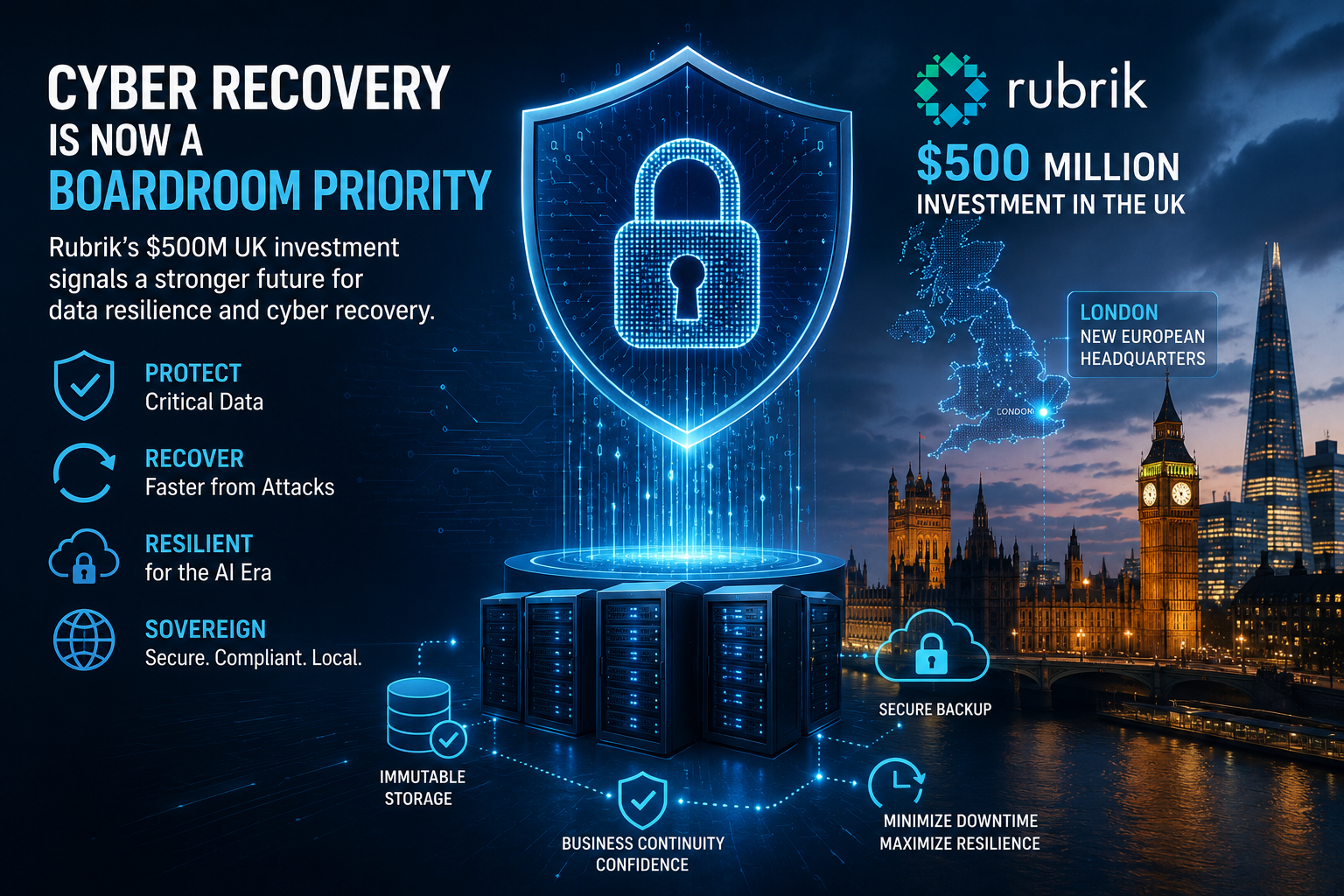
On 9 July 2026, Reuters reported that cybersecurity and data resilience company Rubrik announced a $500 million investment in the UK over the next five years and named London as its European headquarters. The company said the move reflects the UK’s importance as one of its fastest-growing markets and supports European data sovereignty, cyberattack recovery and AI scalability.
This is not only a story about one cybersecurity company.
It shows where the market is heading.
Companies are no longer asking only:
“How do we prevent attacks?”
They are also asking:
“How fast can we recover if something goes wrong?”
What Did Rubrik Announce?
Rubrik is a cybersecurity and data resilience company. Its business focuses on helping organisations protect data, recover from cyberattacks and manage cyber resilience.
According to Reuters, Rubrik announced a $500 million UK investment over five years and selected London as its European headquarters. The company also said its Security Cloud will be available on AWS European Sovereign Cloud, supporting sovereign cyber resilience for public and regulated sectors.
The announcement also connects to a wider trend.
More companies are thinking about where their data is stored, who can access it, how it is protected and how quickly it can be recovered after an incident.
This matters for businesses in every industry.
Finance.
Healthcare.
Education.
Manufacturing.
Retail.
Technology.
Professional services.
Government-linked organisations.
Any company that depends on digital systems needs to think about cyber recovery.
Why Cyber Recovery Matters
Cybersecurity is not only about keeping attackers out.
It is also about keeping the business running.
A company can invest in firewalls, endpoint protection, email security and access control. These tools reduce risk. But they do not remove risk completely.
If an attacker gets in, the company needs a way to recover.
Without recovery planning, a cyber incident can become a business crisis.
Operations may stop.
Staff may lose access to systems.
Customer service may be interrupted.
Invoices may be delayed.
Important files may be encrypted.
Management may not know which systems to restore first.
Customers may lose confidence.
That is why cyber recovery is now part of business continuity.
It is not just an IT backup topic.
It is a business survival topic.
The Difference Between Backup and Cyber Recovery
Many businesses already have backups.
But backup and cyber recovery are not the same thing.
A backup is a copy of data.
Cyber recovery is the process of using clean, trusted data to bring the business back after an attack.
A normal backup may not be enough if:
- The backup was also infected
- The backup was deleted by an attacker
- The backup was not tested
- The recovery process is too slow
- The company does not know which system to restore first
- The backup does not include all critical systems
- The recovery point is too old
- The backup account was compromised
This is why companies need to review backup quality, not just backup existence.
The important question is not:
“Do we have backup?”
The better question is:
“Can we recover safely, quickly and confidently?”
Data Sovereignty Is Becoming More Important
Rubrik’s announcement also highlights data sovereignty.
Data sovereignty means data is subject to the laws and controls of the country or region where it is stored or processed.
This is becoming more important for regulated industries and companies that handle sensitive information.
Businesses may need to consider:
- Where data is hosted
- Where backup is stored
- Which cloud region is used
- Who can access the data
- Whether data leaves the country or region
- Whether the provider supports compliance requirements
- Whether recovery can happen within approved locations
For companies operating across regions, this can become complicated.
A cloud system may be global.
A backup platform may be regional.
A support team may be overseas.
A customer may require data to stay within a certain jurisdiction.
This is why data location and recovery planning should be part of cloud strategy.
AI Makes Cyber Resilience More Urgent
AI is changing cybersecurity in two ways.
First, companies are using AI tools in daily work.
They may use AI for customer support, coding, reporting, document search, analytics, threat detection or automation.
Second, attackers may also use AI.
They can create better phishing messages, automate research, generate convincing fake communication and speed up attack preparation.
This means companies need stronger security and faster response.
Reuters reported that Rubrik is also advancing AI resilience through tools such as Rubrik Agent Cloud, with features including real-time security oversight and “agent rewind” capabilities to reverse unintended actions by AI agents.
This is an important signal.
As AI agents become more common, businesses will need to manage not only human mistakes, but also automated mistakes.
An AI agent may take an action too quickly.
It may access the wrong data.
It may trigger a workflow incorrectly.
It may make a change that needs to be reversed.
That means resilience is not only about recovering from attackers.
It is also about recovering from automation errors.
Why This Matters for Businesses
Every modern company depends on data.
Customer records.
Invoices.
Contracts.
Email.
Files.
Cloud systems.
Databases.
Applications.
Support tickets.
Reports.
Backups.
If this data becomes unavailable, the business slows down or stops.
That is why cyber recovery should be discussed at management level.
It affects revenue, operations, customer trust, legal exposure and reputation.
The IT team may manage the tools.
But management must understand the risk.
A company should know:
- What systems are most critical?
- How long can the business operate without them?
- How much data can be lost before it becomes serious?
- Are backups protected from ransomware?
- Has recovery been tested?
- Who approves recovery during an incident?
- Who communicates with customers?
- Who contacts vendors, legal teams or insurers?
- What is the recovery priority?
These are business questions, not only technical questions.
The Cost of Poor Recovery Planning
Cyber incidents are stressful.
When recovery planning is weak, the pressure becomes worse.
Teams may not know what to do first.
Management may not know whether data is safe.
Customers may ask for updates.
Employees may be unable to work.
Vendors may need to be contacted.
There may be legal or compliance obligations.
If there is no tested recovery plan, the company may waste valuable time.
In a serious incident, time matters.
Every hour of downtime can affect operations, sales, support and customer confidence.
This is why companies should prepare before an attack happens.
What Companies Should Review Now
Businesses do not need to wait for a major incident to improve cyber recovery.
They can start with practical steps.
1. Identify Critical Systems
List the systems that are most important to daily operations.
This may include email, accounting software, customer portals, ERP systems, file servers, databases, websites, payment systems and cloud applications.
2. Define Recovery Objectives
Every company should understand two simple terms.
Recovery Time Objective, or RTO, means how fast the system needs to be restored.
Recovery Point Objective, or RPO, means how much data loss is acceptable.
For example, can the company afford to lose one day of data?
One hour?
Five minutes?
The answer affects backup design.
3. Protect Backup From Attackers
Backup should not be easy to delete or encrypt.
Where possible, companies should use immutable backup, offsite backup and separate access control.
Backup accounts should also use multi-factor authentication.
4. Test Recovery Regularly
A backup is only useful if it can be restored.
Companies should test recovery from time to time.
This helps confirm that files, systems and applications can actually be brought back.
5. Review Cloud and Data Location
Companies should know where their primary systems and backups are hosted.
This matters for compliance, performance, support and recovery planning.
6. Prepare an Incident Response Plan
A cyber recovery plan should connect with incident response.
The company should know who makes decisions, who contacts vendors, who handles communication and what systems must be restored first.
7. Train Staff
Human error is still a major risk.
Employees should understand phishing, password safety, file handling, data protection and reporting procedures.
Training should be clear and practical.
Cyber Recovery Is Now Part of Business Strategy
The Rubrik investment shows that cyber resilience is becoming a major market priority.
This is not surprising.
Businesses are using more cloud systems.
Data volume is growing.
AI adoption is increasing.
Cyberattacks are becoming more advanced.
Regulators and customers are asking more questions about data protection.
All of this makes recovery more important.
Companies that prepare early will be in a better position.
They can respond faster.
They can reduce downtime.
They can protect customer trust.
They can make better decisions during incidents.
Cyber recovery is no longer a “nice to have”.
It is part of responsible business planning.
Closing Thoughts
Rubrik’s $500 million UK investment is a clear sign that cyber recovery and data resilience are becoming more important worldwide.
The lesson for businesses is simple.
Do not only focus on stopping attacks.
Prepare for recovery too.
Know your critical systems.
Protect your backup.
Test restoration.
Review data location.
Control access.
Prepare an incident response plan.
Train your staff.
As companies use more cloud services and AI tools, the ability to recover quickly will become one of the most important parts of cybersecurity.
At Net Onboard, we help businesses build secure, reliable and scalable cloud environments through managed cloud hosting, cybersecurity, backup and business continuity solutions.
If your company wants to strengthen backup protection, improve recovery readiness or review cloud security risk, speak to our team today.