

Security gaps have a way of sneaking up on you. They show up as a locked system, a regulatory notice, or a customer asking why their data appeared somewhere it should not. By that point, the gap already had access to your business for an unknown amount of time.
The businesses that get caught are not necessarily the least careful. They are the ones that waited too long to find out where they stood.
SMEs accounted for over 65% of reported incidents in Malaysia in 2024, according to CyberSecurity Malaysia, and ransomware on Malaysian SMEs rose 42% year-on-year in 2025.
This article covers five specific situations that signal a cybersecurity risk assessment is the right call, explains the difference between a vulnerability assessment, a penetration test, and a full risk assessment, and walks through what a credible report should contain. If you are evaluating a security partner, the last section covers what to ask before you sign.
When to Commission a Cybersecurity Risk Assessment
These are the five situations where a cybersecurity risk assessment should be commissioned within 30 days, not deferred to the next annual review.
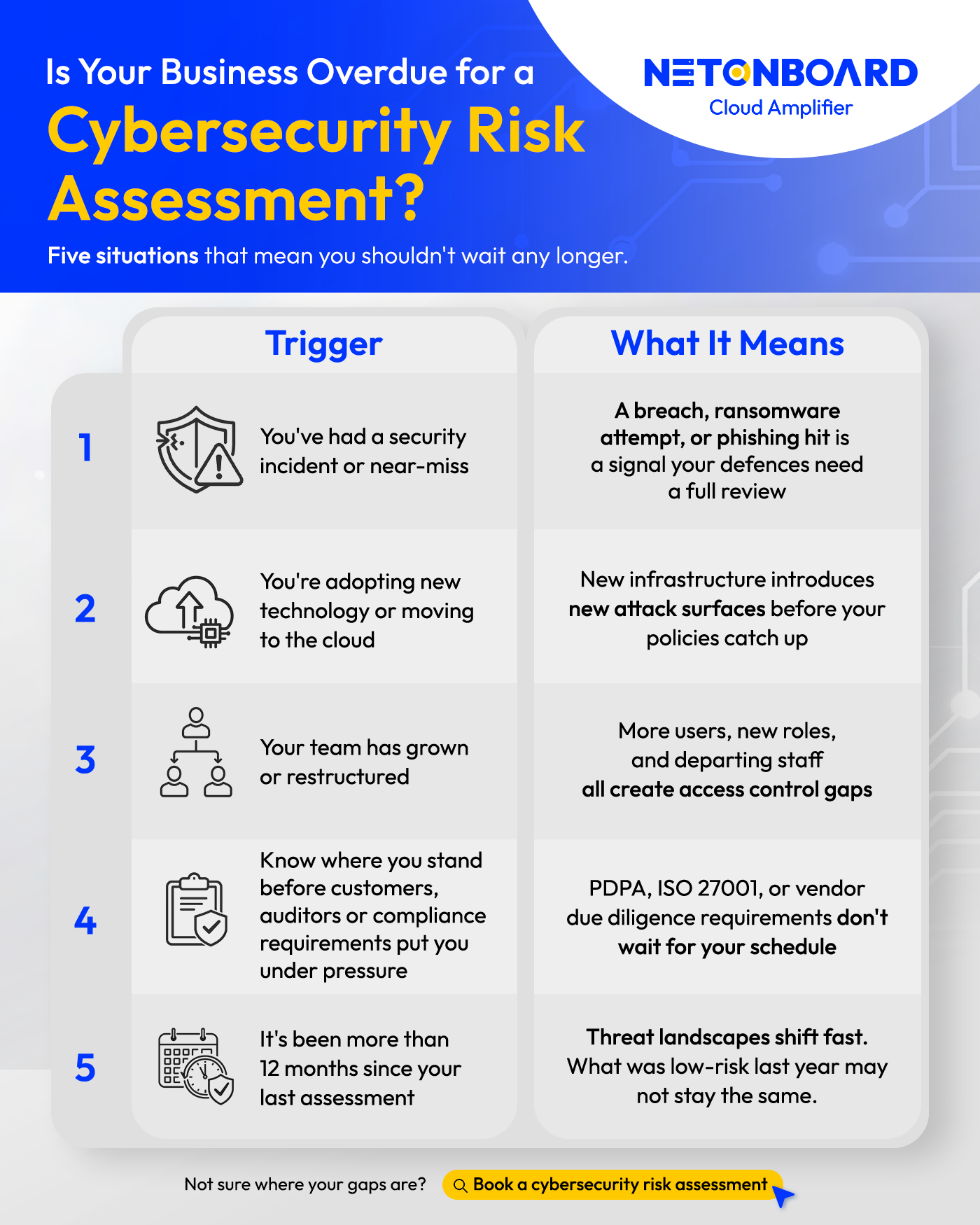
Trigger 1: A Failed Audit or Compliance Deadline Within 90 Days
What this looks like: External audit findings received, or a PDPA, RMiT, or ISO 27001 deadline is approaching.
Why act now: A formal assessment gives you the evidence trail to demonstrate active remediation. Regulators distinguish between businesses that identified and addressed gaps and businesses that were surprised by them.
Key output needed: Compliance-mapped findings with a prioritised remediation roadmap and documented timeline.
Trigger 2: A Near-Miss Security Incident
What this looks like: A phishing email that almost got through, a suspicious login from an unknown location, a data export that nobody authorised.
Why act now: Near-misses confirm that gaps exist and give you a specific entry point for the assessment. Acting while logs are fresh and memory is intact is far more effective than acting six months later. Near-misses are the most actionable signal you will get.
Key output needed: Root cause analysis, affected system scope, and a remediation plan before the same vector is used again.
Trigger 3: Post-Merger or Acquisition IT Integration
What this looks like: Two IT environments are being connected, user credentials merged, and systems linked across the combined entity.
Why act now: Post-merger integration is one of the highest-risk periods in a company’s security lifecycle. You are inheriting the other party’s vulnerabilities the moment systems are linked. That exposure becomes yours immediately.
Key output needed: A clean baseline assessment of both environments before or immediately after integration, with gap mapping across the combined estate.
Trigger 4: New SaaS Tools or Cloud Infrastructure Rolled Out
What this looks like: A new CRM, ERP migration, move to cloud storage, or shift to hybrid work with remote access has just gone live.
Why act now: Every new system adds attack surface. Malaysian businesses typically add SaaS tools fast during growth periods and review the security implications later. By the time “later” arrives, misconfigured settings have been sitting exposed for months, and nobody can easily remember what was turned on when.
Key output needed: Configuration review of new systems, access control validation, and integration security assessment.
Trigger 5: A Regulatory Change Directly Affecting Your Industry
What this looks like: The PDPA Amendment Act 2024 is the clearest recent example. New data breach notification obligations, DPO appointment requirements, and stricter cross-border data transfer rules came into force in June 2025.
Why act now: A regulatory change creates a compliance gap between your current controls and the new requirements. That gap will not stay unknown indefinitely. A formal assessment closes it with documented evidence before a regulator or incident does it for you.
Key output needed: Gap analysis mapped to the new regulatory requirements, with a remediation roadmap and owner assignments.
Which Assessment Do You Actually Need?
These three terms are used interchangeably in the market. They are not the same thing. Each produces a different output and serves a different purpose.

Vulnerability Assessment
What it does: Vulnerability assessments in Malaysia use automated scanning to identify known weaknesses across systems, networks, applications, and cloud environments. Produces a ranked inventory of potential risks.
What it does not do: Test whether those weaknesses can actually be exploited.
Cost range: RM 5,000 to RM 15,000 per engagement depending on scope.
Right for: Regular security monitoring and ongoing risk management. Most security teams run these quarterly or monthly. Good starting point for businesses with no current baseline.
Penetration Testing
What it does: Ethical hackers actively attempt to exploit identified vulnerabilities, simulating a real attacker. Shows not just what is vulnerable but also how far an attacker could get and what they could access.
What it does not do: Provide a broad inventory of all potential risks the way a vulnerability assessment does. Focused, not exhaustive.
Cost range: RM 15,000 to RM 50,000 per engagement.
Right for: After major system changes, before serving large enterprise clients who require it as a procurement condition, or following a near-miss incident.
Full Cybersecurity Risk Assessment
What it does: Reviews people, processes, and technology controls against a compliance framework (PDPA, ISO 27001, NIST, or RMiT). Produces a gap analysis with a prioritised remediation roadmap.
What it does not do: Replace a vulnerability assessment or pentest. It is a posture review, not a technical exploitation exercise.
Cost range: RM 8,000 to RM 20,000 for a Security Posture Assessment (SPA).
Right for: Businesses beginning their security journey, those responding to a significant compliance change, or those needing a board-ready risk picture. Most businesses eventually need all three, in this order: vulnerability assessment, then pentest, then full risk assessment.
What a Credible Assessment Deliverable Looks Like
Managed cybersecurity services from a credible provider should include all six of these components:
- Executive summary: Non-technical. Covers overall risk posture, key findings, and the three most critical items to fix first. This is what goes to the board or the business owner.
- Scope and methodology: Precise description of what was tested, what was excluded, and the methods used. Without this, you cannot compare assessments over time or defend findings to a regulator.
- Findings with severity ratings: Each finding rated critical, high, medium, or low, with a plain-language explanation of what it means for the business.
- Remediation roadmap: Prioritised, actionable steps with owner, timeline, and estimated effort. A findings list without a roadmap is a diagnosis without a prescription.
- Compliance mapping: Findings mapped to relevant frameworks (PDPA, RMiT, ISO 27001) so you know precisely which regulatory obligations each gap affects.
- Retest schedule: Proposed timeline for verifying that remediated items are actually fixed. Remediation without verification leaves you uncertain about whether the fix worked.
If a provider cannot show you a sample report structure before you engage, that is a signal to look elsewhere.
How to Brief a Security Partner in Malaysia
The quality of a security audit in Malaysia is directly shaped by the brief you give the provider. Include these five things as a minimum:
- Scope: Every system, application, cloud environment, network segment, and physical site in scope. Be explicit about what is excluded and why.
- Regulatory context: The frameworks you are working against: PDPA, RMiT, ISO 27001, or industry-specific requirements.
- Known concerns: Recent incidents, near-misses, audit findings, or specific systems you are worried about.
- Business impact priorities: Your most critical systems, and any existing RTO/RPO targets if you have them.
- Timeline and budget range: A RM 8,000 engagement cannot deliver the same depth as a RM 35,000 one. A good provider will tell you that upfront.
When reviewing proposals, these questions matter most:
- What framework will the assessment map to?
- What does the deliverable look like?
- Do you offer a retest after remediation?
- What experience do you have with businesses of our size and sector?
- How do you handle findings requiring immediate escalation?
- What ongoing support is available after the assessment closes?
The answers tell you far more than the price.
If your business falls into any of the five trigger categories above, the right next step is a structured assessment, not a wait-and-see approach. Net Onboard’s cybersecurity risk assessment in Malaysia covers vulnerability assessment and penetration testing alongside full compliance-mapped risk assessments.
Speak to the team to scope an engagement that fits your business and timeline. For the ongoing detection and response capability that makes post-assessment remediation effective, Net Onboard’s security operations services run alongside the assessment programme.