
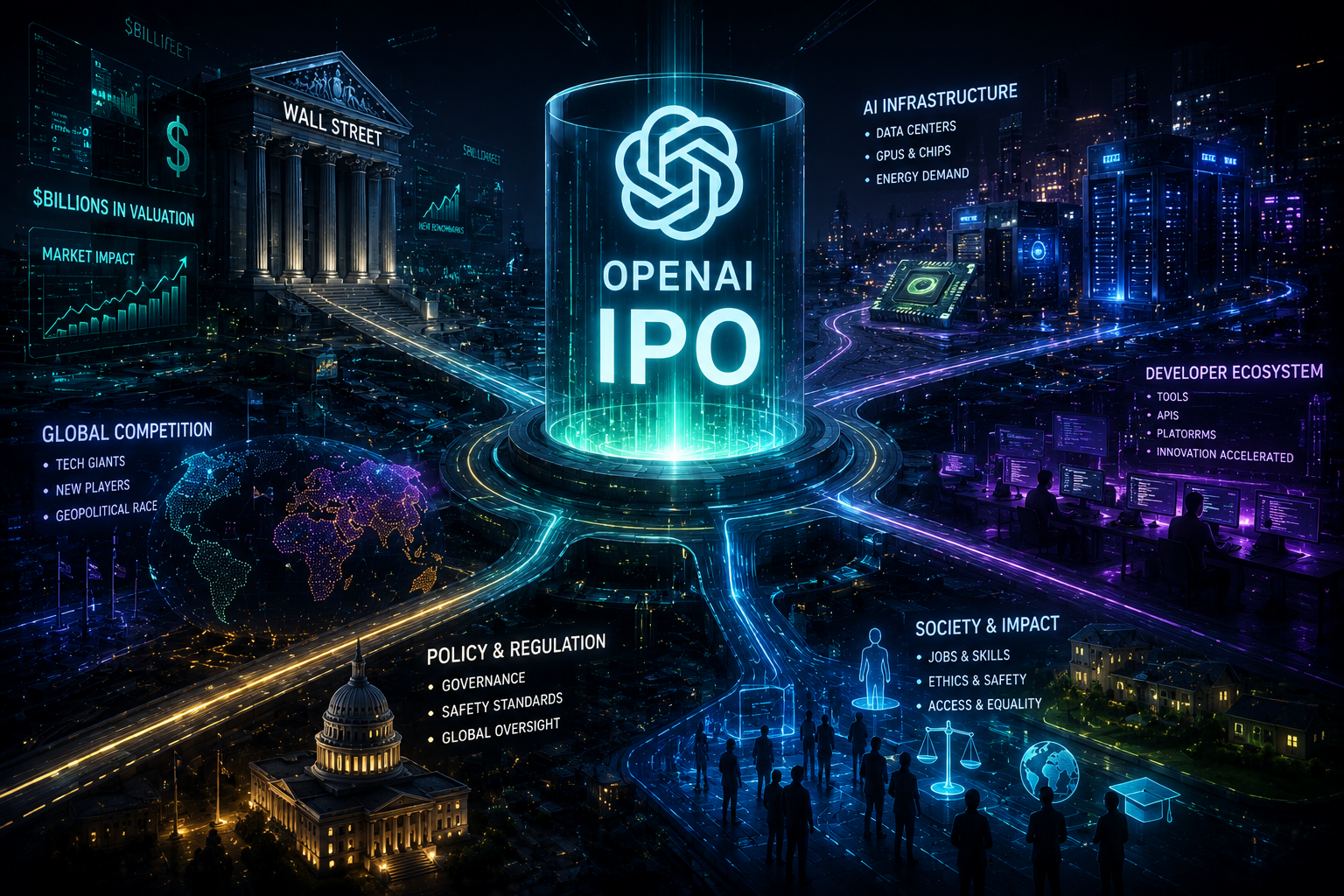
OpenAI has confidentially filed for a U.S. initial public offering, following Anthropic’s own IPO filing just days earlier. The move could reshape how the company balances research, product development, and investor expectations. For developers, this isn’t financial news—it’s a signal that the AI industry is entering a more mature phase.
What Happened
OpenAI confirmed on 8 June that it had confidentially filed paperwork for a U.S. initial public offering. According to Reuters, the company has not announced a listing date or the size of the offering, but reports suggest it could pursue a valuation approaching US$1 trillion. The filing follows Anthropic’s confidential IPO submission earlier in the month, meaning two of the world’s largest AI companies are now preparing for public markets. The timing reflects enormous investor demand for AI companies after months of rapid enterprise adoption. Rather than raising another private funding round, OpenAI appears ready to test whether public investors are willing to finance the next generation of AI infrastructure at unprecedented scale.
Why This Actually Matters
Public companies operate differently from private ones.
Investors expect predictable revenue, steady growth, and disciplined spending.
That could influence how AI companies develop products.
Developers may see greater emphasis on enterprise subscriptions, API adoption, long-term platform stability, and predictable pricing rather than experimental features.
Infrastructure investment is another factor.
Training frontier AI models now costs billions of dollars, requiring new data centres, custom chips, networking equipment, and electricity at a scale few companies can afford.
Access to public capital gives OpenAI another way to fund that expansion.
For engineering teams building on OpenAI’s APIs, a financially stronger company could mean more reliable infrastructure and faster product development.
At the same time, public market expectations may push AI vendors to focus more heavily on commercial products that generate sustainable revenue.
The Part Most Coverage Gets Wrong
Most headlines focused on OpenAI’s potential valuation.
That number is interesting.
It isn’t the important part.
The real story is that AI companies are beginning to resemble cloud providers rather than software startups.
Success will increasingly depend on capital investment, infrastructure efficiency, enterprise adoption, and operational reliability.
Benchmark performance still matters.
But maintaining thousands of GPUs, expanding global regions, and supporting millions of API requests every day may matter even more.
The AI industry is shifting from research-led competition to infrastructure-led competition.
Public markets simply accelerate that transition.
What Happens Next
The IPO process will likely remain confidential until OpenAI publishes a prospectus or announces pricing.
In the meantime, expect increased competition among AI providers as each tries to strengthen enterprise adoption before reaching public markets.
Developers should pay close attention to API pricing, infrastructure expansion, and platform roadmaps.
Those decisions will shape the next generation of AI applications more than any single benchmark result.
KEY TAKEAWAYS
- OpenAI’s IPO reflects the AI industry’s transition from startup to infrastructure business.
- Enterprise adoption and reliable APIs are becoming as important as model performance.
- Capital investment will increasingly determine which AI platforms can scale globally.