
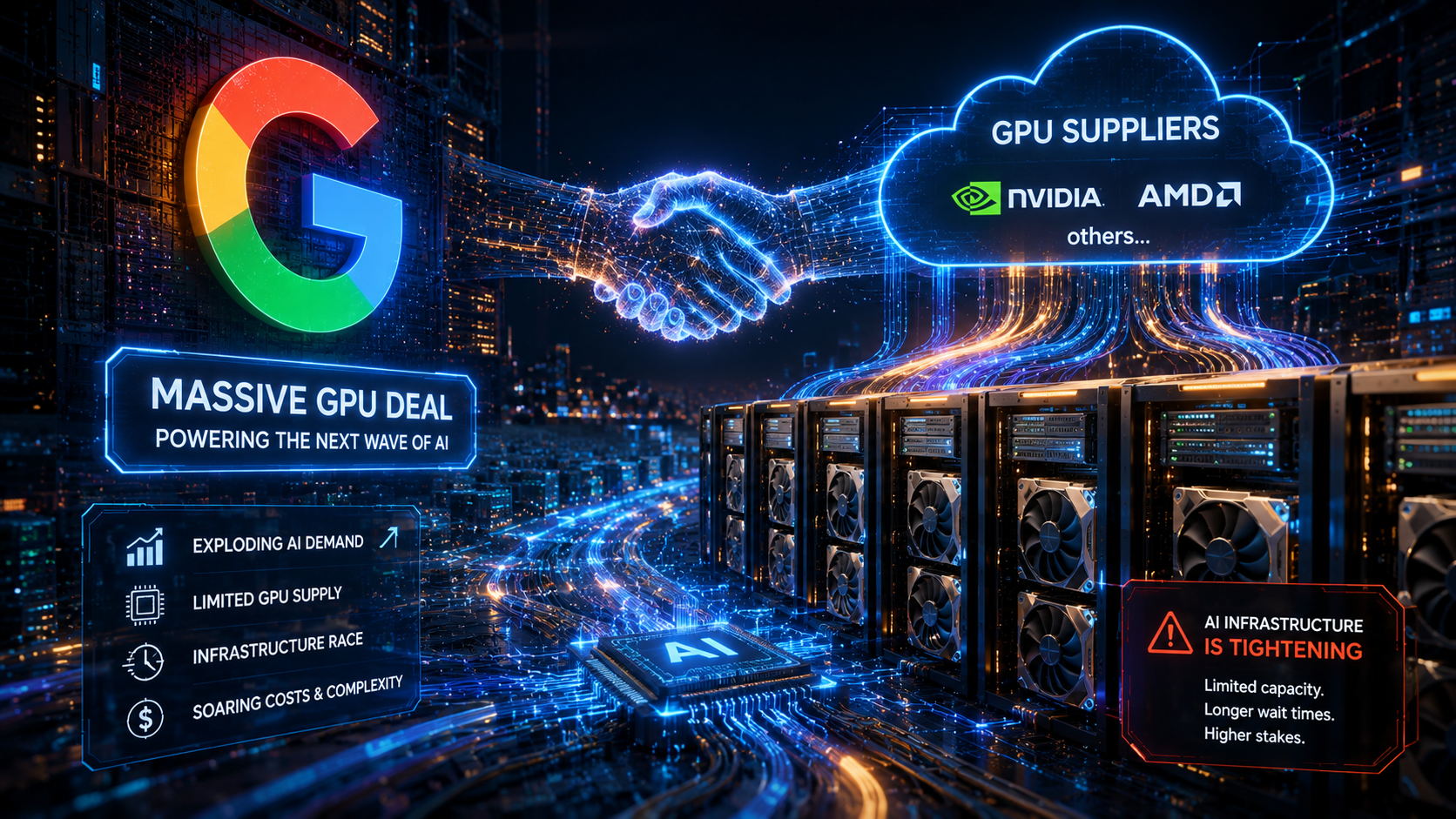
Google has signed one of the largest AI compute agreements ever disclosed, securing access to around 110,000 NVIDIA GPUs through a multi-year infrastructure deal. The announcement reflects how difficult it has become to obtain GPU capacity for large-scale AI services. For companies in Malaysia and Singapore, the impact is likely to be seen through cloud pricing, AI service availability, and deployment timelines.
What Happened
On 5 June 2026, Reuters reported that Google entered into a multi-year agreement with SpaceX to secure AI computing capacity as demand for Gemini Enterprise and other AI services continues to grow. The infrastructure includes roughly 110,000 NVIDIA GPUs alongside supporting CPUs, memory, and networking equipment. The deal follows Anthropic’s earlier agreement for dedicated AI compute, highlighting an industry-wide race to secure GPU resources before new data centres come online. The disclosed contract is worth tens of billions of dollars over several years, making it one of the largest compute infrastructure agreements ever made public. Rather than building enough capacity internally, major technology companies are increasingly reserving GPU clusters years in advance.
Why This Actually Matters
This may sound like a story for Silicon Valley.
It isn’t.
Many organisations in Malaysia and Singapore already rely on cloud AI services from Google Cloud, Microsoft Azure, AWS, and Anthropic.
When hyperscalers compete for GPU capacity, the effects eventually reach everyone else.
Developers may experience longer waiting times for high-end GPU instances.
Enterprises could face higher inference costs as cloud providers balance growing demand.
Regional startups may also find it harder to train large models without relying on overseas infrastructure.
Instead of assuming unlimited cloud resources, engineering teams should begin designing AI applications that use compute efficiently.
Smaller models, retrieval-augmented generation (RAG), caching, and model routing are becoming practical cost-saving strategies rather than optional optimisations.
For many ASEAN businesses, efficient AI architecture may become a competitive advantage.
The Part Most Coverage Gets Wrong
Most headlines focused on the dollar value of Google’s agreement.
The more important point is what it says about supply.
If one of the world’s largest cloud providers still needs external GPU capacity, it suggests that demand continues to outpace available infrastructure.
For Malaysia and Singapore, this reinforces the importance of regional investments in AI-ready data centres.
Governments across ASEAN have already announced incentives for cloud infrastructure and AI development.
The challenge is no longer attracting investment.
It is ensuring there is enough power, networking, and skilled talent to operate next-generation AI infrastructure.
What Happens Next
Expect cloud providers to continue expanding data centre capacity across Asia-Pacific over the next 12 to 24 months.
Malaysia and Singapore remain attractive locations because of their mature digital ecosystems, strong connectivity, and growing AI demand.
Businesses planning AI projects should monitor cloud pricing, GPU availability, and new regional infrastructure announcements rather than assuming today’s costs will remain stable.
The race for AI is increasingly becoming a race for compute.
KEY TAKEAWAYS
- AI infrastructure is becoming a limited resource, not an unlimited cloud service.
- Optimising GPU usage will matter as much as choosing the right AI model.
- Malaysia and Singapore are well positioned to benefit from continued investment in regional AI infrastructure.